Weiyu Zhang, Jiaqi Ji, Hong Li, Jie Li, Yiming Sun, Yi Tang, Tianqi Yang, Weiyi Jin, Yongqing Zhao, Congshu Huang, Chenliang Gong
{"title":"Nitrogen-Rich Covalent Organic Frameworks Composited High-Temperature Proton Exchange Membranes with Ultralow Volume Expansion and Reduced Phosphoric Acid Leakage","authors":"Weiyu Zhang, Jiaqi Ji, Hong Li, Jie Li, Yiming Sun, Yi Tang, Tianqi Yang, Weiyi Jin, Yongqing Zhao, Congshu Huang, Chenliang Gong","doi":"10.1021/acsami.4c10408","DOIUrl":null,"url":null,"abstract":"Phosphoric acid (PA) leakage and volume expansion are critical factors limiting long-term stable operation of PA-doped polybenzimidazole (PBI) for high-temperature proton exchange membrane fuel cells. Enhancing the interaction between the polymer matrix and PA provides an effective way to minimize PA loss and inhibit excessive membrane swelling. The covalent organic frameworks (COFs) are helpful in improving the performance of PA-PBI membranes due to the robust frameworks, adjustable structures, and good compatibility with polymers. Here, in this work, we synthesized porous COFs named TTA-DFP containing triazine rings and pyridine groups at room temperature for as short as 2 h without oxygen isolation. TTA-DFP was then blended with commercial poly[2,2′-(<i>p</i>-oxidiphenylene)-5,5′-benzimidazole] (OPBI) to prepare composite membranes. The abundant alkaline N sites in TTA-DFP exhibit strong interactions with PA and OPBI, which not only provide more proton transport pathways to promote proton conduction but also immobilize PA in acidophilic micropores to reduce PA leakage. The composite membranes exhibit a much lower volume swelling ratio than that of the OPBI membrane. The PA retention of the composite membrane after 120 h of treatment at 80 °C and 40% relative humidity can reach as high as 84.6%. Particularly, the proton conductivity of the composite membrane doped with 15 wt% TTA-DFP achieves 0.112 S cm<sup>–1</sup> at 180 °C without humidification with a swelling ratio of 24.1%. In addition, it has an optimal peak power density of 824.4 mW cm<sup>–2</sup> at 180 °C, which is 1.7 times that of the OPBI membrane. The stability of the composite membrane is much better than that of OPBI at a current density of 0.3 A cm<sup>–2</sup> at 140 °C for 120 h.","PeriodicalId":5,"journal":{"name":"ACS Applied Materials & Interfaces","volume":"32 1","pages":""},"PeriodicalIF":8.2000,"publicationDate":"2024-09-18","publicationTypes":"Journal Article","fieldsOfStudy":null,"isOpenAccess":false,"openAccessPdf":"","citationCount":"0","resultStr":null,"platform":"Semanticscholar","paperid":null,"PeriodicalName":"ACS Applied Materials & Interfaces","FirstCategoryId":"88","ListUrlMain":"https://doi.org/10.1021/acsami.4c10408","RegionNum":2,"RegionCategory":"材料科学","ArticlePicture":[],"TitleCN":null,"AbstractTextCN":null,"PMCID":null,"EPubDate":"","PubModel":"","JCR":"Q1","JCRName":"MATERIALS SCIENCE, MULTIDISCIPLINARY","Score":null,"Total":0}
引用次数: 0
Abstract
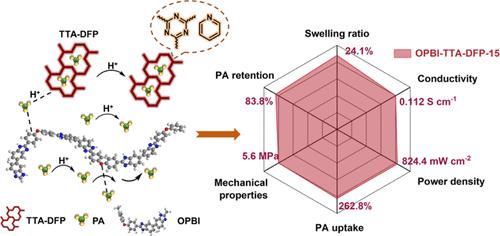
Phosphoric acid (PA) leakage and volume expansion are critical factors limiting long-term stable operation of PA-doped polybenzimidazole (PBI) for high-temperature proton exchange membrane fuel cells. Enhancing the interaction between the polymer matrix and PA provides an effective way to minimize PA loss and inhibit excessive membrane swelling. The covalent organic frameworks (COFs) are helpful in improving the performance of PA-PBI membranes due to the robust frameworks, adjustable structures, and good compatibility with polymers. Here, in this work, we synthesized porous COFs named TTA-DFP containing triazine rings and pyridine groups at room temperature for as short as 2 h without oxygen isolation. TTA-DFP was then blended with commercial poly[2,2′-(p-oxidiphenylene)-5,5′-benzimidazole] (OPBI) to prepare composite membranes. The abundant alkaline N sites in TTA-DFP exhibit strong interactions with PA and OPBI, which not only provide more proton transport pathways to promote proton conduction but also immobilize PA in acidophilic micropores to reduce PA leakage. The composite membranes exhibit a much lower volume swelling ratio than that of the OPBI membrane. The PA retention of the composite membrane after 120 h of treatment at 80 °C and 40% relative humidity can reach as high as 84.6%. Particularly, the proton conductivity of the composite membrane doped with 15 wt% TTA-DFP achieves 0.112 S cm–1 at 180 °C without humidification with a swelling ratio of 24.1%. In addition, it has an optimal peak power density of 824.4 mW cm–2 at 180 °C, which is 1.7 times that of the OPBI membrane. The stability of the composite membrane is much better than that of OPBI at a current density of 0.3 A cm–2 at 140 °C for 120 h.
期刊介绍:
ACS Applied Materials & Interfaces is a leading interdisciplinary journal that brings together chemists, engineers, physicists, and biologists to explore the development and utilization of newly-discovered materials and interfacial processes for specific applications. Our journal has experienced remarkable growth since its establishment in 2009, both in terms of the number of articles published and the impact of the research showcased. We are proud to foster a truly global community, with the majority of published articles originating from outside the United States, reflecting the rapid growth of applied research worldwide.



 京公网安备 11010802042870号
京ICP备2023020795号-1
京公网安备 11010802042870号
京ICP备2023020795号-1

 分享
分享
 求助内容:
求助内容: 应助结果提醒方式:
 扫码关注我们
