Yejuan Xue, Yueda Wang, Heng Zhang, Weilong Kong, Yuxin Zhou, Bo Kang, Prof. Zhimei Huang, Prof. Hongfa Xiang
{"title":"Molecular Design of Mono-Fluorinated Ether-Based Electrolyte for All-Climate Lithium-Ion Batteries and Lithium-Metal Batteries","authors":"Yejuan Xue, Yueda Wang, Heng Zhang, Weilong Kong, Yuxin Zhou, Bo Kang, Prof. Zhimei Huang, Prof. Hongfa Xiang","doi":"10.1002/anie.202414201","DOIUrl":null,"url":null,"abstract":"<p>Fluorinated-ethers are promising electrolyte solvents in lithium metal batteries, for their high antioxidant and excellent reductive stability on Li anode. However, fluorinated-ethers with high fluorination degree suffer from low ionic conductivity and narrow temperature adaptibility. Herein, we synthesize a mono-fluorinated linear ether of bis(2-fluoroethoxy) methane (BFME) with enhanced solvated ability. The −OCH<sub>2</sub>O− structure and fluoride substitution on the β-C position endows the BFME electrolyte with moderate affinity to Li<sup>+</sup>, thereby improving the ionic conductivity and decreasing the Li<sup>+</sup>-desolvation energy barrier at a wide temperature range of −60–60 °C. Additionally, the electrolyte with anion-participated solvation structure demonstrates high film-forming ability by forming LiF-rich interfacial film on the electrode surfaces, rendering the graphite anode with an initial Coulombic efficiency (CE) of 94.9 % and a Li plating/stripping CE of 99.8 % by Aurbach method. Consequently, the Graphite||LiFePO<sub>4</sub> pouch cells delivered 83.2 %, 92.5 % and 81.2 % capacity retention after 1250, 200 and 300 cycles at 25, −20 °C and 60 °C, respectively. Moreover, the Li||LFP pouch cell with 3 Ah capacity can operate for 65 cycles with 99 % capacity retention, verifying the effectiveness of the BFME electrolyte in stabilizing the interfaces and broadening the temperature adaptibility of lithium-ion and lithium metal batteries.</p>","PeriodicalId":125,"journal":{"name":"Angewandte Chemie International Edition","volume":"64 2","pages":""},"PeriodicalIF":16.9000,"publicationDate":"2024-09-19","publicationTypes":"Journal Article","fieldsOfStudy":null,"isOpenAccess":false,"openAccessPdf":"","citationCount":"0","resultStr":null,"platform":"Semanticscholar","paperid":null,"PeriodicalName":"Angewandte Chemie International Edition","FirstCategoryId":"92","ListUrlMain":"https://onlinelibrary.wiley.com/doi/10.1002/anie.202414201","RegionNum":1,"RegionCategory":"化学","ArticlePicture":[],"TitleCN":null,"AbstractTextCN":null,"PMCID":null,"EPubDate":"","PubModel":"","JCR":"Q1","JCRName":"CHEMISTRY, MULTIDISCIPLINARY","Score":null,"Total":0}
引用次数: 0
Abstract
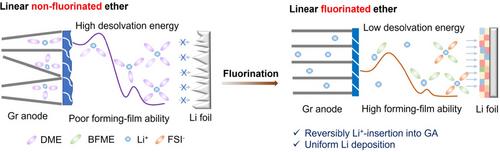
Fluorinated-ethers are promising electrolyte solvents in lithium metal batteries, for their high antioxidant and excellent reductive stability on Li anode. However, fluorinated-ethers with high fluorination degree suffer from low ionic conductivity and narrow temperature adaptibility. Herein, we synthesize a mono-fluorinated linear ether of bis(2-fluoroethoxy) methane (BFME) with enhanced solvated ability. The −OCH2O− structure and fluoride substitution on the β-C position endows the BFME electrolyte with moderate affinity to Li+, thereby improving the ionic conductivity and decreasing the Li+-desolvation energy barrier at a wide temperature range of −60–60 °C. Additionally, the electrolyte with anion-participated solvation structure demonstrates high film-forming ability by forming LiF-rich interfacial film on the electrode surfaces, rendering the graphite anode with an initial Coulombic efficiency (CE) of 94.9 % and a Li plating/stripping CE of 99.8 % by Aurbach method. Consequently, the Graphite||LiFePO4 pouch cells delivered 83.2 %, 92.5 % and 81.2 % capacity retention after 1250, 200 and 300 cycles at 25, −20 °C and 60 °C, respectively. Moreover, the Li||LFP pouch cell with 3 Ah capacity can operate for 65 cycles with 99 % capacity retention, verifying the effectiveness of the BFME electrolyte in stabilizing the interfaces and broadening the temperature adaptibility of lithium-ion and lithium metal batteries.
期刊介绍:
Angewandte Chemie, a journal of the German Chemical Society (GDCh), maintains a leading position among scholarly journals in general chemistry with an impressive Impact Factor of 16.6 (2022 Journal Citation Reports, Clarivate, 2023). Published weekly in a reader-friendly format, it features new articles almost every day. Established in 1887, Angewandte Chemie is a prominent chemistry journal, offering a dynamic blend of Review-type articles, Highlights, Communications, and Research Articles on a weekly basis, making it unique in the field.



 京公网安备 11010802042870号
京ICP备2023020795号-1
京公网安备 11010802042870号
京ICP备2023020795号-1

 分享
分享
 求助内容:
求助内容: 应助结果提醒方式:
 扫码关注我们
