Xuanyi Zhou, Biao Zhang, Pengbo Lyu, Lei Xi, Fangkun Li, Zengsheng Ma, Min Zhu and Jun Liu
{"title":"Chemo-mechanical stable cathode interphase via interface in situ catalytic-conversion integrated design for all solid-state batteries†","authors":"Xuanyi Zhou, Biao Zhang, Pengbo Lyu, Lei Xi, Fangkun Li, Zengsheng Ma, Min Zhu and Jun Liu","doi":"10.1039/D4EE02827A","DOIUrl":null,"url":null,"abstract":"<p >All-solid-state lithium batteries (ASSLBs) based on LiNi<small><sub>1−<em>x</em>−<em>y</em></sub></small>Co<small><sub><em>x</em></sub></small>Mn<small><sub><em>y</em></sub></small>O<small><sub>2</sub></small> cathodes suffer from rock-ribbed electrolyte–cathode interface issues such as oxygen evolution and side reactions with electrolytes at high operating voltages, resulting in severe structure deterioration and rapid capacity decay. Herein, a type of synergistic “catalytic conversion”-integrated mechanism was strategically exploited to <em>in situ</em> construct a steerable cathode–electrolyte interface (CEI), aiming to synchronously enhance electrochemical and structural stability upon cycling. By employing functional polypyrrole (PPy) as a coating layer on high voltage-operated LiNi<small><sub>0.8</sub></small>Co<small><sub>0.1</sub></small>Mn<small><sub>0.1</sub></small>O<small><sub>2</sub></small> (NCM811), we revealed that the N–H bond of the polypyrrole ring can cause N–H⋯O hydrogen bonding interaction to alleviate oxygen evolution. By employing functional polypyrrole (PPy) as coating layer on high voltage-operated LiNi<small><sub>0.8</sub></small>Co<small><sub>0.1</sub></small>Mn<small><sub>0.1</sub></small>O<small><sub>2</sub></small> (NCM811), we unveils that the N–H bond of polypyrrole ring can product N–H⋯O hydrogen bonding interaction to alleviate oxygen evolution. Specifically, the hydrogen bonding between the nitrogen-hydrogen (N–H) groups of polypyrrole (PPy) and lattice oxygen escaped form NCM811 facilitates the reduction of protons to generate hydroxide ions (OH<small><sup>−</sup></small>). The resulting astray OH<small><sup>−</sup></small> together with O<small><sup>2−</sup></small> further coordinated with Li<small><sup>+</sup></small> around the aromatic skeleton interrupted by a nucleophilic π–π interaction, thereby promoting the <em>in situ</em> generation of an Li<small><sub>2</sub></small>O–LiOH-rich CEI. Finally, parasitic interfacial side reactions and oxygen evolution are considerably suppressed, endowing the NCM@PPy full cell with excellent cycling performance and a capacity retention of 81.2% after 300 cycles. This <em>in situ</em>-generated Li<small><sub>2</sub></small>O–LiOH-rich CEI enables the NCM811 cathode to achieve a considerable capacity of 122 mA h g<small><sup>−1</sup></small> at 0.5C with an operating voltage of 4.3 V and a lifetime of more than 100 cycles, demonstrating its practical application potential in the energy storage field.</p>","PeriodicalId":72,"journal":{"name":"Energy & Environmental Science","volume":" 21","pages":" 8174-8188"},"PeriodicalIF":30.8000,"publicationDate":"2024-09-18","publicationTypes":"Journal Article","fieldsOfStudy":null,"isOpenAccess":false,"openAccessPdf":"","citationCount":"0","resultStr":null,"platform":"Semanticscholar","paperid":null,"PeriodicalName":"Energy & Environmental Science","FirstCategoryId":"88","ListUrlMain":"https://pubs.rsc.org/en/content/articlelanding/2024/ee/d4ee02827a","RegionNum":1,"RegionCategory":"材料科学","ArticlePicture":[],"TitleCN":null,"AbstractTextCN":null,"PMCID":null,"EPubDate":"","PubModel":"","JCR":"Q1","JCRName":"CHEMISTRY, MULTIDISCIPLINARY","Score":null,"Total":0}
引用次数: 0
Abstract
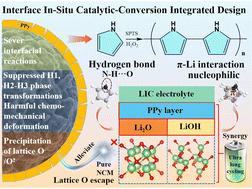
All-solid-state lithium batteries (ASSLBs) based on LiNi1−x−yCoxMnyO2 cathodes suffer from rock-ribbed electrolyte–cathode interface issues such as oxygen evolution and side reactions with electrolytes at high operating voltages, resulting in severe structure deterioration and rapid capacity decay. Herein, a type of synergistic “catalytic conversion”-integrated mechanism was strategically exploited to in situ construct a steerable cathode–electrolyte interface (CEI), aiming to synchronously enhance electrochemical and structural stability upon cycling. By employing functional polypyrrole (PPy) as a coating layer on high voltage-operated LiNi0.8Co0.1Mn0.1O2 (NCM811), we revealed that the N–H bond of the polypyrrole ring can cause N–H⋯O hydrogen bonding interaction to alleviate oxygen evolution. By employing functional polypyrrole (PPy) as coating layer on high voltage-operated LiNi0.8Co0.1Mn0.1O2 (NCM811), we unveils that the N–H bond of polypyrrole ring can product N–H⋯O hydrogen bonding interaction to alleviate oxygen evolution. Specifically, the hydrogen bonding between the nitrogen-hydrogen (N–H) groups of polypyrrole (PPy) and lattice oxygen escaped form NCM811 facilitates the reduction of protons to generate hydroxide ions (OH−). The resulting astray OH− together with O2− further coordinated with Li+ around the aromatic skeleton interrupted by a nucleophilic π–π interaction, thereby promoting the in situ generation of an Li2O–LiOH-rich CEI. Finally, parasitic interfacial side reactions and oxygen evolution are considerably suppressed, endowing the NCM@PPy full cell with excellent cycling performance and a capacity retention of 81.2% after 300 cycles. This in situ-generated Li2O–LiOH-rich CEI enables the NCM811 cathode to achieve a considerable capacity of 122 mA h g−1 at 0.5C with an operating voltage of 4.3 V and a lifetime of more than 100 cycles, demonstrating its practical application potential in the energy storage field.
期刊介绍:
Energy & Environmental Science, a peer-reviewed scientific journal, publishes original research and review articles covering interdisciplinary topics in the (bio)chemical and (bio)physical sciences, as well as chemical engineering disciplines. Published monthly by the Royal Society of Chemistry (RSC), a not-for-profit publisher, Energy & Environmental Science is recognized as a leading journal. It boasts an impressive impact factor of 8.500 as of 2009, ranking 8th among 140 journals in the category "Chemistry, Multidisciplinary," second among 71 journals in "Energy & Fuels," second among 128 journals in "Engineering, Chemical," and first among 181 scientific journals in "Environmental Sciences."
Energy & Environmental Science publishes various types of articles, including Research Papers (original scientific work), Review Articles, Perspectives, and Minireviews (feature review-type articles of broad interest), Communications (original scientific work of an urgent nature), Opinions (personal, often speculative viewpoints or hypotheses on current topics), and Analysis Articles (in-depth examination of energy-related issues).



 京公网安备 11010802042870号
京ICP备2023020795号-1
京公网安备 11010802042870号
京ICP备2023020795号-1

 分享
分享
 求助内容:
求助内容: 应助结果提醒方式:
 扫码关注我们
