Saurabh Khuje, Abdullah Islam, Long Zhu, Jun Zhang, Zhongxuan Wang, Thomas Parker, Jian Yu, Shenqiang Ren
{"title":"Gradient Corrosion-Resistant Copper Using Molecular Decomposable Ink from Recycling","authors":"Saurabh Khuje, Abdullah Islam, Long Zhu, Jun Zhang, Zhongxuan Wang, Thomas Parker, Jian Yu, Shenqiang Ren","doi":"10.1021/acsaelm.4c01259","DOIUrl":null,"url":null,"abstract":"Oxidation and corrosion present significant challenges for copper in critical applications such as electronics. Graphene-like carbon materials hold promise for preventing oxidation and corrosion, but their application to metallic surfaces is hindered by a complex immobilization process. Herein, we describe copper-based molecular decomposable inks derived from recycling which enable <i>in situ</i> conversion to form a copper─graphitic carbon hierarchical structure. This structure withstands severe corrosive and oxidative environments and maintains stable performance across a wide temperature range, from cryogenic (−193 °C) to high temperature (500 °C) conditions. The graphitic carbon shell acts as an effective barrier, preventing oxidation and corrosion by creating lengthy diffusion routes within the hierarchical copper matrix. This enables the reliable operation of a printed antenna under a corrosive environment in a reliable fashion. The results show that the copper with a graphitic carbon shell has excellent oxidation and corrosion resistance capabilities, and the findings can be expanded to establish printed molecular decomposable materials as a platform for rapid prototyping of anticorrosion and antioxidation electronics suitable for different environmental conditions.","PeriodicalId":3,"journal":{"name":"ACS Applied Electronic Materials","volume":"17 1","pages":""},"PeriodicalIF":4.7000,"publicationDate":"2024-09-16","publicationTypes":"Journal Article","fieldsOfStudy":null,"isOpenAccess":false,"openAccessPdf":"","citationCount":"0","resultStr":null,"platform":"Semanticscholar","paperid":null,"PeriodicalName":"ACS Applied Electronic Materials","FirstCategoryId":"88","ListUrlMain":"https://doi.org/10.1021/acsaelm.4c01259","RegionNum":3,"RegionCategory":"材料科学","ArticlePicture":[],"TitleCN":null,"AbstractTextCN":null,"PMCID":null,"EPubDate":"","PubModel":"","JCR":"Q1","JCRName":"ENGINEERING, ELECTRICAL & ELECTRONIC","Score":null,"Total":0}
引用次数: 0
Abstract
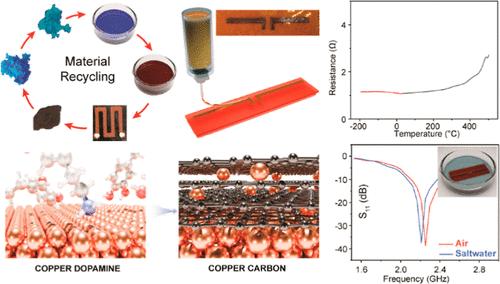
Oxidation and corrosion present significant challenges for copper in critical applications such as electronics. Graphene-like carbon materials hold promise for preventing oxidation and corrosion, but their application to metallic surfaces is hindered by a complex immobilization process. Herein, we describe copper-based molecular decomposable inks derived from recycling which enable in situ conversion to form a copper─graphitic carbon hierarchical structure. This structure withstands severe corrosive and oxidative environments and maintains stable performance across a wide temperature range, from cryogenic (−193 °C) to high temperature (500 °C) conditions. The graphitic carbon shell acts as an effective barrier, preventing oxidation and corrosion by creating lengthy diffusion routes within the hierarchical copper matrix. This enables the reliable operation of a printed antenna under a corrosive environment in a reliable fashion. The results show that the copper with a graphitic carbon shell has excellent oxidation and corrosion resistance capabilities, and the findings can be expanded to establish printed molecular decomposable materials as a platform for rapid prototyping of anticorrosion and antioxidation electronics suitable for different environmental conditions.
期刊介绍:
ACS Applied Electronic Materials is an interdisciplinary journal publishing original research covering all aspects of electronic materials. The journal is devoted to reports of new and original experimental and theoretical research of an applied nature that integrate knowledge in the areas of materials science, engineering, optics, physics, and chemistry into important applications of electronic materials. Sample research topics that span the journal's scope are inorganic, organic, ionic and polymeric materials with properties that include conducting, semiconducting, superconducting, insulating, dielectric, magnetic, optoelectronic, piezoelectric, ferroelectric and thermoelectric.
Indexed/Abstracted:
Web of Science SCIE
Scopus
CAS
INSPEC
Portico




 京公网安备 11010802042870号
京ICP备2023020795号-1
京公网安备 11010802042870号
京ICP备2023020795号-1

 分享
分享
 求助内容:
求助内容: 应助结果提醒方式:
 扫码关注我们
