Metabolic dysfunction-associated steatotic liver disease and MetALD increases the risk of liver cancer and gastrointestinal cancer: A nationwide cohort study

IF 6.7 1区 医学 Q1 GASTROENTEROLOGY & HEPATOLOGY Alimentary Pharmacology & Therapeutics Pub Date : 2024-09-20 DOI:10.1111/apt.18286
Yewan Park, Jooyi Jung, Seungbong Han, Gi-Ae Kim
{"title":"Metabolic dysfunction-associated steatotic liver disease and MetALD increases the risk of liver cancer and gastrointestinal cancer: A nationwide cohort study","authors":"Yewan Park,&nbsp;Jooyi Jung,&nbsp;Seungbong Han,&nbsp;Gi-Ae Kim","doi":"10.1111/apt.18286","DOIUrl":null,"url":null,"abstract":"<div>\n \n \n <section>\n \n <h3> Background</h3>\n \n <p>The new nomenclature of metabolic dysfunction-associated steatotic liver disease (MASLD) substituting nonalcoholic fatty liver disease was proposed along with a new category of MASLD with increased alcohol intake (MetALD).</p>\n </section>\n \n <section>\n \n <h3> Aims</h3>\n \n <p>We aimed to explore the cancer risk by MASLD and MetALD.</p>\n </section>\n \n <section>\n \n <h3> Methods</h3>\n \n <p>This nationwide cohort study included 3,596,709 participants who underwent a health check-up in 2011 in South Korea. Steatotic liver disease (SLD) was defined as a fatty liver index ≥30. Participants were categorized into four exclusive groups: MASLD, MetALD, other combination aetiology and no SLD. The subdistribution hazard ratio (SHR) was calculated using the Fine–Gray model after adjusting other variables.</p>\n </section>\n \n <section>\n \n <h3> Results</h3>\n \n <p>During the 33.9 million person-years of follow-up, 285,845 participants (7.9%) developed cancers. Compared with no SLD, MASLD, MetALD and other combination aetiology had an increased risk of all cancer. Liver cancer risk escalated from no SLD to MASLD (SHR, 1.16; 95% CI, 1.12–1.21), MetALD (SHR, 2.06; 95% CI, 1.92–2.20) and other combination aetiology (SHR, 8.16; 95% CI, 7.69–8.67). Gastrointestinal cancers including oesophagus, stomach, colorectal, biliary and pancreas cancers increased in MASLD (SHR, 1.13; 95% CI, 1.11–1.15), MetALD (SHR, 1.17; 95% CI, 1.14–1.21) and other combination aetiology (SHR, 1.09; 95% CI, 1.05–1.13). A modest increase in lung cancer and hormone-sensitive cancer was observed with MASLD.</p>\n </section>\n \n <section>\n \n <h3> Conclusions</h3>\n \n <p>This study showed that MASLD and MetALD are associated with an increased risk of cancer, particularly liver and gastrointestinal cancers. The findings build new evidence for the clinical outcomes of MetALD while highlighting the importance of managing alcohol intake properly in MASLD and MetALD.</p>\n </section>\n </div>","PeriodicalId":121,"journal":{"name":"Alimentary Pharmacology & Therapeutics","volume":"60 11-12","pages":"1599-1608"},"PeriodicalIF":6.7000,"publicationDate":"2024-09-20","publicationTypes":"Journal Article","fieldsOfStudy":null,"isOpenAccess":false,"openAccessPdf":"https://onlinelibrary.wiley.com/doi/epdf/10.1111/apt.18286","citationCount":"0","resultStr":null,"platform":"Semanticscholar","paperid":null,"PeriodicalName":"Alimentary Pharmacology & Therapeutics","FirstCategoryId":"3","ListUrlMain":"https://onlinelibrary.wiley.com/doi/10.1111/apt.18286","RegionNum":1,"RegionCategory":"医学","ArticlePicture":[],"TitleCN":null,"AbstractTextCN":null,"PMCID":null,"EPubDate":"","PubModel":"","JCR":"Q1","JCRName":"GASTROENTEROLOGY & HEPATOLOGY","Score":null,"Total":0}
引用次数: 0

Abstract

Background

The new nomenclature of metabolic dysfunction-associated steatotic liver disease (MASLD) substituting nonalcoholic fatty liver disease was proposed along with a new category of MASLD with increased alcohol intake (MetALD).

Aims

We aimed to explore the cancer risk by MASLD and MetALD.

Methods

This nationwide cohort study included 3,596,709 participants who underwent a health check-up in 2011 in South Korea. Steatotic liver disease (SLD) was defined as a fatty liver index ≥30. Participants were categorized into four exclusive groups: MASLD, MetALD, other combination aetiology and no SLD. The subdistribution hazard ratio (SHR) was calculated using the Fine–Gray model after adjusting other variables.

Results

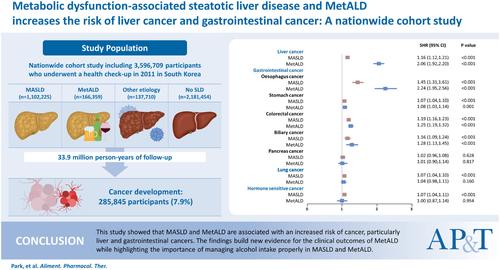
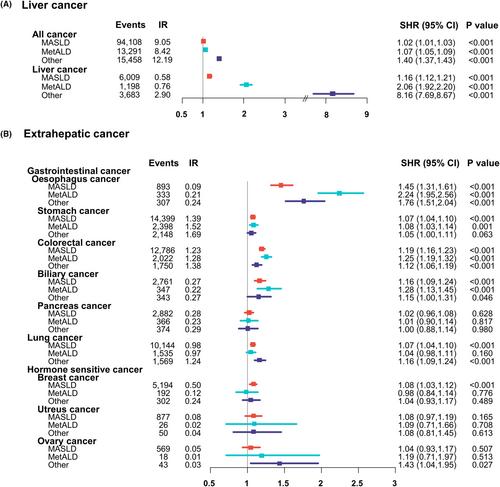
During the 33.9 million person-years of follow-up, 285,845 participants (7.9%) developed cancers. Compared with no SLD, MASLD, MetALD and other combination aetiology had an increased risk of all cancer. Liver cancer risk escalated from no SLD to MASLD (SHR, 1.16; 95% CI, 1.12–1.21), MetALD (SHR, 2.06; 95% CI, 1.92–2.20) and other combination aetiology (SHR, 8.16; 95% CI, 7.69–8.67). Gastrointestinal cancers including oesophagus, stomach, colorectal, biliary and pancreas cancers increased in MASLD (SHR, 1.13; 95% CI, 1.11–1.15), MetALD (SHR, 1.17; 95% CI, 1.14–1.21) and other combination aetiology (SHR, 1.09; 95% CI, 1.05–1.13). A modest increase in lung cancer and hormone-sensitive cancer was observed with MASLD.

Conclusions

This study showed that MASLD and MetALD are associated with an increased risk of cancer, particularly liver and gastrointestinal cancers. The findings build new evidence for the clinical outcomes of MetALD while highlighting the importance of managing alcohol intake properly in MASLD and MetALD.
Abstract Image

Abstract Image

查看原文
分享 分享
微信好友 朋友圈 QQ好友 复制链接
本刊更多论文
代谢功能障碍相关性脂肪肝和代谢性脂肪肝会增加肝癌和胃肠道癌症的风险:一项全国性队列研究
代谢功能障碍相关性脂肪性肝病(MASLD)取代了非酒精性脂肪肝,同时还提出了代谢功能障碍相关性脂肪性肝病与酒精摄入增加(MetALD)这一新类别。
本文章由计算机程序翻译,如有差异,请以英文原文为准。
求助全文
约1分钟内获得全文 去求助
来源期刊
CiteScore
15.60
自引率
7.90%
发文量
527
审稿时长
3-6 weeks
期刊介绍: Alimentary Pharmacology & Therapeutics is a global pharmacology journal focused on the impact of drugs on the human gastrointestinal and hepato-biliary systems. It covers a diverse range of topics, often with immediate clinical relevance to its readership.
期刊最新文献
Review Article: TL1A Inhibitors in IBD - Mechanistic Rationale and Clinical Evidence. Review Article: An Update on Non-Invasive Tests for Steatotic Liver Disease - Insights From the ESSENCE Phase 3 Trial and Longitudinal Studies. Editorial: Pushing Forward With Pharmacotherapies for Patients With Alcohol-Associated Cirrhosis. Editorial: Peroxisome Proliferator-Activated Receptor Agonists-Shifting the Goalpost From Biochemical Response to Symptom Directed Therapy in PBC. Letter: Steroid Tapering in Ulcerative Colitis: The Importance of Disease Severity and Maintenance Therapy.
×
引用
GB/T 7714-2015
复制
MLA
复制
APA
复制
导出至
BibTeX EndNote RefMan NoteFirst NoteExpress
×
×
提示
您的信息不完整,为了账户安全,请先补充。
现在去补充
×
提示
您因"违规操作"
具体请查看互助需知
我知道了
×
提示
现在去查看 取消
×
提示
确定
0
微信
客服QQ
Book学术公众号 扫码关注我们
反馈
×
意见反馈
请填写您的意见或建议
请填写您的手机或邮箱
已复制链接
已复制链接
快去分享给好友吧!
我知道了
×
扫码分享
扫码分享
Book学术官方微信
Book学术文献互助
Book学术文献互助群
群 号:604180095
Book学术
文献互助 智能选刊 最新文献 互助须知 联系我们:info@booksci.cn
Book学术提供免费学术资源搜索服务,方便国内外学者检索中英文文献。致力于提供最便捷和优质的服务体验。
Copyright © 2023 Book学术 All rights reserved.
ghs 京公网安备 11010802042870号 京ICP备2023020795号-1