Qiuwen Gong, Gan Sha, Xinyu Han, Zhenhua Guo, Lei Yang, Ting Chen, Wei Yang, Ronglei Tan, Meng Liu, Fengdie Xia, Guang Chen, Yufei Li, Xin Shen, Kabin Xie, Guangqin Cai, Honghong Hu, Jie Luo, Qiang Li, Guotian Li
{"title":"Knockout of phosphatidate phosphohydrolase genes confers broad-spectrum disease resistance in plants","authors":"Qiuwen Gong, Gan Sha, Xinyu Han, Zhenhua Guo, Lei Yang, Ting Chen, Wei Yang, Ronglei Tan, Meng Liu, Fengdie Xia, Guang Chen, Yufei Li, Xin Shen, Kabin Xie, Guangqin Cai, Honghong Hu, Jie Luo, Qiang Li, Guotian Li","doi":"10.1111/pbi.14477","DOIUrl":null,"url":null,"abstract":"<p>Phosphatidic acid (PA) is considered a second messenger that interacts with protein kinases, phosphatases and NADPH oxidases (Kong <i>et al</i>., <span>2024</span>), amplifying the signal to initiate plant defence responses (Li and Wang, <span>2019</span>). In rice, mutation of <i>RBL1</i> causes the accumulation of PA, enhancing multipathogen resistance (Sha <i>et al</i>., <span>2023</span>). In our previous study, we attempted to rescue <i>rbl1</i> mutant by overexpressing phosphatidate phosphohydrolase (<i>PAH</i>) genes. However, overexpression of <i>PAH2</i> reduced the PA level but did not affect the disease resistance of <i>rbl1</i>, which prompted us to test the role of PA and <i>PAHs</i> in rice immunity in the wild-type (WT) background. Here, we identified that knockout of <i>PAHs</i> caused PA accumulation and enhanced multipathogen resistance in rice and Arabidopsis.</p><p>Phylogenetic analyses reveal that PAHs are highly conserved in plants. Rice PAHs contain conserved NLIP and LNS2 signature motifs (Figure 1a). <i>PAH1</i> and <i>PAH2</i> were transcribed in all rice tissues examined, with the highest level in the leaf (Figure 1b). PAH-GFP signals predominantly co-localized with the endoplasmic reticulum (ER) marker HDEL1 (Figure 1c). The yeast <i>pah1</i> mutant is lethal at 37 °C. We transformed rice <i>PAH1</i> and <i>PAH2</i> genes into the WT yeast strain, respectively, and knocked out the yeast endogenous <i>PAH1</i> gene. The rice <i>PAH</i> complementation strains grew well on the induction medium YPGal but not on the non-inducing medium YPD at 37 °C, indicating that rice PAH1 and PAH2 function as PA phosphohydrolases in yeast (Figure 1d).</p><p>To investigate the functions of rice <i>PAHs</i>, we genome-edited <i>PAHs</i> by targeting their first exons and obtained <i>pah</i> single mutants (Figure 1e). Since all mutations in <i>pah1</i> and <i>pah2</i> led to loss-of-function and no off-targets were observed, we crossed <i>pah1-1</i> and <i>pah2-1</i> and created the <i>pah1pah2</i> double mutant (Figures S1 and S2). We next tested ROS production in rice <i>pah</i> plants. The <i>pah1pah2</i> leaves exhibited a robust ROS burst when challenged with chitin. The total photon counts, denoting the ROS level, showed an obvious increase in <i>pah1pah2</i> (Figure 1f). When infected with rice blast fungus <i>Magnaporthe oryzae</i>, the lesion area of <i>pah1pah2</i> was much smaller than other lines and only 46.1% of the WT (Figure 1g). We subsequently tested the disease resistance of rice <i>pah1pah2</i> lines with the rice bacterial blight pathogen <i>Xanthomonas oryzae</i> pv. <i>oryzae</i> (<i>Xoo</i>). Similarly, the lesion length was much shorter in <i>pah1pah2</i> (1.51 cm) compared with the WT (9.40 cm) as well as the <i>pah1-1</i> (7.02 cm) and <i>pah2-1</i> (6.64 cm) (Figure 1h). In summary, both fungal and bacterial infection assays demonstrate enhanced resistance of <i>pah1pah2</i>. Besides, <i>pah1pah2</i> exhibited some growth inhibition, and the plant height of <i>pah1pah2</i> was 77.8% of the WT (Figures 1i, S1 and S3). Salicylic acid (SA) plays key roles in plant defence. The SA level increased 1.39-fold in <i>pah1pah2</i> compared with the WT (Figure 1j).</p><p>To investigate whether the role of the <i>PAH</i> genes in immunity is conserved, we obtained Arabidopsis <i>pah</i> mutants (Eastmond <i>et al</i>., <span>2010</span>), and the <i>pah1pah2</i> seedlings were shorter than the WT (Col-0) (Figure 1k). Infection with <i>Botrytis cinerea, pah1pah2</i> plants developed smaller lesions, a 28.3% reduction than the WT. Similarly, when inoculated with <i>Phytophthora capsici</i>, the lesion area of <i>pah1pah2</i> (11.0 mm<sup>2</sup>) was only 15.7% of the WT (70.4 mm<sup>2</sup>), and smaller lesion areas were also shown in <i>pah1</i> and <i>pah2</i> (Figure 1l,m). We further examined the levels of phosphorylated MAPKs (pMAPKs). Under flg22 and chitin treatments, the levels of pMAPKs were significantly higher in the Arabidopsis <i>pah1pah2</i> mutants as well as <i>pah2</i> than that in the WT (Figure 1n). The results are consistent with increased ROS levels in rice <i>pah1pah2</i> , which indicates that increased PA at the plasma membrane by knockout of the ER-localized PAHs ultimately enhances plant immune responses in the plasma membrane.</p><p>To investigate <i>PAH</i>-mediated regulation of gene transcription and metabolism, we performed RNA-seq and lipidomics analyses. <i>PR</i> genes and <i>FLS2</i> were upregulated in rice <i>pah1pah2</i> (Figure 1o). Furthermore, Gene Ontology (GO) enrichment analyses of differentially expressed genes (DEGs) between WT and <i>pah1pah2</i> plants showed that ‘response to lipid’, ‘defense response’ and ‘defense response to fungus/bacterium’ were enriched (Figure 1p), which are consistent with the enhanced disease resistance of <i>pah1pah2</i>. Then using the hierarchical clustering analyses, three clusters were identified in Arabidopsis and rice (Figure 1q). In the ‘genes upregulated in <i>pah1pah2</i>’ cluster, the expression levels of many hormone-related genes that are involved in JA, ET, SA and IAA were simultaneously upregulated in <i>pah1pah2</i> lines (Figure 1r), indicating that these plant hormones are likely involved in resistance and growth of <i>pah1pah2</i> lines. Knockout of <i>PAHs</i> resulted in the increase of PA and decrease of DAG in rice <i>pah1pah2</i> (Figure 1s). Additionally, immunity-related genes, <i>Chia4a</i>, <i>NPR3</i>, <i>RBOHE</i>, <i>JAZ9</i> and <i>ERF</i>, and genes negatively regulating plant growth, including <i>SAUR</i>, were upregulated in <i>pah1pah2</i> mutants (Figure 1s). Overexpression of the <i>SAUR</i> genes inhibited the biosynthesis of plant growth hormones, some of which were upregulated in <i>pah1pah2</i>, thus partially explaining the growth defects of <i>pah1pah2</i>. In summary, knockout of <i>PAH</i> genes alters phospholipid metabolism in plants, and accumulated PA activates the expression of immunity-related genes, but negatively regulates plant growth.</p><p>In conclusion, knockout of both <i>PAH</i> genes enhances plant resistance but inhibits plant growth, an immunity-growth tradeoff. Previously, we used genome editing to break this tradeoff in <i>RBL1</i> and generated alleles that balance growth and immunity (Sha <i>et al</i>., <span>2023</span>). Moreover, uORF insertion into the promoter to manipulate protein translation, pathogen-induced silencing of <i>PAHs</i> and optimal natural <i>PAH</i> alleles are options to engineer plant <i>PAH</i>s for multipathogen resistance without yield penalty (Xiong <i>et al</i>., <span>2022</span>; Zhou <i>et al</i>., <span>2018</span>). The PA metabolism-related genes <i>PAHs</i> are highly conserved in plants, and the role of <i>PAHs</i> in multipathogen resistance in other crops is worthy of further investigation.</p><p>G.L., G.S., Q.G., and X.H. are coinventors on a patent no. ZL202311556377.0. The remaining authors declare no conflict of interest.</p><p>G.L. and G.S. designed the experiments. G.S., L.Y., Q.G., W.Y., X.H., Z.G., T.C., R.T., G.C., Y.L., X.S., M.L., F.X., K.X., G.C., H.H., J.L., and Q.L. performed the experiments. G.L., G.S., X.H., and Q.G. drafted and revised the manuscript. All authors read and approved the final manuscript.</p>","PeriodicalId":221,"journal":{"name":"Plant Biotechnology Journal","volume":"23 1","pages":"72-74"},"PeriodicalIF":10.5000,"publicationDate":"2024-09-22","publicationTypes":"Journal Article","fieldsOfStudy":null,"isOpenAccess":false,"openAccessPdf":"https://onlinelibrary.wiley.com/doi/epdf/10.1111/pbi.14477","citationCount":"0","resultStr":null,"platform":"Semanticscholar","paperid":null,"PeriodicalName":"Plant Biotechnology Journal","FirstCategoryId":"5","ListUrlMain":"https://onlinelibrary.wiley.com/doi/10.1111/pbi.14477","RegionNum":1,"RegionCategory":"生物学","ArticlePicture":[],"TitleCN":null,"AbstractTextCN":null,"PMCID":null,"EPubDate":"","PubModel":"","JCR":"Q1","JCRName":"BIOTECHNOLOGY & APPLIED MICROBIOLOGY","Score":null,"Total":0}
引用次数: 0
Abstract
Phosphatidic acid (PA) is considered a second messenger that interacts with protein kinases, phosphatases and NADPH oxidases (Kong et al., 2024), amplifying the signal to initiate plant defence responses (Li and Wang, 2019). In rice, mutation of RBL1 causes the accumulation of PA, enhancing multipathogen resistance (Sha et al., 2023). In our previous study, we attempted to rescue rbl1 mutant by overexpressing phosphatidate phosphohydrolase (PAH) genes. However, overexpression of PAH2 reduced the PA level but did not affect the disease resistance of rbl1, which prompted us to test the role of PA and PAHs in rice immunity in the wild-type (WT) background. Here, we identified that knockout of PAHs caused PA accumulation and enhanced multipathogen resistance in rice and Arabidopsis.
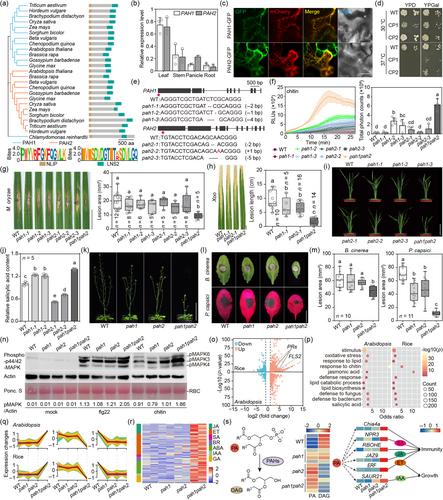
Phylogenetic analyses reveal that PAHs are highly conserved in plants. Rice PAHs contain conserved NLIP and LNS2 signature motifs (Figure 1a). PAH1 and PAH2 were transcribed in all rice tissues examined, with the highest level in the leaf (Figure 1b). PAH-GFP signals predominantly co-localized with the endoplasmic reticulum (ER) marker HDEL1 (Figure 1c). The yeast pah1 mutant is lethal at 37 °C. We transformed rice PAH1 and PAH2 genes into the WT yeast strain, respectively, and knocked out the yeast endogenous PAH1 gene. The rice PAH complementation strains grew well on the induction medium YPGal but not on the non-inducing medium YPD at 37 °C, indicating that rice PAH1 and PAH2 function as PA phosphohydrolases in yeast (Figure 1d).
To investigate the functions of rice PAHs, we genome-edited PAHs by targeting their first exons and obtained pah single mutants (Figure 1e). Since all mutations in pah1 and pah2 led to loss-of-function and no off-targets were observed, we crossed pah1-1 and pah2-1 and created the pah1pah2 double mutant (Figures S1 and S2). We next tested ROS production in rice pah plants. The pah1pah2 leaves exhibited a robust ROS burst when challenged with chitin. The total photon counts, denoting the ROS level, showed an obvious increase in pah1pah2 (Figure 1f). When infected with rice blast fungus Magnaporthe oryzae, the lesion area of pah1pah2 was much smaller than other lines and only 46.1% of the WT (Figure 1g). We subsequently tested the disease resistance of rice pah1pah2 lines with the rice bacterial blight pathogen Xanthomonas oryzae pv. oryzae (Xoo). Similarly, the lesion length was much shorter in pah1pah2 (1.51 cm) compared with the WT (9.40 cm) as well as the pah1-1 (7.02 cm) and pah2-1 (6.64 cm) (Figure 1h). In summary, both fungal and bacterial infection assays demonstrate enhanced resistance of pah1pah2. Besides, pah1pah2 exhibited some growth inhibition, and the plant height of pah1pah2 was 77.8% of the WT (Figures 1i, S1 and S3). Salicylic acid (SA) plays key roles in plant defence. The SA level increased 1.39-fold in pah1pah2 compared with the WT (Figure 1j).
To investigate whether the role of the PAH genes in immunity is conserved, we obtained Arabidopsis pah mutants (Eastmond et al., 2010), and the pah1pah2 seedlings were shorter than the WT (Col-0) (Figure 1k). Infection with Botrytis cinerea, pah1pah2 plants developed smaller lesions, a 28.3% reduction than the WT. Similarly, when inoculated with Phytophthora capsici, the lesion area of pah1pah2 (11.0 mm2) was only 15.7% of the WT (70.4 mm2), and smaller lesion areas were also shown in pah1 and pah2 (Figure 1l,m). We further examined the levels of phosphorylated MAPKs (pMAPKs). Under flg22 and chitin treatments, the levels of pMAPKs were significantly higher in the Arabidopsis pah1pah2 mutants as well as pah2 than that in the WT (Figure 1n). The results are consistent with increased ROS levels in rice pah1pah2 , which indicates that increased PA at the plasma membrane by knockout of the ER-localized PAHs ultimately enhances plant immune responses in the plasma membrane.
To investigate PAH-mediated regulation of gene transcription and metabolism, we performed RNA-seq and lipidomics analyses. PR genes and FLS2 were upregulated in rice pah1pah2 (Figure 1o). Furthermore, Gene Ontology (GO) enrichment analyses of differentially expressed genes (DEGs) between WT and pah1pah2 plants showed that ‘response to lipid’, ‘defense response’ and ‘defense response to fungus/bacterium’ were enriched (Figure 1p), which are consistent with the enhanced disease resistance of pah1pah2. Then using the hierarchical clustering analyses, three clusters were identified in Arabidopsis and rice (Figure 1q). In the ‘genes upregulated in pah1pah2’ cluster, the expression levels of many hormone-related genes that are involved in JA, ET, SA and IAA were simultaneously upregulated in pah1pah2 lines (Figure 1r), indicating that these plant hormones are likely involved in resistance and growth of pah1pah2 lines. Knockout of PAHs resulted in the increase of PA and decrease of DAG in rice pah1pah2 (Figure 1s). Additionally, immunity-related genes, Chia4a, NPR3, RBOHE, JAZ9 and ERF, and genes negatively regulating plant growth, including SAUR, were upregulated in pah1pah2 mutants (Figure 1s). Overexpression of the SAUR genes inhibited the biosynthesis of plant growth hormones, some of which were upregulated in pah1pah2, thus partially explaining the growth defects of pah1pah2. In summary, knockout of PAH genes alters phospholipid metabolism in plants, and accumulated PA activates the expression of immunity-related genes, but negatively regulates plant growth.
In conclusion, knockout of both PAH genes enhances plant resistance but inhibits plant growth, an immunity-growth tradeoff. Previously, we used genome editing to break this tradeoff in RBL1 and generated alleles that balance growth and immunity (Sha et al., 2023). Moreover, uORF insertion into the promoter to manipulate protein translation, pathogen-induced silencing of PAHs and optimal natural PAH alleles are options to engineer plant PAHs for multipathogen resistance without yield penalty (Xiong et al., 2022; Zhou et al., 2018). The PA metabolism-related genes PAHs are highly conserved in plants, and the role of PAHs in multipathogen resistance in other crops is worthy of further investigation.
G.L., G.S., Q.G., and X.H. are coinventors on a patent no. ZL202311556377.0. The remaining authors declare no conflict of interest.
G.L. and G.S. designed the experiments. G.S., L.Y., Q.G., W.Y., X.H., Z.G., T.C., R.T., G.C., Y.L., X.S., M.L., F.X., K.X., G.C., H.H., J.L., and Q.L. performed the experiments. G.L., G.S., X.H., and Q.G. drafted and revised the manuscript. All authors read and approved the final manuscript.
期刊介绍:
Plant Biotechnology Journal aspires to publish original research and insightful reviews of high impact, authored by prominent researchers in applied plant science. The journal places a special emphasis on molecular plant sciences and their practical applications through plant biotechnology. Our goal is to establish a platform for showcasing significant advances in the field, encompassing curiosity-driven studies with potential applications, strategic research in plant biotechnology, scientific analysis of crucial issues for the beneficial utilization of plant sciences, and assessments of the performance of plant biotechnology products in practical applications.



 京公网安备 11010802042870号
京ICP备2023020795号-1
京公网安备 11010802042870号
京ICP备2023020795号-1

 分享
分享
 求助内容:
求助内容: 应助结果提醒方式:
 扫码关注我们
