Aishwarya Chauhan, Priyanka Chauhan and Ravi Shankar
{"title":"Synthesis of anionic alkaline earth metal methanesulfonates bearing photo-responsive methylviologen†","authors":"Aishwarya Chauhan, Priyanka Chauhan and Ravi Shankar","doi":"10.1039/D4DT02229G","DOIUrl":null,"url":null,"abstract":"<p >Anionic coordination frameworks stabilized by methylviologen (MV<small><sup>2+</sup></small>; 1,1′-dimethyl 4,4′-bipyridinium) as a photochromic module are a distinct class of functional materials. Herein, we report the first examples of alkaline earth metal methanesulfonates [MV{Mg(OSO<small><sub>2</sub></small>Me)<small><sub>3</sub></small>(H<small><sub>2</sub></small>O)<small><sub>2</sub></small>}<small><sub>2</sub></small>] (<strong>1</strong>), [MV{Ca(OSO<small><sub>2</sub></small>Me)<small><sub>3</sub></small>(H<small><sub>2</sub></small>O)<small><sub>2</sub></small>}<small><sub>2</sub></small>] (<strong>2</strong>), [2{Mg(OSO<small><sub>2</sub></small>Me)<small><sub>2</sub></small>(H<small><sub>2</sub></small>O)<small><sub>4</sub></small>}MV·2OSO<small><sub>2</sub></small>Me] (<strong>3</strong>), and [Me<small><sub>4</sub></small>-pip{Ca<small><sub>2</sub></small>(OSO<small><sub>2</sub></small>Me)<small><sub>6</sub></small>(H<small><sub>2</sub></small>O)<small><sub>2</sub></small>}]<small><sub><em>n</em></sub></small> (<strong>4</strong>) incorporating methylviologen or tetra-<em>N</em>-methylpiperazinium (Me<small><sub>4</sub></small>-pip) as a charge-balancing cation. X-ray crystallographic studies of <strong>1–3</strong> emphasize the role of isolated ion-pairs for the construction of hydrogen-bonded supramolecular assemblies and the ability of methanesulfonates to donate electrons (centroid⋯O = 3.09–3.15 Å) to promote photoinduced one-electron reduction of MV<small><sup>2+</sup></small> to an MV˙<small><sup>+</sup></small> radical cation in the solid state. The inorganic framework in <strong>4</strong> adopts a layered motif with an inter-lamellar spacing of 11.8 Å, providing spatial expanse to accommodate the organic cations.</p>","PeriodicalId":71,"journal":{"name":"Dalton Transactions","volume":" 41","pages":" 17014-17020"},"PeriodicalIF":3.3000,"publicationDate":"2024-09-20","publicationTypes":"Journal Article","fieldsOfStudy":null,"isOpenAccess":false,"openAccessPdf":"","citationCount":"0","resultStr":null,"platform":"Semanticscholar","paperid":null,"PeriodicalName":"Dalton Transactions","FirstCategoryId":"92","ListUrlMain":"https://pubs.rsc.org/en/content/articlelanding/2024/dt/d4dt02229g","RegionNum":3,"RegionCategory":"化学","ArticlePicture":[],"TitleCN":null,"AbstractTextCN":null,"PMCID":null,"EPubDate":"","PubModel":"","JCR":"Q2","JCRName":"CHEMISTRY, INORGANIC & NUCLEAR","Score":null,"Total":0}
引用次数: 0
Abstract
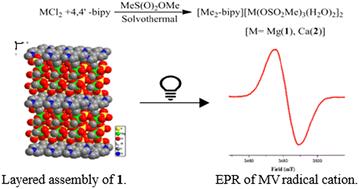
Anionic coordination frameworks stabilized by methylviologen (MV2+; 1,1′-dimethyl 4,4′-bipyridinium) as a photochromic module are a distinct class of functional materials. Herein, we report the first examples of alkaline earth metal methanesulfonates [MV{Mg(OSO2Me)3(H2O)2}2] (1), [MV{Ca(OSO2Me)3(H2O)2}2] (2), [2{Mg(OSO2Me)2(H2O)4}MV·2OSO2Me] (3), and [Me4-pip{Ca2(OSO2Me)6(H2O)2}]n (4) incorporating methylviologen or tetra-N-methylpiperazinium (Me4-pip) as a charge-balancing cation. X-ray crystallographic studies of 1–3 emphasize the role of isolated ion-pairs for the construction of hydrogen-bonded supramolecular assemblies and the ability of methanesulfonates to donate electrons (centroid⋯O = 3.09–3.15 Å) to promote photoinduced one-electron reduction of MV2+ to an MV˙+ radical cation in the solid state. The inorganic framework in 4 adopts a layered motif with an inter-lamellar spacing of 11.8 Å, providing spatial expanse to accommodate the organic cations.
期刊介绍:
Dalton Transactions is a journal for all areas of inorganic chemistry, which encompasses the organometallic, bioinorganic and materials chemistry of the elements, with applications including synthesis, catalysis, energy conversion/storage, electrical devices and medicine. Dalton Transactions welcomes high-quality, original submissions in all of these areas and more, where the advancement of knowledge in inorganic chemistry is significant.



 京公网安备 11010802042870号
京ICP备2023020795号-1
京公网安备 11010802042870号
京ICP备2023020795号-1

 分享
分享
 求助内容:
求助内容: 应助结果提醒方式:
 扫码关注我们
