{"title":"Novel mixed nickel/cobalt hexacyanoferrate microcubes with synergistic effects for aqueous hybrid supercapacitors†","authors":"Vu Van Thuy, Nguyen Si Hieu and Tran Viet Thu","doi":"10.1039/D4DT02124J","DOIUrl":null,"url":null,"abstract":"<p >Combining different metals in coordination compounds is an efficient strategy to improve their various properties. Herein, mixed nickel–cobalt hexacyanoferrate (Ni<small><sub><em>x</em></sub></small>Co<small><sub><em>y</em></sub></small>HCF) microcubes of varying <em>x</em> : <em>y</em> molar ratios are synthesized <em>via</em> a co-precipitation route and comprehensively characterized to study their material and electrochemical properties. Ni<small><sub><em>x</em></sub></small>Co<small><sub><em>y</em></sub></small>HCF microcubes display the battery-type electrochemical energy storage mechanism in aqueous electrolytes. Among the samples, Ni<small><sub>1</sub></small>Co<small><sub>2</sub></small>HCF microcubes deliver the highest specific capacity of 134 mA h g<small><sup>−1</sup></small> (1068 F g<small><sup>−1</sup></small>) at a specific current of 1 A g<small><sup>−1</sup></small>. This significant enhancement in the capacity indicates the synergistic and cooperative effects between Ni and Co sites in Ni<small><sub>1</sub></small>Co<small><sub>2</sub></small>HCF microcubes. The asymmetric supercapacitor device assembled with Ni<small><sub>1</sub></small>Co<small><sub>2</sub></small>HCF microcubes delivers an excellent energy density of 74.4 μW h cm<small><sup>−2</sup></small> at a power density of 750 μW cm<small><sup>−2</sup></small> and retains 87.7% of its initial capacity after 2000 cycles at a current density of 5 mA cm<small><sup>−2</sup></small>, indicating its robust structural integrity and electrochemical durability. This study highlights the promising potential of mixed-metal hexacyanoferrates as high-performance electrodes for aqueous supercapacitors.</p>","PeriodicalId":71,"journal":{"name":"Dalton Transactions","volume":" 42","pages":" 17333-17342"},"PeriodicalIF":3.3000,"publicationDate":"2024-09-20","publicationTypes":"Journal Article","fieldsOfStudy":null,"isOpenAccess":false,"openAccessPdf":"","citationCount":"0","resultStr":null,"platform":"Semanticscholar","paperid":null,"PeriodicalName":"Dalton Transactions","FirstCategoryId":"92","ListUrlMain":"https://pubs.rsc.org/en/content/articlelanding/2024/dt/d4dt02124j","RegionNum":3,"RegionCategory":"化学","ArticlePicture":[],"TitleCN":null,"AbstractTextCN":null,"PMCID":null,"EPubDate":"","PubModel":"","JCR":"Q2","JCRName":"CHEMISTRY, INORGANIC & NUCLEAR","Score":null,"Total":0}
引用次数: 0
Abstract
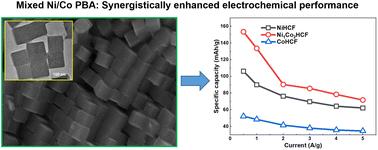
Combining different metals in coordination compounds is an efficient strategy to improve their various properties. Herein, mixed nickel–cobalt hexacyanoferrate (NixCoyHCF) microcubes of varying x : y molar ratios are synthesized via a co-precipitation route and comprehensively characterized to study their material and electrochemical properties. NixCoyHCF microcubes display the battery-type electrochemical energy storage mechanism in aqueous electrolytes. Among the samples, Ni1Co2HCF microcubes deliver the highest specific capacity of 134 mA h g−1 (1068 F g−1) at a specific current of 1 A g−1. This significant enhancement in the capacity indicates the synergistic and cooperative effects between Ni and Co sites in Ni1Co2HCF microcubes. The asymmetric supercapacitor device assembled with Ni1Co2HCF microcubes delivers an excellent energy density of 74.4 μW h cm−2 at a power density of 750 μW cm−2 and retains 87.7% of its initial capacity after 2000 cycles at a current density of 5 mA cm−2, indicating its robust structural integrity and electrochemical durability. This study highlights the promising potential of mixed-metal hexacyanoferrates as high-performance electrodes for aqueous supercapacitors.
期刊介绍:
Dalton Transactions is a journal for all areas of inorganic chemistry, which encompasses the organometallic, bioinorganic and materials chemistry of the elements, with applications including synthesis, catalysis, energy conversion/storage, electrical devices and medicine. Dalton Transactions welcomes high-quality, original submissions in all of these areas and more, where the advancement of knowledge in inorganic chemistry is significant.



 京公网安备 11010802042870号
京ICP备2023020795号-1
京公网安备 11010802042870号
京ICP备2023020795号-1

 分享
分享
 求助内容:
求助内容: 应助结果提醒方式:
 扫码关注我们
