Haipeng Zhang, Xiaodong Lian, Fan Gao, Conghao Song, Beibei Feng, Xianbo Zheng, Xiaobei Wang, Nan Hou, Jun Cheng, Wei Wang, Langlang Zhang, Jidong Li, Xia Ye, Jiancan Feng, Bin Tan
{"title":"A gap-free genome of pillar peach (Prunus persica L.) provides new insights into branch angle and double flower traits","authors":"Haipeng Zhang, Xiaodong Lian, Fan Gao, Conghao Song, Beibei Feng, Xianbo Zheng, Xiaobei Wang, Nan Hou, Jun Cheng, Wei Wang, Langlang Zhang, Jidong Li, Xia Ye, Jiancan Feng, Bin Tan","doi":"10.1111/pbi.14480","DOIUrl":null,"url":null,"abstract":"<p>Peach (<i>Prunus persica</i> L.), a deciduous fruit tree in the Rosaceae family, is widely cultivated around the world. The release of the peach genome which significantly propelled the progress of gene mapping (Lian <i>et al</i>., <span>2022</span>; Verde <i>et al</i>., <span>2013</span>; Zhou <i>et al</i>., <span>2023</span>). However, the existing peach genomes all contain multiple gaps (Table S1), which may lead to inaccurate gene annotation or gene mapping (Zhou <i>et al</i>., <span>2022</span>).</p><p>Here, we present ‘Zhaoshouhong’ peach (ZSH, also named ‘Terutebeni’, pillar type and double flower) gap-free genome assembly generated by combing Nanopore ultra-long and Hi-C reads. After scaffolding with the Hi-C data, the contigs were anchored to eight chromosomes (Appendix S1). Notably, Chromosome 1 (Chr1), Chr2, Chr3, Chr4, Chr6 and Chr7 were each covered by a single contig. Two gaps remaining on Chr5, and a single gap on Chr8 were successfully filled using the raw Nanopore ultra-long reads. Finally, a complete gap-free peach nuclear genome was obtained, with a total size of 239.34 Mb and contig N50 of 29.67 Mb (Figure 1a, Figure S1, Tables S2 and S3). Additionally, the mitochondrial and chloroplast genomes were assembled using the ultra-long and Illumina sequencing reads (Figures S2 and S3).</p><p>A total of 112 959 366 bps was annotated as repeat elements (Table S4). The telomeric satellites were present at the 16 chromosome ends (Table S5), eight candidate centromeres were predicated in the ZSH genome (Table S6), the high Benchmarking universal single-copy orthologs (BUSCO) value (98.88%), Long terminal repeats (LTR) assembly index (31.03), integrity (99.63%) and accuracy (QV = 53.3) indicate the genome meets a high-quality level of assembly (Table S7). The gene models were adjusted manually using IGV-GSAman (v0.6.38, https://tbtools.cowtransfer.com/s/a11146181df14f, Figure S4), 24 901 protein-coding genes were obtained, and 23 253 genes were functionally annotated (Figure S5 and Table S8).</p><p>Branch angle is one of the most important agronomic traits in fruit trees. To identify the major genes influencing branch angle in ZSH peach, structural variations were identified between the ZSH and the other peach genomes (standard type, Figure 1b; Figures S6, S7; Table S9), and 9100 variations involving in 3523 genes were commonly detected between the ZSH and the other peach genomes (Figure S8; Table S10). Notably, 25 genes showed high expression levels in standard types than that in pillar types (Figure S9; Table S11). Among these 25 genes, Pp02G17890.t1 (<i>PpTAC1</i>), a homologous gene of <i>OsTAC1</i> in rice (Ku <i>et al</i>., <span>2011</span>), was related to the tiller angle. Interestingly, compared with other peach genomes, the <i>PpTAC1</i> in ZSH exhibited an 11 bp deletion in the promoter and a 4422 bp insertion in the exon (Figure 1c). Compared with standard peach, the variants were present in the coding or promoter sequence of <i>PpTAC1</i> in other 10 pillar peach cultivars (Figure 1c; Table S12). These findings showed a close relationship between variation in <i>PpTAC1</i> and the branch angle in peach.</p><p>For single/double flower traits, a significant peak on Chr2 and a minor peak on Chr6 were found using 334 natural peach germplasms (Figure 1d; Table S13). Two new mutations (a 5033 bp insertion and a 1210 bp insertion) that disrupt the miR172d gene were identified in ZSH using comparative genomic analysis and gene cloning. The variation in miR172d was used as a molecular marker to distinguish the single- and double-flower trait (Table S14). The presence of either the 1210 bp or 5033 bp insertions detected in 27 varieties with double flower was absent in the six single-flower accessions and in other five double-flower accessions (‘No.18’, ‘HongChuizhi’, ‘1-1-4’, ‘1-2-7’ and ‘Huayulu’) (Figure S10; Table S14).</p><p>To further identify other candidate genes that contribute to the single/double flower trait, a hybrid population was produced from ‘No.18’ (double-flower) and ‘Okubo’ (single flower) (Table S15). A major locus on Chr6 was identified using the two pools with single flower (pool 1) and double flower (pool 2) based on bulked-segregant analysis (BSA) (Figure 1e). A 994 bp heterozygous deletion was identified in the coding region of Pp06G22680.t1 in No. 18 peach based on combing re-sequencing data (Figure S11). Intriguingly, Pp06G22680.t1 encodes an APETALA2 transcription factor (PpAP2), which is known to play roles in flower development. PCR results demonstrated that the 994 bp deletion was present in all hybrids with double-flower but absent in hybrids with single flower (Figure S12; Table S15). This finding indicates that the 994 bp deletion within <i>PpAP2</i> contributes to the double-flower trait in the ‘No. 18’ peach. Furthermore, the 994 bp deletion genotypes of <i>PpAP2</i> were present in ‘Hongchuizhi’, ‘1-1-4’ and ‘1-2-7’, but it was absent in ‘Huayulu’ (Figure S13).</p><p>Interestingly, a single nucleotide polymorphism (SNP) (G/T) located in the binding site of miR172d in PpAP2 was identified in ‘Huayulu’ (Figure 1f). We therefore postulated that this SNP prevents miR172d from effectively targeting and degrading PpAP2. In transiently transformed <i>Nicotiana benthamiana</i> leaves, the PpAP2 (G<sup>1346</sup>) group showed a dramatic decreased fluorescence signal, indicating that PpAP2 (G<sup>1346</sup>) can be targeted and degraded by miR172d (Figure 1g). Therefore, the mutation from G to T in the miR172d binding site prevents it from targeting and degrading <i>PpAP2</i>, resulting in the double-flower trait in ‘Huayulu’ peach (Figure 1h). Overall, miR172d and <i>PpAP2</i> were identified as co-regulators of the single/double flower phenotype in peach.</p><p>Other than the above, candidate loci associating with showy/nonshowy flowers, hairiness/hairless and three other important agronomic traits were pinpointed (Table S13; Figure S14).</p><p>In conclusion, a complete gap-free peach genome was obtained. The gene structure was manually refined to ensure high accuracy. Using this genome, we identified the variations in <i>PpTAC1</i>, miR172d, and PpAP2 were associated with their corresponding traits in peach. The gap-free peach genome offers a valuable genomic resource for facilitating the genetic improvement of peach and related species.</p><p>This work was supported by the National Natural Science Foundation of China (32102329), Modern Agricultural Industry Technology of Henan Province (HARS-22-09-G1) and the Special Fund for Young Talents in Henan Agricultural University (30501339).</p><p>The authors declare that they have no conflicts of interest.</p><p>B.T., J.F., H.Z. and X.L. designed this experiment. F.G., C.S., B.F., X.W., J.C., W.W., N.H., X.Z., X.Y. H.Z., L.Z. and J.L. conducted work. H.Z., B.T. and J.F. edited and revised the manuscript.</p>","PeriodicalId":221,"journal":{"name":"Plant Biotechnology Journal","volume":"23 1","pages":"81-83"},"PeriodicalIF":12.8000,"publicationDate":"2024-09-22","publicationTypes":"Journal Article","fieldsOfStudy":null,"isOpenAccess":false,"openAccessPdf":"https://onlinelibrary.wiley.com/doi/epdf/10.1111/pbi.14480","citationCount":"0","resultStr":null,"platform":"Semanticscholar","paperid":null,"PeriodicalName":"Plant Biotechnology Journal","FirstCategoryId":"5","ListUrlMain":"https://onlinelibrary.wiley.com/doi/10.1111/pbi.14480","RegionNum":1,"RegionCategory":"生物学","ArticlePicture":[],"TitleCN":null,"AbstractTextCN":null,"PMCID":null,"EPubDate":"","PubModel":"","JCR":"Q1","JCRName":"BIOTECHNOLOGY & APPLIED MICROBIOLOGY","Score":null,"Total":0}
引用次数: 0
Abstract
Peach (Prunus persica L.), a deciduous fruit tree in the Rosaceae family, is widely cultivated around the world. The release of the peach genome which significantly propelled the progress of gene mapping (Lian et al., 2022; Verde et al., 2013; Zhou et al., 2023). However, the existing peach genomes all contain multiple gaps (Table S1), which may lead to inaccurate gene annotation or gene mapping (Zhou et al., 2022).
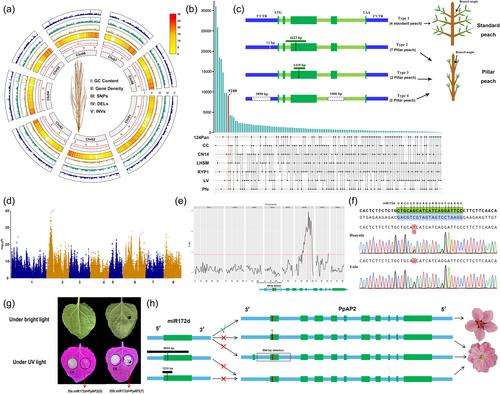
Here, we present ‘Zhaoshouhong’ peach (ZSH, also named ‘Terutebeni’, pillar type and double flower) gap-free genome assembly generated by combing Nanopore ultra-long and Hi-C reads. After scaffolding with the Hi-C data, the contigs were anchored to eight chromosomes (Appendix S1). Notably, Chromosome 1 (Chr1), Chr2, Chr3, Chr4, Chr6 and Chr7 were each covered by a single contig. Two gaps remaining on Chr5, and a single gap on Chr8 were successfully filled using the raw Nanopore ultra-long reads. Finally, a complete gap-free peach nuclear genome was obtained, with a total size of 239.34 Mb and contig N50 of 29.67 Mb (Figure 1a, Figure S1, Tables S2 and S3). Additionally, the mitochondrial and chloroplast genomes were assembled using the ultra-long and Illumina sequencing reads (Figures S2 and S3).
A total of 112 959 366 bps was annotated as repeat elements (Table S4). The telomeric satellites were present at the 16 chromosome ends (Table S5), eight candidate centromeres were predicated in the ZSH genome (Table S6), the high Benchmarking universal single-copy orthologs (BUSCO) value (98.88%), Long terminal repeats (LTR) assembly index (31.03), integrity (99.63%) and accuracy (QV = 53.3) indicate the genome meets a high-quality level of assembly (Table S7). The gene models were adjusted manually using IGV-GSAman (v0.6.38, https://tbtools.cowtransfer.com/s/a11146181df14f, Figure S4), 24 901 protein-coding genes were obtained, and 23 253 genes were functionally annotated (Figure S5 and Table S8).
Branch angle is one of the most important agronomic traits in fruit trees. To identify the major genes influencing branch angle in ZSH peach, structural variations were identified between the ZSH and the other peach genomes (standard type, Figure 1b; Figures S6, S7; Table S9), and 9100 variations involving in 3523 genes were commonly detected between the ZSH and the other peach genomes (Figure S8; Table S10). Notably, 25 genes showed high expression levels in standard types than that in pillar types (Figure S9; Table S11). Among these 25 genes, Pp02G17890.t1 (PpTAC1), a homologous gene of OsTAC1 in rice (Ku et al., 2011), was related to the tiller angle. Interestingly, compared with other peach genomes, the PpTAC1 in ZSH exhibited an 11 bp deletion in the promoter and a 4422 bp insertion in the exon (Figure 1c). Compared with standard peach, the variants were present in the coding or promoter sequence of PpTAC1 in other 10 pillar peach cultivars (Figure 1c; Table S12). These findings showed a close relationship between variation in PpTAC1 and the branch angle in peach.
For single/double flower traits, a significant peak on Chr2 and a minor peak on Chr6 were found using 334 natural peach germplasms (Figure 1d; Table S13). Two new mutations (a 5033 bp insertion and a 1210 bp insertion) that disrupt the miR172d gene were identified in ZSH using comparative genomic analysis and gene cloning. The variation in miR172d was used as a molecular marker to distinguish the single- and double-flower trait (Table S14). The presence of either the 1210 bp or 5033 bp insertions detected in 27 varieties with double flower was absent in the six single-flower accessions and in other five double-flower accessions (‘No.18’, ‘HongChuizhi’, ‘1-1-4’, ‘1-2-7’ and ‘Huayulu’) (Figure S10; Table S14).
To further identify other candidate genes that contribute to the single/double flower trait, a hybrid population was produced from ‘No.18’ (double-flower) and ‘Okubo’ (single flower) (Table S15). A major locus on Chr6 was identified using the two pools with single flower (pool 1) and double flower (pool 2) based on bulked-segregant analysis (BSA) (Figure 1e). A 994 bp heterozygous deletion was identified in the coding region of Pp06G22680.t1 in No. 18 peach based on combing re-sequencing data (Figure S11). Intriguingly, Pp06G22680.t1 encodes an APETALA2 transcription factor (PpAP2), which is known to play roles in flower development. PCR results demonstrated that the 994 bp deletion was present in all hybrids with double-flower but absent in hybrids with single flower (Figure S12; Table S15). This finding indicates that the 994 bp deletion within PpAP2 contributes to the double-flower trait in the ‘No. 18’ peach. Furthermore, the 994 bp deletion genotypes of PpAP2 were present in ‘Hongchuizhi’, ‘1-1-4’ and ‘1-2-7’, but it was absent in ‘Huayulu’ (Figure S13).
Interestingly, a single nucleotide polymorphism (SNP) (G/T) located in the binding site of miR172d in PpAP2 was identified in ‘Huayulu’ (Figure 1f). We therefore postulated that this SNP prevents miR172d from effectively targeting and degrading PpAP2. In transiently transformed Nicotiana benthamiana leaves, the PpAP2 (G1346) group showed a dramatic decreased fluorescence signal, indicating that PpAP2 (G1346) can be targeted and degraded by miR172d (Figure 1g). Therefore, the mutation from G to T in the miR172d binding site prevents it from targeting and degrading PpAP2, resulting in the double-flower trait in ‘Huayulu’ peach (Figure 1h). Overall, miR172d and PpAP2 were identified as co-regulators of the single/double flower phenotype in peach.
Other than the above, candidate loci associating with showy/nonshowy flowers, hairiness/hairless and three other important agronomic traits were pinpointed (Table S13; Figure S14).
In conclusion, a complete gap-free peach genome was obtained. The gene structure was manually refined to ensure high accuracy. Using this genome, we identified the variations in PpTAC1, miR172d, and PpAP2 were associated with their corresponding traits in peach. The gap-free peach genome offers a valuable genomic resource for facilitating the genetic improvement of peach and related species.
This work was supported by the National Natural Science Foundation of China (32102329), Modern Agricultural Industry Technology of Henan Province (HARS-22-09-G1) and the Special Fund for Young Talents in Henan Agricultural University (30501339).
The authors declare that they have no conflicts of interest.
B.T., J.F., H.Z. and X.L. designed this experiment. F.G., C.S., B.F., X.W., J.C., W.W., N.H., X.Z., X.Y. H.Z., L.Z. and J.L. conducted work. H.Z., B.T. and J.F. edited and revised the manuscript.
期刊介绍:
Plant Biotechnology Journal aspires to publish original research and insightful reviews of high impact, authored by prominent researchers in applied plant science. The journal places a special emphasis on molecular plant sciences and their practical applications through plant biotechnology. Our goal is to establish a platform for showcasing significant advances in the field, encompassing curiosity-driven studies with potential applications, strategic research in plant biotechnology, scientific analysis of crucial issues for the beneficial utilization of plant sciences, and assessments of the performance of plant biotechnology products in practical applications.




 京公网安备 11010802042870号
京ICP备2023020795号-1
京公网安备 11010802042870号
京ICP备2023020795号-1

 分享
分享
 求助内容:
求助内容: 应助结果提醒方式:
 扫码关注我们
