Monocyte/lymphocyte ratio as a risk factor of cardiovascular and all-cause mortality in coronary artery disease with low-density lipoprotein cholesterol levels below 1.4 mmol/L: A large longitudinal multicenter study
Rengui Jiang MD , Huangtao Ruan MD , Wanying Wu MD , Yueting Wang MD , Haozhang Huang MD , Xiaozhao Lu MD , Weipeng Liang MS , Yang Zhou MS , Jielan Wu MD , Xianlin Ruan MD , Jinming Chen MD , Weipeng Zhang MD , Yulong Xiang MS , Zhitao Yan MD, PhD , Yong Liu MD, PhD, FACC , Ning Tan MD, PhD, FACC, FESC
{"title":"Monocyte/lymphocyte ratio as a risk factor of cardiovascular and all-cause mortality in coronary artery disease with low-density lipoprotein cholesterol levels below 1.4 mmol/L: A large longitudinal multicenter study","authors":"Rengui Jiang MD , Huangtao Ruan MD , Wanying Wu MD , Yueting Wang MD , Haozhang Huang MD , Xiaozhao Lu MD , Weipeng Liang MS , Yang Zhou MS , Jielan Wu MD , Xianlin Ruan MD , Jinming Chen MD , Weipeng Zhang MD , Yulong Xiang MS , Zhitao Yan MD, PhD , Yong Liu MD, PhD, FACC , Ning Tan MD, PhD, FACC, FESC","doi":"10.1016/j.jacl.2024.08.005","DOIUrl":null,"url":null,"abstract":"<div><h3>BACKGROUND AND AIMS</h3><div>The monocyte/lymphocyte ratio (MLR), an inflammatory marker, has an unclear relationship with the risk of residual inflammation in patients with coronary artery disease (CAD) and low-density lipoprotein cholesterol (LDL-C) below 1.4 mmol/L. This study aimed to assess the association between the MLR and cardiovascular and all-cause mortalities in these patients.</div></div><div><h3>METHODS</h3><div>A total of 2747 patients diagnosed with CAD via coronary angiography (CAG) and presenting with LDL-C levels < 1.4 mmol/L were enrolled in this observational study conducted from January 2007 to December 2020. Patients were categorized into four groups based on the MLR quartiles. We used Kaplan-Meier analysis and Cox regression models to evaluate the relationship between baseline MLR and cardiovascular and all-cause mortalities.</div></div><div><h3>RESULTS</h3><div>Among the 2747 participants followed up for a median duration of 6 years, there were 184 cardiovascular and 462 all-cause deaths. Elevated MLR levels were found to be associated with an increased risk of both cardiovascular and all-cause mortalities according to the Kaplan-Meier analysis. Multivariate Cox regression analysis demonstrated a significant association between higher MLR and an elevated risk of cardiovascular and all-cause mortality. Compared to the older group, with an increase in MLR levels, the younger group showed a higher hazard ratio for cardiovascular death. Similar results were obtained in the single-vessel disease group.</div></div><div><h3>CONCLUSIONS</h3><div>In patients with CAD and LDL-C levels < 1.4 mmol/L, MLR can serve as a risk factor for both cardiovascular and all-cause mortalities owing to the risk of residual inflammation.</div></div>","PeriodicalId":15392,"journal":{"name":"Journal of clinical lipidology","volume":"18 6","pages":"Pages e986-e994"},"PeriodicalIF":4.6000,"publicationDate":"2024-11-01","publicationTypes":"Journal Article","fieldsOfStudy":null,"isOpenAccess":false,"openAccessPdf":"","citationCount":"0","resultStr":null,"platform":"Semanticscholar","paperid":null,"PeriodicalName":"Journal of clinical lipidology","FirstCategoryId":"3","ListUrlMain":"https://www.sciencedirect.com/science/article/pii/S1933287424002320","RegionNum":3,"RegionCategory":"医学","ArticlePicture":[],"TitleCN":null,"AbstractTextCN":null,"PMCID":null,"EPubDate":"","PubModel":"","JCR":"Q2","JCRName":"PHARMACOLOGY & PHARMACY","Score":null,"Total":0}
引用次数: 0
Abstract
BACKGROUND AND AIMS
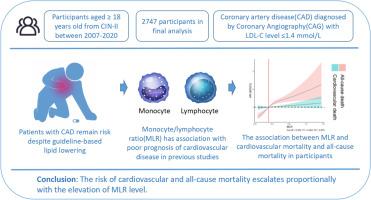
The monocyte/lymphocyte ratio (MLR), an inflammatory marker, has an unclear relationship with the risk of residual inflammation in patients with coronary artery disease (CAD) and low-density lipoprotein cholesterol (LDL-C) below 1.4 mmol/L. This study aimed to assess the association between the MLR and cardiovascular and all-cause mortalities in these patients.
METHODS
A total of 2747 patients diagnosed with CAD via coronary angiography (CAG) and presenting with LDL-C levels < 1.4 mmol/L were enrolled in this observational study conducted from January 2007 to December 2020. Patients were categorized into four groups based on the MLR quartiles. We used Kaplan-Meier analysis and Cox regression models to evaluate the relationship between baseline MLR and cardiovascular and all-cause mortalities.
RESULTS
Among the 2747 participants followed up for a median duration of 6 years, there were 184 cardiovascular and 462 all-cause deaths. Elevated MLR levels were found to be associated with an increased risk of both cardiovascular and all-cause mortalities according to the Kaplan-Meier analysis. Multivariate Cox regression analysis demonstrated a significant association between higher MLR and an elevated risk of cardiovascular and all-cause mortality. Compared to the older group, with an increase in MLR levels, the younger group showed a higher hazard ratio for cardiovascular death. Similar results were obtained in the single-vessel disease group.
CONCLUSIONS
In patients with CAD and LDL-C levels < 1.4 mmol/L, MLR can serve as a risk factor for both cardiovascular and all-cause mortalities owing to the risk of residual inflammation.
期刊介绍:
Because the scope of clinical lipidology is broad, the topics addressed by the Journal are equally diverse. Typical articles explore lipidology as it is practiced in the treatment setting, recent developments in pharmacological research, reports of treatment and trials, case studies, the impact of lifestyle modification, and similar academic material of interest to the practitioner.
Sections of Journal of clinical lipidology will address pioneering studies and the clinicians who conduct them, case studies, ethical standards and conduct, professional guidance such as ATP and NCEP, editorial commentary, letters from readers, National Lipid Association (NLA) news and upcoming event information, as well as abstracts from the NLA annual scientific sessions and the scientific forums held by its chapters, when appropriate.



 京公网安备 11010802042870号
京ICP备2023020795号-1
京公网安备 11010802042870号
京ICP备2023020795号-1

 分享
分享

 求助内容:
求助内容: 应助结果提醒方式:
 扫码关注我们
