Arisa Kato, Eri Shimizu, Hisashi Tsujimura, Akane Kawamoto, Etsuko Watarai, Takanori Igarashi, Hiroyuki Yoshida
{"title":"A Possible Role of cis-8-Octadecenoic Acid of the Sebum in Facial Skin Redness","authors":"Arisa Kato, Eri Shimizu, Hisashi Tsujimura, Akane Kawamoto, Etsuko Watarai, Takanori Igarashi, Hiroyuki Yoshida","doi":"10.1111/jocd.16570","DOIUrl":null,"url":null,"abstract":"<p>Sebum on the skin surface is essential for maintaining the homeostasis and function of human skin; however, excessive sebum secretion and disturbances in sebum composition are known to cause various chronic inflammatory skin disorders [<span>1</span>]. Free fatty acids (FFAs), significant components of human sebum, consist mostly of saturated and monoenoic FFAs with chain lengths of 16 or 18 carbons [<span>2</span>]. Recently, we showed that the proportion of FFAs (C18:1) in sebum positively correlated with cheek redness in healthy individuals. Furthermore, oleic acid (C18:1, <i>cis</i>-9), one of the best-characterized sebum FFAs that induce interleukin-36γ expression, may be a link between skin redness and sebum [<span>3</span>]. In contrast, <i>cis</i>-8-octadecenoic acid (C18:1, <i>cis</i>-8) was first identified in 1974 as the most abundant isomer of sebum FFAs (C18:1) [<span>4, 5</span>]; however, its physiological functions remain elusive, likely owing to its lower commercial availability compared with other FFAs. Here, we investigated the relationship between <i>cis</i>-8-octadecenoic acid and cheek redness in healthy Japanese individuals, and its effects on interleukin-36γ expression in cultured human normal keratinocytes (see the online Supporting materials and methods).</p><p>We first confirmed that <i>cis</i>-8-octadecenoic acid was the most abundant species among the four FFA (C18:1) isomers in skin sebum (Figure 1A). Next, we showed that the percentage composition of <i>cis</i>-8-octadecenoic acid in sebum was positively correlated with skin biophysical parameters associated with facial skin redness, that is, erythema index (EI) and <i>a</i>* values (Figure 1B,C), suggesting that the proportion of <i>cis</i>-8-octadecenoic acid in sebum is related to skin redness. Figure 1D shows representative images of the cheek of participants who had high or low degrees of skin redness and <i>cis</i>-8-octadecenoic acid proportion in the sebum. Recently, the ratio of the pro-inflammatory cytokine interleukin-36γ to the anti-inflammatory cytokine interleukin-37 in the stratum corneum was reported as a new skin inflammatory index that positively correlates with the degree of facial skin redness [<span>6</span>]. Therefore, to investigate the mechanism underlying the involvement of <i>cis</i>-8-octadecenoic acid in skin redness, we evaluated the dose- and time-dependent effects of <i>cis</i>-8-octadecenoic acid on the <i>interleukin-36</i>γ/<i>interleukin-37</i> ratio in human epidermal keratinocytes. Addition of <i>cis</i>-8-octadecenoic acid to culture medium dose-dependently induced <i>interleukin-36</i>γ and <i>interleukin-37</i> mRNA expression and the <i>interleukin-36</i>γ<i>/interleukin-37</i> ratio, showing the highest elevation at dose of 150 μM compared with that of vehicle control (Figure 2A–C). Notably, oleic acid significantly increased <i>interleukin-36</i>γ mRNA expression and the <i>interleukin-36</i>γ/<i>interleukin-37</i> ratio at dose of 50 μM, whereas <i>cis</i>-8-octadecenoic acid at this dose showed no significant induction (Figure 2A,C). These results indicated that <i>cis</i>-8-octadecenoic acid has a more moderate inflammatory effect than oleic acid. Time-course analyses showed that the <i>cis</i>-8-octadecenoic acid (100 or 150 μM)-induced enhancement of the <i>interleukin-36</i>γ<i>/interleukin-37</i> ratio started after 3 h and reached maximal levels 24 h after treatment (Figure 2D). Previously, we demonstrated that <i>N</i>-methyl-D-aspartate (NMDA)-type glutamate receptors are involved in the oleic acid-induced <i>interleukin</i>-<i>36</i>γ<i>/interleukin-37</i> ratio in human epidermal keratinocytes [<span>3</span>]. To investigate the involvement of NMDA-type glutamate receptors in the <i>cis</i>-8-octadecenoic acid-induced <i>interleukin-36</i>γ/<i>interleukin-37</i> ratio, we examined the effects of MK801, a potent NMDA receptor antagonist, on <i>interleukin-36</i>γ and <i>interleukin-37</i> mRNA expression in <i>cis</i>-8-octadecenoic acid-treated keratinocytes. As shown in Figure 2E, <i>cis</i>-8-octadecenoic acid-induced <i>interleukin-36</i>γ/<i>interleukin-37</i> ratio was suppressed by MK801 in a dose-dependent manner. These results suggest that, similar to oleic acid, <i>cis</i>-8-octadecenoic acid upregulates the <i>interleukin-36</i>γ/<i>interleukin-37</i> ratio in part through NMDA-type glutamate receptor, which may lead to increased skin redness. Although further studies are required, the variations in the binding affinity of <i>cis</i>-8-octadecenoic acid and oleic acid for the receptor may be attributed to their distinct inflammatory effects.</p><p>In conclusion, to the best of our knowledge, our study is the first to show that <i>cis</i>-8-octadecenoic acid plays a role in facial skin redness.</p><p>A. Kato, E. Watarai, T. Igarashi, and H. Yoshida designed the research. A. Kato, A. Kawamoto, E. Watarai, E. Shimizu, and T. Igarashi performed the research. A. Kato, A. Kawamoto, E. Shimizu, H. Tsujimura, E. Watarai, T. Igarashi, and H. Yoshida analyzed the data. A. Kato, E. Shimizu, and H. Yoshida wrote the manuscript. All the authors approved the final manuscript.</p><p>The study was conducted under the Declaration of Helsinki and was approved by the Ethical Committee of Kao Corporation (approval no. D123-200512).</p><p>The authors declare no conflicts of interest.</p>","PeriodicalId":15546,"journal":{"name":"Journal of Cosmetic Dermatology","volume":"24 1","pages":""},"PeriodicalIF":2.5000,"publicationDate":"2024-09-15","publicationTypes":"Journal Article","fieldsOfStudy":null,"isOpenAccess":false,"openAccessPdf":"https://www.ncbi.nlm.nih.gov/pmc/articles/PMC11743226/pdf/","citationCount":"0","resultStr":null,"platform":"Semanticscholar","paperid":null,"PeriodicalName":"Journal of Cosmetic Dermatology","FirstCategoryId":"3","ListUrlMain":"https://onlinelibrary.wiley.com/doi/10.1111/jocd.16570","RegionNum":4,"RegionCategory":"医学","ArticlePicture":[],"TitleCN":null,"AbstractTextCN":null,"PMCID":null,"EPubDate":"","PubModel":"","JCR":"Q2","JCRName":"DERMATOLOGY","Score":null,"Total":0}
引用次数: 0
Abstract
Sebum on the skin surface is essential for maintaining the homeostasis and function of human skin; however, excessive sebum secretion and disturbances in sebum composition are known to cause various chronic inflammatory skin disorders [1]. Free fatty acids (FFAs), significant components of human sebum, consist mostly of saturated and monoenoic FFAs with chain lengths of 16 or 18 carbons [2]. Recently, we showed that the proportion of FFAs (C18:1) in sebum positively correlated with cheek redness in healthy individuals. Furthermore, oleic acid (C18:1, cis-9), one of the best-characterized sebum FFAs that induce interleukin-36γ expression, may be a link between skin redness and sebum [3]. In contrast, cis-8-octadecenoic acid (C18:1, cis-8) was first identified in 1974 as the most abundant isomer of sebum FFAs (C18:1) [4, 5]; however, its physiological functions remain elusive, likely owing to its lower commercial availability compared with other FFAs. Here, we investigated the relationship between cis-8-octadecenoic acid and cheek redness in healthy Japanese individuals, and its effects on interleukin-36γ expression in cultured human normal keratinocytes (see the online Supporting materials and methods).
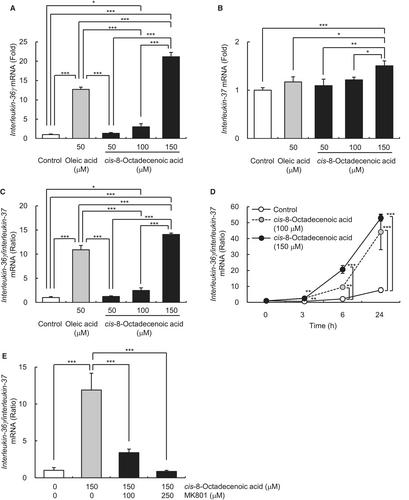
We first confirmed that cis-8-octadecenoic acid was the most abundant species among the four FFA (C18:1) isomers in skin sebum (Figure 1A). Next, we showed that the percentage composition of cis-8-octadecenoic acid in sebum was positively correlated with skin biophysical parameters associated with facial skin redness, that is, erythema index (EI) and a* values (Figure 1B,C), suggesting that the proportion of cis-8-octadecenoic acid in sebum is related to skin redness. Figure 1D shows representative images of the cheek of participants who had high or low degrees of skin redness and cis-8-octadecenoic acid proportion in the sebum. Recently, the ratio of the pro-inflammatory cytokine interleukin-36γ to the anti-inflammatory cytokine interleukin-37 in the stratum corneum was reported as a new skin inflammatory index that positively correlates with the degree of facial skin redness [6]. Therefore, to investigate the mechanism underlying the involvement of cis-8-octadecenoic acid in skin redness, we evaluated the dose- and time-dependent effects of cis-8-octadecenoic acid on the interleukin-36γ/interleukin-37 ratio in human epidermal keratinocytes. Addition of cis-8-octadecenoic acid to culture medium dose-dependently induced interleukin-36γ and interleukin-37 mRNA expression and the interleukin-36γ/interleukin-37 ratio, showing the highest elevation at dose of 150 μM compared with that of vehicle control (Figure 2A–C). Notably, oleic acid significantly increased interleukin-36γ mRNA expression and the interleukin-36γ/interleukin-37 ratio at dose of 50 μM, whereas cis-8-octadecenoic acid at this dose showed no significant induction (Figure 2A,C). These results indicated that cis-8-octadecenoic acid has a more moderate inflammatory effect than oleic acid. Time-course analyses showed that the cis-8-octadecenoic acid (100 or 150 μM)-induced enhancement of the interleukin-36γ/interleukin-37 ratio started after 3 h and reached maximal levels 24 h after treatment (Figure 2D). Previously, we demonstrated that N-methyl-D-aspartate (NMDA)-type glutamate receptors are involved in the oleic acid-induced interleukin-36γ/interleukin-37 ratio in human epidermal keratinocytes [3]. To investigate the involvement of NMDA-type glutamate receptors in the cis-8-octadecenoic acid-induced interleukin-36γ/interleukin-37 ratio, we examined the effects of MK801, a potent NMDA receptor antagonist, on interleukin-36γ and interleukin-37 mRNA expression in cis-8-octadecenoic acid-treated keratinocytes. As shown in Figure 2E, cis-8-octadecenoic acid-induced interleukin-36γ/interleukin-37 ratio was suppressed by MK801 in a dose-dependent manner. These results suggest that, similar to oleic acid, cis-8-octadecenoic acid upregulates the interleukin-36γ/interleukin-37 ratio in part through NMDA-type glutamate receptor, which may lead to increased skin redness. Although further studies are required, the variations in the binding affinity of cis-8-octadecenoic acid and oleic acid for the receptor may be attributed to their distinct inflammatory effects.
In conclusion, to the best of our knowledge, our study is the first to show that cis-8-octadecenoic acid plays a role in facial skin redness.
A. Kato, E. Watarai, T. Igarashi, and H. Yoshida designed the research. A. Kato, A. Kawamoto, E. Watarai, E. Shimizu, and T. Igarashi performed the research. A. Kato, A. Kawamoto, E. Shimizu, H. Tsujimura, E. Watarai, T. Igarashi, and H. Yoshida analyzed the data. A. Kato, E. Shimizu, and H. Yoshida wrote the manuscript. All the authors approved the final manuscript.
The study was conducted under the Declaration of Helsinki and was approved by the Ethical Committee of Kao Corporation (approval no. D123-200512).
皮肤表面的皮脂对维持人体皮肤的稳态和功能至关重要;然而,已知皮脂分泌过多和皮脂成分紊乱可引起各种慢性炎症性皮肤疾病[1]。游离脂肪酸(Free fatty acids, FFAs)是人体皮脂的重要组成部分,主要由链长为16或18个碳的饱和脂肪酸和单烯脂肪酸组成。最近,我们发现健康人皮脂中游离脂肪酸(C18:1)的比例与脸颊发红呈正相关。此外,油酸(C18:1,顺式-9)是最具特征的皮脂FFAs之一,可诱导白细胞介素-36γ表达,可能是皮肤发红和皮脂水肿之间的联系。相比之下,顺式-8-十八烯酸(C18:1,顺式-8)在1974年首次被发现是皮脂游离脂肪酸最丰富的异构体(C18:1) [4,5];然而,其生理功能仍然难以捉摸,可能是由于与其他FFAs相比,其商业可用性较低。在这里,我们研究了顺式-8-十八烯酸与健康日本人脸颊发红之间的关系,以及它对培养的正常人角质形成细胞中白细胞介素-36γ表达的影响(见在线支持材料和方法)。我们首先证实,在皮肤皮脂中的四种FFA (C18:1)异构体中,顺式-8-十八烯酸是最丰富的物种(图1A)。接下来,我们发现皮脂中顺式-8-十八烯酸的百分比组成与与面部皮肤发红相关的皮肤生物物理参数,即红斑指数(EI)和a*值呈正相关(图1B,C),表明皮脂中顺式-8-十八烯酸的比例与皮肤发红有关。图1D显示了不同皮肤发红程度和皮脂中顺式-8-十八烯酸比例的参与者的脸颊代表性图像。最近,角质层中促炎细胞因子白介素-36γ与抗炎细胞因子白介素-37的比值被报道为一种新的皮肤炎症指标,与面部皮肤发红程度[6]呈正相关。因此,为了研究顺式-8-十八烯酸参与皮肤发红的机制,我们评估了顺式-8-十八烯酸对人表皮角质形成细胞中白细胞介素-36γ/白细胞介素-37比例的剂量依赖性和时间依赖性影响。在培养液中添加顺式-8-十八烯酸可诱导白细胞介素-36γ和白细胞介素-37 mRNA的表达以及白细胞介素-36γ/白细胞介素-37的比值,与对照相比,150 μM剂量下升高幅度最大(图2A-C)。值得注意的是,油酸在50 μM剂量下显著增加了白细胞介素-36γ mRNA的表达和白细胞介素-36γ/白细胞介素-37的比值,而该剂量的顺式-8-十八烯酸没有显著的诱导作用(图2A,C)。这些结果表明,顺式-8-十八烯酸比油酸具有更温和的炎症作用。时间过程分析显示,顺式-8-十八烯酸(100 μM或150 μM)诱导的白介素-36γ/白介素-37比值在3 h后开始增强,并在处理后24 h达到最大水平(图2D)。在此之前,我们证实了n-甲基- d-天冬氨酸(NMDA)型谷氨酸受体参与了油酸诱导的人表皮角质形成细胞[3]中白细胞介素-36γ/白细胞介素-37的比例。为了研究NMDA型谷氨酸受体在顺式-8-十八烯酸诱导的白介素-36γ/白介素-37比值中的作用,我们检测了MK801(一种有效的NMDA受体拮抗剂)对顺式-8-十八烯酸处理的角质形成细胞中白介素-36γ和白介素-37 mRNA表达的影响。如图2E所示,顺式-8-十八烯酸诱导的白介素-36γ/白介素-37比值被MK801呈剂量依赖性抑制。这些结果表明,与油酸类似,顺式-8-十八烯酸部分通过nmda型谷氨酸受体上调白介素-36γ/白介素-37的比例,这可能导致皮肤变红。虽然还需要进一步的研究,但顺式-8-十八烯酸和油酸对受体的结合亲和力的变化可能归因于它们不同的炎症作用。总之,据我们所知,我们的研究是第一个表明顺式-8-十八烯酸在面部皮肤发红中起作用的研究。Kato, E. Watarai, T. Igarashi和H. Yoshida设计了这项研究。A. Kato, A. Kawamoto, E. Watarai, E. Shimizu和T. Igarashi进行了这项研究。A. Kato, A. Kawamoto, E. Shimizu, H. Tsujimura, E. Watarai, T. Igarashi和H. Yoshida分析了数据。A.加藤、E.清水和H.吉田撰写了手稿。所有的作者都认可了定稿。本研究依据《赫尔辛基宣言》进行,并经花王公司伦理委员会批准(批准号:d123 - 200512)。作者声明无利益冲突。
期刊介绍:
The Journal of Cosmetic Dermatology publishes high quality, peer-reviewed articles on all aspects of cosmetic dermatology with the aim to foster the highest standards of patient care in cosmetic dermatology. Published quarterly, the Journal of Cosmetic Dermatology facilitates continuing professional development and provides a forum for the exchange of scientific research and innovative techniques.
The scope of coverage includes, but will not be limited to: healthy skin; skin maintenance; ageing skin; photodamage and photoprotection; rejuvenation; biochemistry, endocrinology and neuroimmunology of healthy skin; imaging; skin measurement; quality of life; skin types; sensitive skin; rosacea and acne; sebum; sweat; fat; phlebology; hair conservation, restoration and removal; nails and nail surgery; pigment; psychological and medicolegal issues; retinoids; cosmetic chemistry; dermopharmacy; cosmeceuticals; toiletries; striae; cellulite; cosmetic dermatological surgery; blepharoplasty; liposuction; surgical complications; botulinum; fillers, peels and dermabrasion; local and tumescent anaesthesia; electrosurgery; lasers, including laser physics, laser research and safety, vascular lasers, pigment lasers, hair removal lasers, tattoo removal lasers, resurfacing lasers, dermal remodelling lasers and laser complications.



 京公网安备 11010802042870号
京ICP备2023020795号-1
京公网安备 11010802042870号
京ICP备2023020795号-1

 分享
分享
 求助内容:
求助内容: 应助结果提醒方式:
 扫码关注我们
