Kathryn B McNamara, Ashley M Dungan, Linda L Blackall, Leigh W Simmons
{"title":"Microbial biomarkers as indicators of sperm viability in an insect.","authors":"Kathryn B McNamara, Ashley M Dungan, Linda L Blackall, Leigh W Simmons","doi":"10.1098/rsos.240734","DOIUrl":null,"url":null,"abstract":"<p><p>Our understanding of microbial variation in male reproductive tissues is poorly understood, both regarding how it varies spatially across different tissues and its ability to affect male sperm and semen quality. To redress this gap, we explored the relationship between male sperm viability and male gut and reproductive tract microbiomes in the Pacific field cricket, <i>Teleogryllus oceanicus</i>. We selected cohorts of males within our populations with the highest and lowest natural sperm viability and characterized the bacterial microbiota present in the gut, testes, seminal vesicle, accessory glands and the spermatophore (ejaculate) using 16S ribosomal RNA gene metabarcoding. We identified bacterial taxa corresponding to sperm viability, highlighting for the first time an association between the host's microbial communities and male competitive fertilization success. We also found significant spatial variation in bacterial community structure of reproductive tissue types. Our data demonstrate the importance of considering the microbial diversity of both the host gut and reproductive tract when investigating male fertility in wildlife and potentially human clinical settings.</p>","PeriodicalId":21525,"journal":{"name":"Royal Society Open Science","volume":"11 9","pages":"240734"},"PeriodicalIF":2.9000,"publicationDate":"2024-09-11","publicationTypes":"Journal Article","fieldsOfStudy":null,"isOpenAccess":false,"openAccessPdf":"https://www.ncbi.nlm.nih.gov/pmc/articles/PMC11416813/pdf/","citationCount":"0","resultStr":null,"platform":"Semanticscholar","paperid":null,"PeriodicalName":"Royal Society Open Science","FirstCategoryId":"103","ListUrlMain":"https://doi.org/10.1098/rsos.240734","RegionNum":3,"RegionCategory":"综合性期刊","ArticlePicture":[],"TitleCN":null,"AbstractTextCN":null,"PMCID":null,"EPubDate":"2024/9/1 0:00:00","PubModel":"eCollection","JCR":"Q1","JCRName":"MULTIDISCIPLINARY SCIENCES","Score":null,"Total":0}
引用次数: 0
Abstract
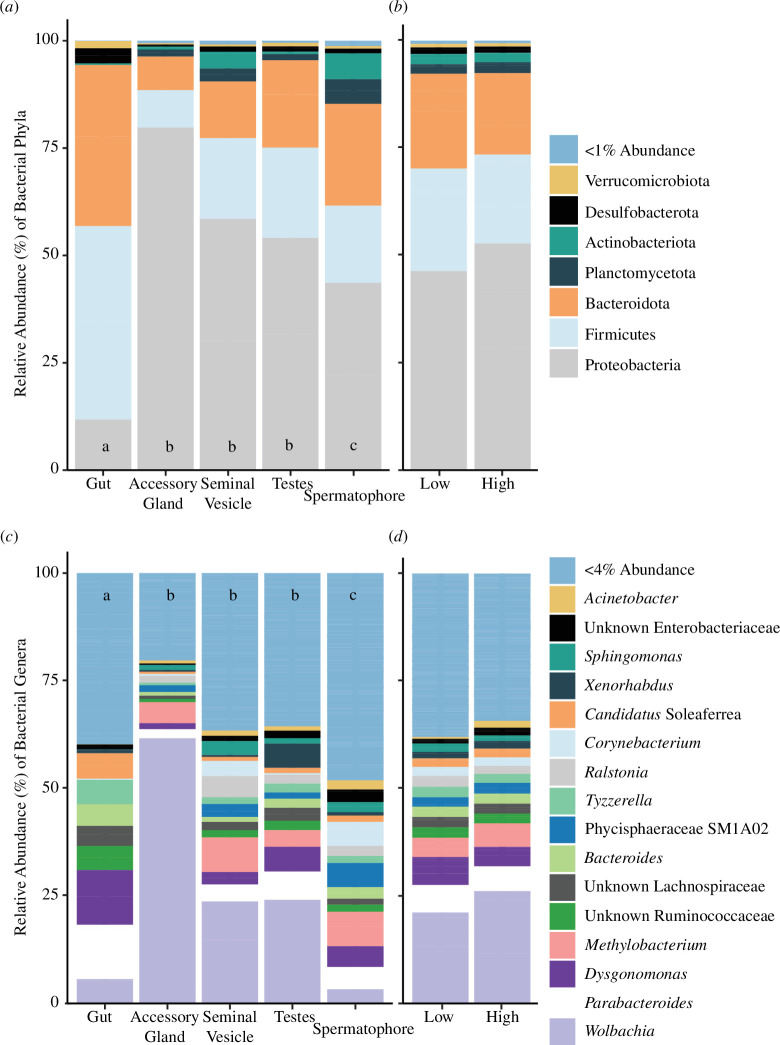
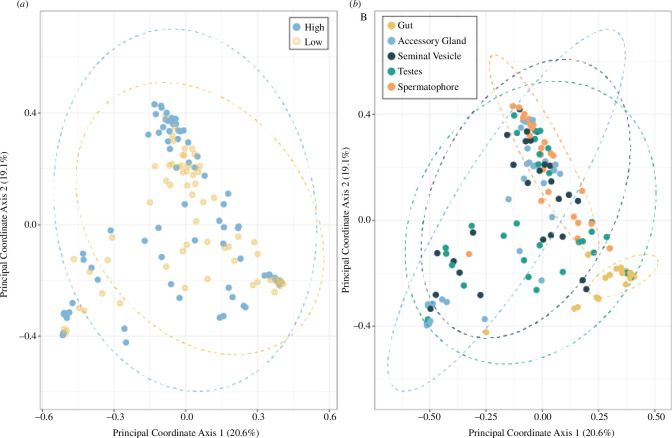
Our understanding of microbial variation in male reproductive tissues is poorly understood, both regarding how it varies spatially across different tissues and its ability to affect male sperm and semen quality. To redress this gap, we explored the relationship between male sperm viability and male gut and reproductive tract microbiomes in the Pacific field cricket, Teleogryllus oceanicus. We selected cohorts of males within our populations with the highest and lowest natural sperm viability and characterized the bacterial microbiota present in the gut, testes, seminal vesicle, accessory glands and the spermatophore (ejaculate) using 16S ribosomal RNA gene metabarcoding. We identified bacterial taxa corresponding to sperm viability, highlighting for the first time an association between the host's microbial communities and male competitive fertilization success. We also found significant spatial variation in bacterial community structure of reproductive tissue types. Our data demonstrate the importance of considering the microbial diversity of both the host gut and reproductive tract when investigating male fertility in wildlife and potentially human clinical settings.
期刊介绍:
Royal Society Open Science is a new open journal publishing high-quality original research across the entire range of science on the basis of objective peer-review.
The journal covers the entire range of science and mathematics and will allow the Society to publish all the high-quality work it receives without the usual restrictions on scope, length or impact.




 京公网安备 11010802042870号
京ICP备2023020795号-1
京公网安备 11010802042870号
京ICP备2023020795号-1

 分享
分享
 求助内容:
求助内容: 应助结果提醒方式:
 扫码关注我们
