{"title":"The anatomy lab as an early opportunity for reflection-based interprofessional education","authors":"Laura Thorp MPTPhD, Alison Doubleday PhD","doi":"10.1002/jdd.13703","DOIUrl":null,"url":null,"abstract":"<p>Educators in health professions programs seek to develop interprofessional educational (IPE) opportunities within existing curricula. Anatomy courses provide an excellent opportunity for IPE activities,<span><sup>1, 2</sup></span> because they represent a common foundational experience occurring early in training across health professions programs. Many anatomy IPE experiences bring students from different programs together highlighting shared foundational knowledge,<span><sup>3</sup></span> but do not intentionally explore how that shared knowledge may relate to future shared clinical practice.</p><p>To address this challenge, we offered an optional IPE anatomy lab experience for preclinical dental and doctor of physical therapy (DPT) students who had completed their human gross anatomy courses within the past 6 months (UIC IRB 2023-1066). Eight DPT and five dental students participated in one 2-h dissection lab (Figure 1). All students participated in dissections of the knee<span><sup>4</sup></span> and temporomandibular joints. These joints were selected to demonstrate functional and structural differences and similarities including age-related degenerative changes and to foster an appreciation for the overlapping work of physical therapists and dentists as it relates to this anatomy. Faculty determined dissection groups, pairing a least one student from each cohort together (Table 1). The session started with a reflection to facilitate discussion about the value and application of anatomy for each discipline and where overlap exists. Faculty highlighted similarities and differences in anatomy, mechanics, and degenerative changes in the respective joints. After dissecting, students completed a feedback reflection that included Likert scale and free response questions. This experience is novel in the following ways: (1) students explored the profession-specific anatomic knowledge of each cohort; (2) students reflected on what they knew about their own and the other's scope of practice; (3) students projected where overlap might exist in future clinical work; (4) the investigation of similarities and differences in the two cohorts occurred in parallel to the investigation of similarities and differences in the chosen synovial joints. Our aim was for students to learn from the experiences, perspectives, and backgrounds of other health professions students through cooperative dissection, discussion, and reflection.</p><p>Figure 2 details responses to Likert-scale questions from the feedback reflection. All Likert scale and free response questions are available in Table 2. Students referenced the opportunity to learn from and teach students in the other cohort, in addition to the ability to review anatomy and focus on the specific joints in more detail as the most valuable aspects of the experience. When asked what they learned about the other profession, students expressed an improved understanding of the depth of knowledge of their colleagues as well enhanced perspective of the scope of practice of the other profession. Students agreed that their anatomic knowledge was enhanced by the experience and that they would like to participate in additional interprofessional activities although they requested additional time for future sessions. The experience allowed both cohorts to think about their professional and interprofessional identities at an early point in their training. Based on the positive responses to this experience, we will continue offering and expand this interprofessional anatomy experience.</p>","PeriodicalId":50216,"journal":{"name":"Journal of Dental Education","volume":"89 S1","pages":"976-978"},"PeriodicalIF":1.6000,"publicationDate":"2024-09-20","publicationTypes":"Journal Article","fieldsOfStudy":null,"isOpenAccess":false,"openAccessPdf":"https://onlinelibrary.wiley.com/doi/epdf/10.1002/jdd.13703","citationCount":"0","resultStr":null,"platform":"Semanticscholar","paperid":null,"PeriodicalName":"Journal of Dental Education","FirstCategoryId":"3","ListUrlMain":"https://onlinelibrary.wiley.com/doi/10.1002/jdd.13703","RegionNum":4,"RegionCategory":"医学","ArticlePicture":[],"TitleCN":null,"AbstractTextCN":null,"PMCID":null,"EPubDate":"","PubModel":"","JCR":"Q3","JCRName":"DENTISTRY, ORAL SURGERY & MEDICINE","Score":null,"Total":0}
引用次数: 0
Abstract
Educators in health professions programs seek to develop interprofessional educational (IPE) opportunities within existing curricula. Anatomy courses provide an excellent opportunity for IPE activities,1, 2 because they represent a common foundational experience occurring early in training across health professions programs. Many anatomy IPE experiences bring students from different programs together highlighting shared foundational knowledge,3 but do not intentionally explore how that shared knowledge may relate to future shared clinical practice.
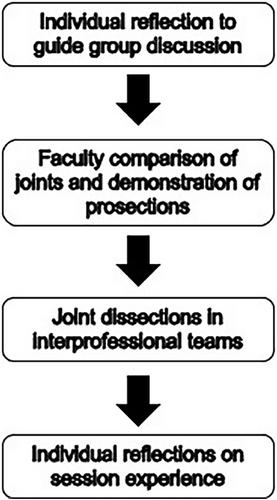
To address this challenge, we offered an optional IPE anatomy lab experience for preclinical dental and doctor of physical therapy (DPT) students who had completed their human gross anatomy courses within the past 6 months (UIC IRB 2023-1066). Eight DPT and five dental students participated in one 2-h dissection lab (Figure 1). All students participated in dissections of the knee4 and temporomandibular joints. These joints were selected to demonstrate functional and structural differences and similarities including age-related degenerative changes and to foster an appreciation for the overlapping work of physical therapists and dentists as it relates to this anatomy. Faculty determined dissection groups, pairing a least one student from each cohort together (Table 1). The session started with a reflection to facilitate discussion about the value and application of anatomy for each discipline and where overlap exists. Faculty highlighted similarities and differences in anatomy, mechanics, and degenerative changes in the respective joints. After dissecting, students completed a feedback reflection that included Likert scale and free response questions. This experience is novel in the following ways: (1) students explored the profession-specific anatomic knowledge of each cohort; (2) students reflected on what they knew about their own and the other's scope of practice; (3) students projected where overlap might exist in future clinical work; (4) the investigation of similarities and differences in the two cohorts occurred in parallel to the investigation of similarities and differences in the chosen synovial joints. Our aim was for students to learn from the experiences, perspectives, and backgrounds of other health professions students through cooperative dissection, discussion, and reflection.
Figure 2 details responses to Likert-scale questions from the feedback reflection. All Likert scale and free response questions are available in Table 2. Students referenced the opportunity to learn from and teach students in the other cohort, in addition to the ability to review anatomy and focus on the specific joints in more detail as the most valuable aspects of the experience. When asked what they learned about the other profession, students expressed an improved understanding of the depth of knowledge of their colleagues as well enhanced perspective of the scope of practice of the other profession. Students agreed that their anatomic knowledge was enhanced by the experience and that they would like to participate in additional interprofessional activities although they requested additional time for future sessions. The experience allowed both cohorts to think about their professional and interprofessional identities at an early point in their training. Based on the positive responses to this experience, we will continue offering and expand this interprofessional anatomy experience.
期刊介绍:
The Journal of Dental Education (JDE) is a peer-reviewed monthly journal that publishes a wide variety of educational and scientific research in dental, allied dental and advanced dental education. Published continuously by the American Dental Education Association since 1936 and internationally recognized as the premier journal for academic dentistry, the JDE publishes articles on such topics as curriculum reform, education research methods, innovative educational and assessment methodologies, faculty development, community-based dental education, student recruitment and admissions, professional and educational ethics, dental education around the world and systematic reviews of educational interest. The JDE is one of the top scholarly journals publishing the most important work in oral health education today; it celebrated its 80th anniversary in 2016.



 京公网安备 11010802042870号
京ICP备2023020795号-1
京公网安备 11010802042870号
京ICP备2023020795号-1

 分享
分享
 求助内容:
求助内容: 应助结果提醒方式:
 扫码关注我们
