The efficient degradation of carbamazepine by Cu-Fe bimetallic composite carbon derived from the waste cation exchange resins: Mechanism, ecotoxicity, and continuous flow catalysis
Qiang Li , Xiaofei Zong , Haochen Li , Xinyu Li , Kun Yang , Jiahui Wu , Longli Wu , Zhengyu Han , Rongling Wang , Yuxuan Ye , Fei Pan
{"title":"The efficient degradation of carbamazepine by Cu-Fe bimetallic composite carbon derived from the waste cation exchange resins: Mechanism, ecotoxicity, and continuous flow catalysis","authors":"Qiang Li , Xiaofei Zong , Haochen Li , Xinyu Li , Kun Yang , Jiahui Wu , Longli Wu , Zhengyu Han , Rongling Wang , Yuxuan Ye , Fei Pan","doi":"10.1016/j.seppur.2024.129813","DOIUrl":null,"url":null,"abstract":"<div><div>The Cu-Fe bimetallic composite carbon (CuFeO<sub>2</sub>@CR) was synthesized by using the waste cation exchange resins as the carbon source to degrade carbamazepine (CBZ) by activating peroxymonulfate (PMS). Results found that 91.3 % of CBZ was degraded under the optimal condition ([PMS] = 0.2 g/L, [CuFeO<sub>2</sub>@CR] = 0.3 g/L, T = 25℃). CuFeO<sub>2</sub>@CR could efficiently degrade CBZ at pH 3.03–9.02 and maintain the degradation at 83.6 % in the fifth cycle. The reactive oxygen species (ROS) were SO<sub>4</sub><sup>•−</sup>, •OH, and <sup>1</sup>O<sub>2</sub> with the relative contribution of 35 %, 29 %, and 36 %, respectively. DFT calculation demonstrated that CuFeO<sub>2</sub>@CR exhibited a preferential affinity for PMS and greater transfer electrons capacity than CR. Three reaction pathways were proposed in the CuFeO<sub>2</sub>@CR/PMS system, and the degradation could effectively reduce the toxicity into non-toxic. The continuous flow catalytic experiment indicated the promising application in the treatment of antibiotic wastewater. This work provides guidance and theoretical support for CBZ degradation mechanisms.</div></div>","PeriodicalId":427,"journal":{"name":"Separation and Purification Technology","volume":"356 ","pages":"Article 129813"},"PeriodicalIF":9.1000,"publicationDate":"2025-04-01","publicationTypes":"Journal Article","fieldsOfStudy":null,"isOpenAccess":false,"openAccessPdf":"","citationCount":"0","resultStr":null,"platform":"Semanticscholar","paperid":null,"PeriodicalName":"Separation and Purification Technology","FirstCategoryId":"5","ListUrlMain":"https://www.sciencedirect.com/science/article/pii/S1383586624035524","RegionNum":1,"RegionCategory":"工程技术","ArticlePicture":[],"TitleCN":null,"AbstractTextCN":null,"PMCID":null,"EPubDate":"2024/9/20 0:00:00","PubModel":"Epub","JCR":"Q1","JCRName":"ENGINEERING, CHEMICAL","Score":null,"Total":0}
引用次数: 0
Abstract
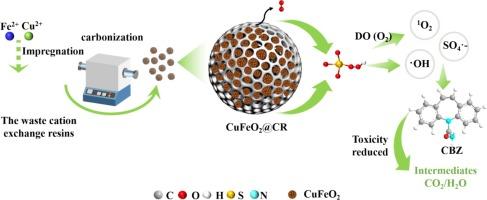
The Cu-Fe bimetallic composite carbon (CuFeO2@CR) was synthesized by using the waste cation exchange resins as the carbon source to degrade carbamazepine (CBZ) by activating peroxymonulfate (PMS). Results found that 91.3 % of CBZ was degraded under the optimal condition ([PMS] = 0.2 g/L, [CuFeO2@CR] = 0.3 g/L, T = 25℃). CuFeO2@CR could efficiently degrade CBZ at pH 3.03–9.02 and maintain the degradation at 83.6 % in the fifth cycle. The reactive oxygen species (ROS) were SO4•−, •OH, and 1O2 with the relative contribution of 35 %, 29 %, and 36 %, respectively. DFT calculation demonstrated that CuFeO2@CR exhibited a preferential affinity for PMS and greater transfer electrons capacity than CR. Three reaction pathways were proposed in the CuFeO2@CR/PMS system, and the degradation could effectively reduce the toxicity into non-toxic. The continuous flow catalytic experiment indicated the promising application in the treatment of antibiotic wastewater. This work provides guidance and theoretical support for CBZ degradation mechanisms.
期刊介绍:
Separation and Purification Technology is a premier journal committed to sharing innovative methods for separation and purification in chemical and environmental engineering, encompassing both homogeneous solutions and heterogeneous mixtures. Our scope includes the separation and/or purification of liquids, vapors, and gases, as well as carbon capture and separation techniques. However, it's important to note that methods solely intended for analytical purposes are not within the scope of the journal. Additionally, disciplines such as soil science, polymer science, and metallurgy fall outside the purview of Separation and Purification Technology. Join us in advancing the field of separation and purification methods for sustainable solutions in chemical and environmental engineering.




 京公网安备 11010802042870号
京ICP备2023020795号-1
京公网安备 11010802042870号
京ICP备2023020795号-1

 分享
分享
 求助内容:
求助内容: 应助结果提醒方式:
 扫码关注我们
