Wenlei Li, Huixin Jin, Hongyan Xie, Meilong Wang, Xue Wang
{"title":"Electrolytic manganese residue and red mud co-treatment: Synthesizing zeolite X and adsorbing leaching solution from electrolytic manganese residue","authors":"Wenlei Li, Huixin Jin, Hongyan Xie, Meilong Wang, Xue Wang","doi":"10.1016/j.seppur.2024.129795","DOIUrl":null,"url":null,"abstract":"<div><div>Electrolytic manganese residue (EMR) and red mud (RM) are solid wastes from electrolytic metallic manganese and alumina production. These wastes continue to accumulate, causing significant environmental damage and resource waste. To solve these problems, porous zeolite X (ERZ) was synthesized with EMR and RM as the main raw materials. ERZ was then employed to adsorb the leaching solution generated during EMR purification. Also, an investigation was carried out to ascertain the most favorable parameters for the synthesis of zeolite, and the resulting ERZ was characterized. The results indicated that the synthesized ERZ exhibits excellent crystallinity, high thermal stability, and a large specific surface area. Next, solid-state NMR (SSNMR), XRD, and Raman spectroscopy were used to characterize the ERZ synthesis process: the structural units of X zeolite are β cages and 4Rs. Additionally, the study examined the adsorption impact of ERZ on impurity ions in the leaching solution, revealing that the adsorption mechanism is chemisorption. Furthermore, the effective regeneration of ERZ demonstrated its significant practical utility. To summarize, this study presents a new feasible way for effectively utilizing EMR and BA.</div></div>","PeriodicalId":427,"journal":{"name":"Separation and Purification Technology","volume":"356 ","pages":"Article 129795"},"PeriodicalIF":9.0000,"publicationDate":"2024-09-21","publicationTypes":"Journal Article","fieldsOfStudy":null,"isOpenAccess":false,"openAccessPdf":"","citationCount":"0","resultStr":null,"platform":"Semanticscholar","paperid":null,"PeriodicalName":"Separation and Purification Technology","FirstCategoryId":"5","ListUrlMain":"https://www.sciencedirect.com/science/article/pii/S1383586624035342","RegionNum":1,"RegionCategory":"工程技术","ArticlePicture":[],"TitleCN":null,"AbstractTextCN":null,"PMCID":null,"EPubDate":"","PubModel":"","JCR":"Q1","JCRName":"ENGINEERING, CHEMICAL","Score":null,"Total":0}
引用次数: 0
Abstract
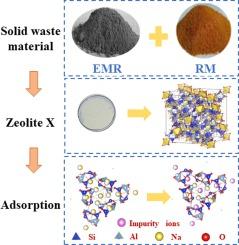
Electrolytic manganese residue (EMR) and red mud (RM) are solid wastes from electrolytic metallic manganese and alumina production. These wastes continue to accumulate, causing significant environmental damage and resource waste. To solve these problems, porous zeolite X (ERZ) was synthesized with EMR and RM as the main raw materials. ERZ was then employed to adsorb the leaching solution generated during EMR purification. Also, an investigation was carried out to ascertain the most favorable parameters for the synthesis of zeolite, and the resulting ERZ was characterized. The results indicated that the synthesized ERZ exhibits excellent crystallinity, high thermal stability, and a large specific surface area. Next, solid-state NMR (SSNMR), XRD, and Raman spectroscopy were used to characterize the ERZ synthesis process: the structural units of X zeolite are β cages and 4Rs. Additionally, the study examined the adsorption impact of ERZ on impurity ions in the leaching solution, revealing that the adsorption mechanism is chemisorption. Furthermore, the effective regeneration of ERZ demonstrated its significant practical utility. To summarize, this study presents a new feasible way for effectively utilizing EMR and BA.
期刊介绍:
Separation and Purification Technology is a premier journal committed to sharing innovative methods for separation and purification in chemical and environmental engineering, encompassing both homogeneous solutions and heterogeneous mixtures. Our scope includes the separation and/or purification of liquids, vapors, and gases, as well as carbon capture and separation techniques. However, it's important to note that methods solely intended for analytical purposes are not within the scope of the journal. Additionally, disciplines such as soil science, polymer science, and metallurgy fall outside the purview of Separation and Purification Technology. Join us in advancing the field of separation and purification methods for sustainable solutions in chemical and environmental engineering.



 京公网安备 11010802042870号
京ICP备2023020795号-1
京公网安备 11010802042870号
京ICP备2023020795号-1

 分享
分享
 求助内容:
求助内容: 应助结果提醒方式:
 扫码关注我们
