Kaiwen Ma , Jian Sun , Rongyue Sun , Chuanwen Zhao
{"title":"Aluminum-enhanced Ca-based CO2 sorbents: Core-shell assembly and the impact of stabilizer precursors","authors":"Kaiwen Ma , Jian Sun , Rongyue Sun , Chuanwen Zhao","doi":"10.1016/j.seppur.2024.129822","DOIUrl":null,"url":null,"abstract":"<div><div>Lately, Ca-based sorbents with a core–shell structure have been effectively produced to augment the sorbent’s capabilities. However, modifying the pristine core of Ca-based pellets with a core–shell structure notably influences the performance of the synthesized sorbent, and research in this domain remains scarce. Here, two categories of Al-stabilized, Ca-based pristine cores were produced using Ca(OH)<sub>2</sub> mixed with Al-based stabilizer precursors of insoluble aluminum oxide and soluble aluminum nitrate, respectively, through the extrusion-spheronization technique. Due to the impact of mechanical extrusion, soluble aluminum nitrate can accumulate in-homogeneously in the Ca-based pristine core, leading to its expansion and rupture during the high-temperature calcination stage because of the decomposition of aluminum nitrate. The oxide-form aluminum stabilizer precursor can be uniformly distributed throughout the Ca-based pristine core pellets, demonstrating notably superior cyclic CO<sub>2</sub> sorption capability and mechanical strength. The Al-fortified, core–shell structured Ca-based sorbent pellets demonstrated a peak CaO carbonation conversion rate of 54.8 % after 100 cycles when the Ca:Al molar ratio was precisely set to 85:15, which is about 2.1 times higher compared to the core–shell Ca-based sorbent pellets composed of a pure CaO core. This is primarily due to the formation of an evenly distributed inert Ca<sub>12</sub>Al<sub>14</sub>O<sub>33</sub> within the pristine core, which effectively reduces high-temperature sintering. Hence, core–shell Ca-based sorbent pellet assembled with an Al-stabilized pristine core, could be a promising candidate for application in the CaL process for CO<sub>2</sub> capture.</div></div>","PeriodicalId":427,"journal":{"name":"Separation and Purification Technology","volume":"356 ","pages":"Article 129822"},"PeriodicalIF":9.0000,"publicationDate":"2025-04-01","publicationTypes":"Journal Article","fieldsOfStudy":null,"isOpenAccess":false,"openAccessPdf":"","citationCount":"0","resultStr":null,"platform":"Semanticscholar","paperid":null,"PeriodicalName":"Separation and Purification Technology","FirstCategoryId":"5","ListUrlMain":"https://www.sciencedirect.com/science/article/pii/S1383586624035615","RegionNum":1,"RegionCategory":"工程技术","ArticlePicture":[],"TitleCN":null,"AbstractTextCN":null,"PMCID":null,"EPubDate":"2024/9/21 0:00:00","PubModel":"Epub","JCR":"Q1","JCRName":"ENGINEERING, CHEMICAL","Score":null,"Total":0}
引用次数: 0
Abstract
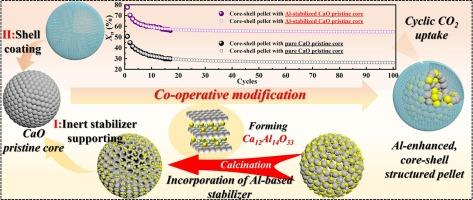
Lately, Ca-based sorbents with a core–shell structure have been effectively produced to augment the sorbent’s capabilities. However, modifying the pristine core of Ca-based pellets with a core–shell structure notably influences the performance of the synthesized sorbent, and research in this domain remains scarce. Here, two categories of Al-stabilized, Ca-based pristine cores were produced using Ca(OH)2 mixed with Al-based stabilizer precursors of insoluble aluminum oxide and soluble aluminum nitrate, respectively, through the extrusion-spheronization technique. Due to the impact of mechanical extrusion, soluble aluminum nitrate can accumulate in-homogeneously in the Ca-based pristine core, leading to its expansion and rupture during the high-temperature calcination stage because of the decomposition of aluminum nitrate. The oxide-form aluminum stabilizer precursor can be uniformly distributed throughout the Ca-based pristine core pellets, demonstrating notably superior cyclic CO2 sorption capability and mechanical strength. The Al-fortified, core–shell structured Ca-based sorbent pellets demonstrated a peak CaO carbonation conversion rate of 54.8 % after 100 cycles when the Ca:Al molar ratio was precisely set to 85:15, which is about 2.1 times higher compared to the core–shell Ca-based sorbent pellets composed of a pure CaO core. This is primarily due to the formation of an evenly distributed inert Ca12Al14O33 within the pristine core, which effectively reduces high-temperature sintering. Hence, core–shell Ca-based sorbent pellet assembled with an Al-stabilized pristine core, could be a promising candidate for application in the CaL process for CO2 capture.
最近,具有核壳结构的钙基吸附剂被有效地生产出来,以增强吸附剂的能力。然而,对具有核壳结构的钙基颗粒的原始内核进行改性会显著影响合成吸附剂的性能,而这方面的研究仍然很少。在此,我们使用 Ca(OH)2 与铝基稳定剂前体(不溶性氧化铝和可溶性硝酸铝)混合,通过挤压-球化技术分别制备了两类铝基稳定的钙基原始内核。由于机械挤压的影响,可溶性硝酸铝会均匀地积聚在钙基原始内核中,导致其在高温煅烧阶段因硝酸铝的分解而膨胀破裂。氧化物形式的铝稳定剂前驱体可以均匀地分布在整个钙基原始芯块中,显示出明显优越的循环二氧化碳吸附能力和机械强度。当 Ca:Al 摩尔比精确设定为 85:15 时,经过 Al 强化的核壳结构 Ca 基吸附剂颗粒在 100 次循环后的 CaO 碳化转化率峰值为 54.8%,与由纯 CaO 核心组成的核壳结构 Ca 基吸附剂颗粒相比,高出约 2.1 倍。这主要是由于在原始内核中形成了均匀分布的惰性 Ca12Al14O33,从而有效地减少了高温烧结。因此,用铝稳定的原始内核组装的核壳钙基吸附剂球团有可能成为钙捕集工艺中用于捕集二氧化碳的理想候选材料。
期刊介绍:
Separation and Purification Technology is a premier journal committed to sharing innovative methods for separation and purification in chemical and environmental engineering, encompassing both homogeneous solutions and heterogeneous mixtures. Our scope includes the separation and/or purification of liquids, vapors, and gases, as well as carbon capture and separation techniques. However, it's important to note that methods solely intended for analytical purposes are not within the scope of the journal. Additionally, disciplines such as soil science, polymer science, and metallurgy fall outside the purview of Separation and Purification Technology. Join us in advancing the field of separation and purification methods for sustainable solutions in chemical and environmental engineering.



 京公网安备 11010802042870号
京ICP备2023020795号-1
京公网安备 11010802042870号
京ICP备2023020795号-1

 分享
分享
 求助内容:
求助内容: 应助结果提醒方式:
 扫码关注我们
