Gabriel Laquete De Barros , Arda Tuhanioglu , Sumanjot Kaur , Leonardo Nora , Ali Ubeyitogullari
{"title":"Extraction of anthocyanins from purple sweet potato using supercritical carbon dioxide and conventional approaches","authors":"Gabriel Laquete De Barros , Arda Tuhanioglu , Sumanjot Kaur , Leonardo Nora , Ali Ubeyitogullari","doi":"10.1016/j.afres.2024.100505","DOIUrl":null,"url":null,"abstract":"<div><div>This research investigates the potential of supercritical carbon dioxide (SC<img>CO<sub>2</sub>) technology as a green and sustainable approach to improve anthocyanin extraction from purple sweet potatoes (PSP). The study explored different extraction parameters (i.e., temperatures of 35–55 °C, cosolvent concentrations of 10–30 % (w/w), ethanol ratios of 30–70 % (v/v), pressures of 30–40 MPa, extraction times of 120–180 min, and solvent: sample ratios of 25:1–45:1(v/w)), to optimize the total phenolic content (TPC), anthocyanin content (ANC), and antioxidant activity (AA). Additionally, conventional extraction methods using different solvent (ethanol and methanol) mixtures, solvent: sample ratios (15:1; 45:1; 6:1 (v/w)), temperatures (35–50 °C), and extraction times (50–60 min) were performed for the extraction of phenolic compounds from PSP. The highest TPC (340 mg GAE/g dry PSP), ANC (136 mg C3G/100 g dry PSP), and AA (ABTS (7.3 mg TEV/g dry PSP), DPPH (18.2 mg TEV/g dry PSP), and FRAP (1399 mg GAE/100 g)) were achieved with 30 MPa, 35 °C and 20 % cosolvent concentration operated for 180 min. These findings underscore the use of SC<img>CO<sub>2</sub> extraction to obtain anthocyanin extracts that can potentially be used as a coloring agent in the food industry. The proposed SC<img>CO<sub>2</sub> extraction method provides an eco-friendly alternative to conventional methods for extracting phenolic compounds.</div></div>","PeriodicalId":8168,"journal":{"name":"Applied Food Research","volume":"4 2","pages":"Article 100505"},"PeriodicalIF":0.0000,"publicationDate":"2024-09-12","publicationTypes":"Journal Article","fieldsOfStudy":null,"isOpenAccess":false,"openAccessPdf":"https://www.sciencedirect.com/science/article/pii/S277250222400115X/pdfft?md5=045ef73078762b6b993a44af847aff21&pid=1-s2.0-S277250222400115X-main.pdf","citationCount":"0","resultStr":null,"platform":"Semanticscholar","paperid":null,"PeriodicalName":"Applied Food Research","FirstCategoryId":"1085","ListUrlMain":"https://www.sciencedirect.com/science/article/pii/S277250222400115X","RegionNum":0,"RegionCategory":null,"ArticlePicture":[],"TitleCN":null,"AbstractTextCN":null,"PMCID":null,"EPubDate":"","PubModel":"","JCR":"","JCRName":"","Score":null,"Total":0}
引用次数: 0
Abstract
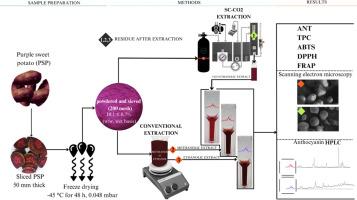
This research investigates the potential of supercritical carbon dioxide (SCCO2) technology as a green and sustainable approach to improve anthocyanin extraction from purple sweet potatoes (PSP). The study explored different extraction parameters (i.e., temperatures of 35–55 °C, cosolvent concentrations of 10–30 % (w/w), ethanol ratios of 30–70 % (v/v), pressures of 30–40 MPa, extraction times of 120–180 min, and solvent: sample ratios of 25:1–45:1(v/w)), to optimize the total phenolic content (TPC), anthocyanin content (ANC), and antioxidant activity (AA). Additionally, conventional extraction methods using different solvent (ethanol and methanol) mixtures, solvent: sample ratios (15:1; 45:1; 6:1 (v/w)), temperatures (35–50 °C), and extraction times (50–60 min) were performed for the extraction of phenolic compounds from PSP. The highest TPC (340 mg GAE/g dry PSP), ANC (136 mg C3G/100 g dry PSP), and AA (ABTS (7.3 mg TEV/g dry PSP), DPPH (18.2 mg TEV/g dry PSP), and FRAP (1399 mg GAE/100 g)) were achieved with 30 MPa, 35 °C and 20 % cosolvent concentration operated for 180 min. These findings underscore the use of SCCO2 extraction to obtain anthocyanin extracts that can potentially be used as a coloring agent in the food industry. The proposed SCCO2 extraction method provides an eco-friendly alternative to conventional methods for extracting phenolic compounds.



 京公网安备 11010802042870号
京ICP备2023020795号-1
京公网安备 11010802042870号
京ICP备2023020795号-1

 分享
分享

 求助内容:
求助内容: 应助结果提醒方式:
 扫码关注我们
