{"title":"Segmented Dynamic Adaptive Look-Ahead Smoothing Feedrate Scheduling With Joint Jerk Constraints of 6R Robot Manipulators","authors":"Yan Xu;Yaqiu Liu;Xun Liu;Jiabin Cao;Lin Zhang","doi":"10.1109/TASE.2024.3458984","DOIUrl":null,"url":null,"abstract":"With the continuous development of robotic technology, there is an increasing demand for efficient, smooth, and precise trajectory planning and interpolation. For the robot manipulators with 6 rotational (6R) joints, smooth task paths are crucial for high-quality task and precise dynamic trajectory tracking. However, nonlinear mapping between joint and cartesian space complicates feedrate scheduling under joint constraints. Existing methods, like S-shape feedrate profiles or time-optimal approaches, are inefficient or compromise trajectory stability. This paper proposes a segment-based dynamically adaptive smooth look-ahead feedrate scheduling method based on local dynamic window and a Maximum Velocity Curve (MVC) for 6R robot manipulators. It balances the efficiency and stability of motion execution while considering spline trajectory and joint constraints. Five types of segmented velocities under the local dynamic window are identified, with adaptive smoothing strategies developed. Feedrate remains constant within segments and transitions smoothly between them, enhancing trajectory quality. The results of the smoothing preprocessing can be directly used for feedrate profile generation, ensuring smooth, non-oscillating motion while meeting performance and constraint requirements, which is better suited for real-time interpolation. Simulation and experimentation confirm the proposed method’s effectiveness. Note to Practitioners—The motivation of this article stems from the need to develop a feedrate scheduling method with joint jerk constraints of 6R robot manipulators for practical tasks like polishing, engraving, welding, and spraying. 6R robots, due to their nonlinear coupling kinematics, often fail to meet joint constraints. Existing methods, inefficient or requiring frequent changes in joint acceleration/jerk for time optimality, adversely affect task quality. To balance smoothness and operational efficiency for 6R robot tasks, we propose the segmented dynamic adaptive look-ahead smoothing feedrate scheduling with joint jerk constraints of 6R robot manipulators, ensuring trajectory execution within joint limits and balancing smoothness and operational efficiency, which is better suited for real-time interpolation. This method can be of great interest to readers working on precision manufacturing and robotics feedrate profile generation method.","PeriodicalId":51060,"journal":{"name":"IEEE Transactions on Automation Science and Engineering","volume":"22 ","pages":"7033-7051"},"PeriodicalIF":6.4000,"publicationDate":"2024-09-24","publicationTypes":"Journal Article","fieldsOfStudy":null,"isOpenAccess":false,"openAccessPdf":"","citationCount":"0","resultStr":null,"platform":"Semanticscholar","paperid":null,"PeriodicalName":"IEEE Transactions on Automation Science and Engineering","FirstCategoryId":"94","ListUrlMain":"https://ieeexplore.ieee.org/document/10691920/","RegionNum":2,"RegionCategory":"计算机科学","ArticlePicture":[],"TitleCN":null,"AbstractTextCN":null,"PMCID":null,"EPubDate":"","PubModel":"","JCR":"Q1","JCRName":"AUTOMATION & CONTROL SYSTEMS","Score":null,"Total":0}
引用次数: 0
Abstract
With the continuous development of robotic technology, there is an increasing demand for efficient, smooth, and precise trajectory planning and interpolation. For the robot manipulators with 6 rotational (6R) joints, smooth task paths are crucial for high-quality task and precise dynamic trajectory tracking. However, nonlinear mapping between joint and cartesian space complicates feedrate scheduling under joint constraints. Existing methods, like S-shape feedrate profiles or time-optimal approaches, are inefficient or compromise trajectory stability. This paper proposes a segment-based dynamically adaptive smooth look-ahead feedrate scheduling method based on local dynamic window and a Maximum Velocity Curve (MVC) for 6R robot manipulators. It balances the efficiency and stability of motion execution while considering spline trajectory and joint constraints. Five types of segmented velocities under the local dynamic window are identified, with adaptive smoothing strategies developed. Feedrate remains constant within segments and transitions smoothly between them, enhancing trajectory quality. The results of the smoothing preprocessing can be directly used for feedrate profile generation, ensuring smooth, non-oscillating motion while meeting performance and constraint requirements, which is better suited for real-time interpolation. Simulation and experimentation confirm the proposed method’s effectiveness. Note to Practitioners—The motivation of this article stems from the need to develop a feedrate scheduling method with joint jerk constraints of 6R robot manipulators for practical tasks like polishing, engraving, welding, and spraying. 6R robots, due to their nonlinear coupling kinematics, often fail to meet joint constraints. Existing methods, inefficient or requiring frequent changes in joint acceleration/jerk for time optimality, adversely affect task quality. To balance smoothness and operational efficiency for 6R robot tasks, we propose the segmented dynamic adaptive look-ahead smoothing feedrate scheduling with joint jerk constraints of 6R robot manipulators, ensuring trajectory execution within joint limits and balancing smoothness and operational efficiency, which is better suited for real-time interpolation. This method can be of great interest to readers working on precision manufacturing and robotics feedrate profile generation method.
期刊介绍:
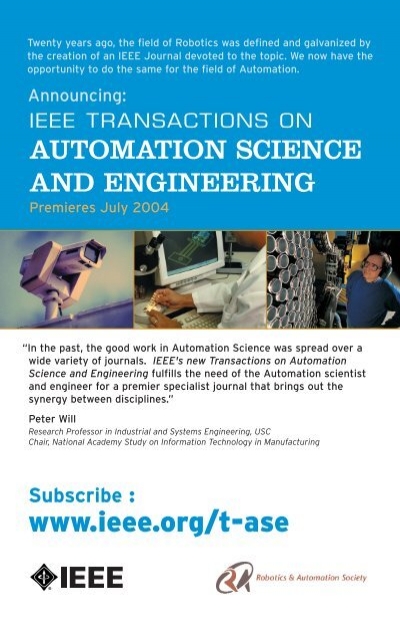
The IEEE Transactions on Automation Science and Engineering (T-ASE) publishes fundamental papers on Automation, emphasizing scientific results that advance efficiency, quality, productivity, and reliability. T-ASE encourages interdisciplinary approaches from computer science, control systems, electrical engineering, mathematics, mechanical engineering, operations research, and other fields. T-ASE welcomes results relevant to industries such as agriculture, biotechnology, healthcare, home automation, maintenance, manufacturing, pharmaceuticals, retail, security, service, supply chains, and transportation. T-ASE addresses a research community willing to integrate knowledge across disciplines and industries. For this purpose, each paper includes a Note to Practitioners that summarizes how its results can be applied or how they might be extended to apply in practice.



 京公网安备 11010802042870号
京ICP备2023020795号-1
京公网安备 11010802042870号
京ICP备2023020795号-1

 分享
分享
 求助内容:
求助内容: 应助结果提醒方式:
 扫码关注我们
