Chunliang Zhao , Xinyu Li , Guannan Liu , Xianze Wang
{"title":"Selective adsorption of trace CO2 by immobilized amino acid ionic liquids with ultra-micropores based on amino MOFs","authors":"Chunliang Zhao , Xinyu Li , Guannan Liu , Xianze Wang","doi":"10.1016/j.seppur.2024.129742","DOIUrl":null,"url":null,"abstract":"<div><div>Great attention has been paid to effectively capture trace CO<sub>2</sub> in air or a confined space for ensuring human safety, but it remains challenging to enhance CO<sub>2</sub> capacity and selectivity concurrently. In this study, metal–organic frameworks (MOFs) were combined with amino groups (NH<sub>2</sub>-MIL-125(Ti) and NH<sub>2</sub>-UIO-66(Zr)) and amino acid anion-functionalized ionic liquids (ILs), namely 1-Butyl-3-methylimidazolium glycinate ([BMIm]Gly) and 1-Butyl-3-methylimidazolium arginine ([BMIm]Arg) to prepare various ionic liquid (IL) composites containing various IL contents. Relative to pristine supports, incorporating ILs significantly enhanced CO<sub>2</sub> capacity together with CO<sub>2</sub>/N<sub>2</sub> selectivity, in particular in the confined spaces (<5000 ppm) or in air (415 ppm). At a 50 wt% IL loading, new ultra-micropores (<0.65 nm) could be obtained in IL-NH<sub>2</sub>-UIO-66(Zr) composite, but they did not occur within pristine supports or the rest IL-NH<sub>2</sub>-UIO-66(Zr) (10 wt%, 30 wt% and 70 wt%). Among them, CO<sub>2</sub> uptake of 50 wt% [BMIm]Arg-NH<sub>2</sub>-UIO-66(Zr) peak at 0.0005 and 0.005 bar (2.93 and 3.87 mmolCO<sub>2</sub>/g-adsorbent, respectively) at 313 K; besides, recyclability significantly increased compared with the latest values reported. Additionally, the excellent optimal CO<sub>2</sub>/N<sub>2</sub> selectivity was determined to be 8916 at 0.005 bar and 288 K, which increased by 254.7 folds relative to NH<sub>2</sub>-UIO-66(Zr). In the meantime, as revealed by mixed gas breakthrough experimental results, 50 wt% [BMIm]Arg-NH<sub>2</sub>-UIO-66(Zr) showed superb CO<sub>2</sub> separation effect in air and simulated confined spaces. Such ultra-high CO<sub>2</sub> separation efficacy is associated with the synergistic effect of chemical interaction of IL anion with amino groups in MOFs and CO<sub>2</sub> and the novel ultra-micropore effect. Findings in the present work shed more lights on designing hierarchically porous IL composites that possess ultra-micropores to efficiently remove trace CO<sub>2</sub>.</div></div>","PeriodicalId":427,"journal":{"name":"Separation and Purification Technology","volume":"356 ","pages":"Article 129742"},"PeriodicalIF":9.0000,"publicationDate":"2025-04-01","publicationTypes":"Journal Article","fieldsOfStudy":null,"isOpenAccess":false,"openAccessPdf":"","citationCount":"0","resultStr":null,"platform":"Semanticscholar","paperid":null,"PeriodicalName":"Separation and Purification Technology","FirstCategoryId":"5","ListUrlMain":"https://www.sciencedirect.com/science/article/pii/S1383586624034816","RegionNum":1,"RegionCategory":"工程技术","ArticlePicture":[],"TitleCN":null,"AbstractTextCN":null,"PMCID":null,"EPubDate":"2024/9/21 0:00:00","PubModel":"Epub","JCR":"Q1","JCRName":"ENGINEERING, CHEMICAL","Score":null,"Total":0}
引用次数: 0
Abstract
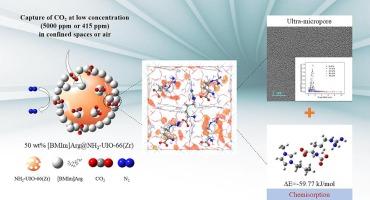
Great attention has been paid to effectively capture trace CO2 in air or a confined space for ensuring human safety, but it remains challenging to enhance CO2 capacity and selectivity concurrently. In this study, metal–organic frameworks (MOFs) were combined with amino groups (NH2-MIL-125(Ti) and NH2-UIO-66(Zr)) and amino acid anion-functionalized ionic liquids (ILs), namely 1-Butyl-3-methylimidazolium glycinate ([BMIm]Gly) and 1-Butyl-3-methylimidazolium arginine ([BMIm]Arg) to prepare various ionic liquid (IL) composites containing various IL contents. Relative to pristine supports, incorporating ILs significantly enhanced CO2 capacity together with CO2/N2 selectivity, in particular in the confined spaces (<5000 ppm) or in air (415 ppm). At a 50 wt% IL loading, new ultra-micropores (<0.65 nm) could be obtained in IL-NH2-UIO-66(Zr) composite, but they did not occur within pristine supports or the rest IL-NH2-UIO-66(Zr) (10 wt%, 30 wt% and 70 wt%). Among them, CO2 uptake of 50 wt% [BMIm]Arg-NH2-UIO-66(Zr) peak at 0.0005 and 0.005 bar (2.93 and 3.87 mmolCO2/g-adsorbent, respectively) at 313 K; besides, recyclability significantly increased compared with the latest values reported. Additionally, the excellent optimal CO2/N2 selectivity was determined to be 8916 at 0.005 bar and 288 K, which increased by 254.7 folds relative to NH2-UIO-66(Zr). In the meantime, as revealed by mixed gas breakthrough experimental results, 50 wt% [BMIm]Arg-NH2-UIO-66(Zr) showed superb CO2 separation effect in air and simulated confined spaces. Such ultra-high CO2 separation efficacy is associated with the synergistic effect of chemical interaction of IL anion with amino groups in MOFs and CO2 and the novel ultra-micropore effect. Findings in the present work shed more lights on designing hierarchically porous IL composites that possess ultra-micropores to efficiently remove trace CO2.
期刊介绍:
Separation and Purification Technology is a premier journal committed to sharing innovative methods for separation and purification in chemical and environmental engineering, encompassing both homogeneous solutions and heterogeneous mixtures. Our scope includes the separation and/or purification of liquids, vapors, and gases, as well as carbon capture and separation techniques. However, it's important to note that methods solely intended for analytical purposes are not within the scope of the journal. Additionally, disciplines such as soil science, polymer science, and metallurgy fall outside the purview of Separation and Purification Technology. Join us in advancing the field of separation and purification methods for sustainable solutions in chemical and environmental engineering.




 京公网安备 11010802042870号
京ICP备2023020795号-1
京公网安备 11010802042870号
京ICP备2023020795号-1

 分享
分享
 求助内容:
求助内容: 应助结果提醒方式:
 扫码关注我们
