Nian Zhang, Dinesh Dhumal, Shanny Hsuan Kuo, Shi Qian Lew, Pankaj D. Patil, Raleb Taher, Sanika Vaidya, Christina Galanakou, Abdechakour Elkihel, Myung Whan Oh, Sook Yin Chong, Domenico Marson, Jun Zheng, Oleg Rouvinski, Williams O. Abolarin, Sabrina Pricl, Gee W. Lau, Leo Tsz On Lee, Ling Peng
{"title":"Targeting the phosphatidylglycerol lipid: An amphiphilic dendrimer as a promising antibacterial candidate","authors":"Nian Zhang, Dinesh Dhumal, Shanny Hsuan Kuo, Shi Qian Lew, Pankaj D. Patil, Raleb Taher, Sanika Vaidya, Christina Galanakou, Abdechakour Elkihel, Myung Whan Oh, Sook Yin Chong, Domenico Marson, Jun Zheng, Oleg Rouvinski, Williams O. Abolarin, Sabrina Pricl, Gee W. Lau, Leo Tsz On Lee, Ling Peng","doi":"10.1126/sciadv.adn8117","DOIUrl":null,"url":null,"abstract":"<div >The rapid emergence and spread of multidrug-resistant bacterial pathogens require the development of antibacterial agents that are robustly effective while inducing no toxicity or resistance development. In this context, we designed and synthesized amphiphilic dendrimers as antibacterial candidates. We report the promising potent antibacterial activity shown by the amphiphilic dendrimer <b>AD1b</b>, composed of a long hydrophobic alkyl chain and a tertiary amine-terminated poly(amidoamine) dendron, against a panel of Gram-negative bacteria, including multidrug-resistant <i>Escherichia coli</i> and <i>Acinetobacter baumannii.</i> <b>AD1b</b> exhibited effective activity against drug-resistant bacterial infections in vivo. Mechanistic studies revealed that <b>AD1b</b> targeted the membrane phospholipids phosphatidylglycerol (PG) and cardiolipin (CL), leading to the disruption of the bacterial membrane and proton motive force, metabolic disturbance, leakage of cellular components, and, ultimately, cell death. Together, <b>AD1b</b> that specifically interacts with PG/CL in bacterial membranes supports the use of small amphiphilic dendrimers as a promising strategy to target drug-resistant bacterial pathogens and addresses the global antibiotic crisis.</div>","PeriodicalId":21609,"journal":{"name":"Science Advances","volume":"10 39","pages":""},"PeriodicalIF":12.5000,"publicationDate":"2024-09-25","publicationTypes":"Journal Article","fieldsOfStudy":null,"isOpenAccess":false,"openAccessPdf":"https://www.science.org/doi/reader/10.1126/sciadv.adn8117","citationCount":"0","resultStr":null,"platform":"Semanticscholar","paperid":null,"PeriodicalName":"Science Advances","FirstCategoryId":"103","ListUrlMain":"https://www.science.org/doi/10.1126/sciadv.adn8117","RegionNum":1,"RegionCategory":"综合性期刊","ArticlePicture":[],"TitleCN":null,"AbstractTextCN":null,"PMCID":null,"EPubDate":"","PubModel":"","JCR":"Q1","JCRName":"MULTIDISCIPLINARY SCIENCES","Score":null,"Total":0}
引用次数: 0
Abstract
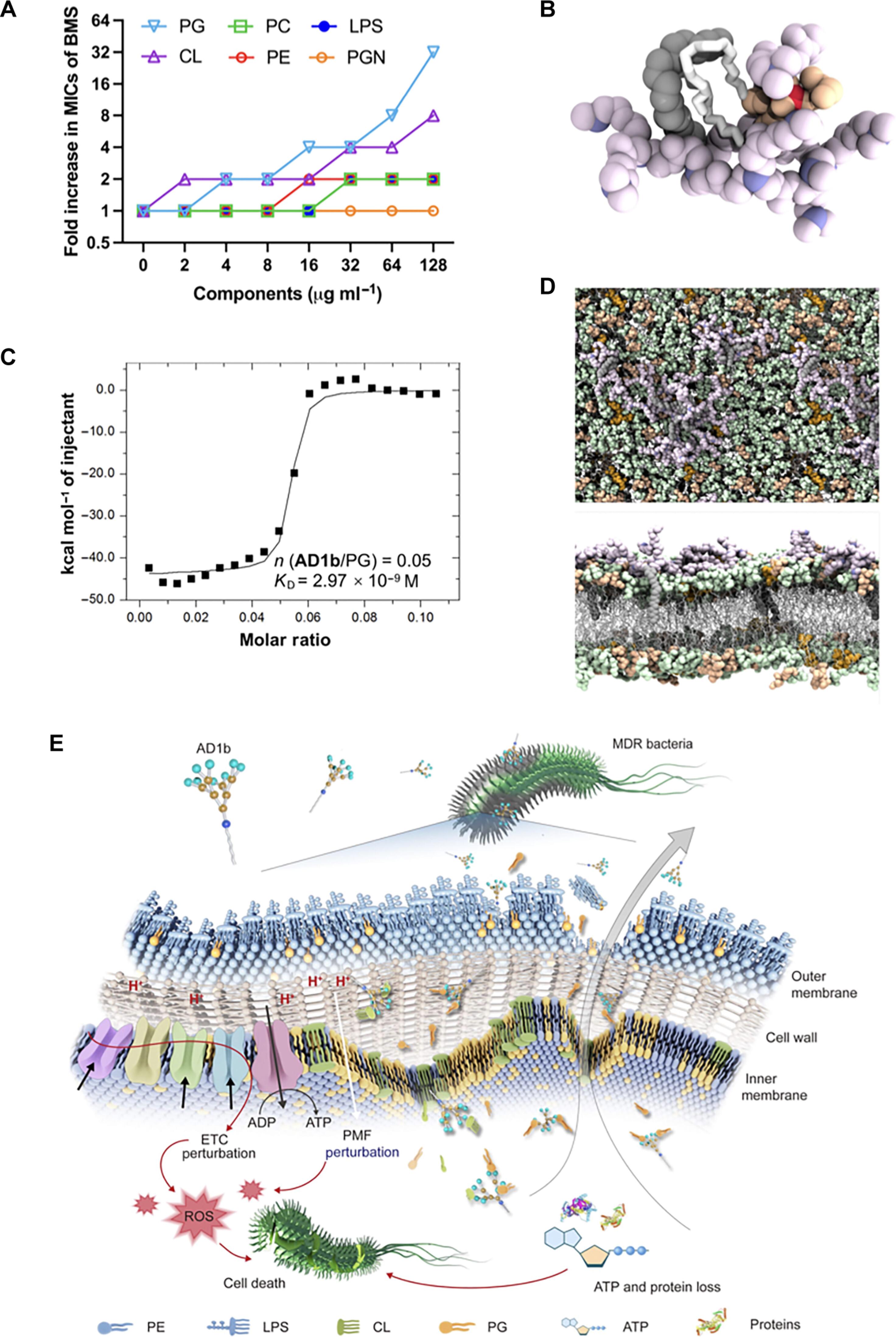
The rapid emergence and spread of multidrug-resistant bacterial pathogens require the development of antibacterial agents that are robustly effective while inducing no toxicity or resistance development. In this context, we designed and synthesized amphiphilic dendrimers as antibacterial candidates. We report the promising potent antibacterial activity shown by the amphiphilic dendrimer AD1b, composed of a long hydrophobic alkyl chain and a tertiary amine-terminated poly(amidoamine) dendron, against a panel of Gram-negative bacteria, including multidrug-resistant Escherichia coli and Acinetobacter baumannii.AD1b exhibited effective activity against drug-resistant bacterial infections in vivo. Mechanistic studies revealed that AD1b targeted the membrane phospholipids phosphatidylglycerol (PG) and cardiolipin (CL), leading to the disruption of the bacterial membrane and proton motive force, metabolic disturbance, leakage of cellular components, and, ultimately, cell death. Together, AD1b that specifically interacts with PG/CL in bacterial membranes supports the use of small amphiphilic dendrimers as a promising strategy to target drug-resistant bacterial pathogens and addresses the global antibiotic crisis.
期刊介绍:
Science Advances, an open-access journal by AAAS, publishes impactful research in diverse scientific areas. It aims for fair, fast, and expert peer review, providing freely accessible research to readers. Led by distinguished scientists, the journal supports AAAS's mission by extending Science magazine's capacity to identify and promote significant advances. Evolving digital publishing technologies play a crucial role in advancing AAAS's global mission for science communication and benefitting humankind.



 京公网安备 11010802042870号
京ICP备2023020795号-1
京公网安备 11010802042870号
京ICP备2023020795号-1

 分享
分享
 求助内容:
求助内容: 应助结果提醒方式:
 扫码关注我们
