Kenika Khotchasanthong, Kunlanit Chinchan, Kanokwan Kongpatpanich, Waraporn Pinyo, Filip Kielar, Winya Dungkaew, Mongkol Sukwattanasinitt, Sakchai Laksee and Kittipong Chainok
{"title":"Construction of 2D zinc(ii) MOFs with tricarboxylate and N-donor mixed ligands for multiresponsive luminescence sensors and CO2 adsorption†","authors":"Kenika Khotchasanthong, Kunlanit Chinchan, Kanokwan Kongpatpanich, Waraporn Pinyo, Filip Kielar, Winya Dungkaew, Mongkol Sukwattanasinitt, Sakchai Laksee and Kittipong Chainok","doi":"10.1039/D4DT01825G","DOIUrl":null,"url":null,"abstract":"<p >The solvothermal reactions of ZnCl<small><sub>2</sub></small>·6H<small><sub>2</sub></small>O, benzene-1,3,5-tribenzoic acid (H<small><sub>3</sub></small>btb), and N-heterocyclic ancillary imidazole (Im) or aminopyrimidine (a mp) ligands led to the creation of two-dimensional (2D) zinc(<small>II</small>) based metal–organic frameworks (MOFs), (Me<small><sub>2</sub></small>NH<small><sub>2</sub></small>)<small><sub>2</sub></small>[Zn<small><sub>2</sub></small>(btb)<small><sub>2</sub></small>(Im)<small><sub>2</sub></small>]·2DMF·3MeOH (<strong>1</strong>) and (Me<small><sub>2</sub></small>NH<small><sub>2</sub></small>)<small><sub>2</sub></small>[Zn<small><sub>2</sub></small>(btb)<small><sub>2</sub></small>(amp)]·H<small><sub>2</sub></small>O·2DMF·MeOH (<strong>2</strong>). The btb<small><sup>3−</sup></small> ligands in <strong>1</strong> and <strong>2</strong> form an anionic 2D layered structure with a (6<small><sup>3</sup></small>) honeycomb (hcb) topology by linking to Zn(<small>II</small>) centres through their carboxylate groups. The incorporation of N-heterocyclic auxiliary ligands Im and amp into the hcb nets resulted in the formation of a 2D hydrogen-bonded and covalently pillared bilayer structure featuring two-fold interpenetrating networks. Each of these networks consists of small channels that are occupied by Me<small><sub>2</sub></small>NH<small><sub>2</sub></small> cations and solvent molecules. Both <strong>1</strong> and <strong>2</strong> emit blue luminescence emissions in the solid state at room temperature and exhibit a great selectivity and sensitivity for the detection of acetone and multiple heavy metal ions including Hg<small><sup>2+</sup></small>, Cu<small><sup>2+</sup></small>, Fe<small><sup>2+</sup></small>, Pb<small><sup>2+</sup></small>, Cr<small><sup>3+</sup></small>, and Fe<small><sup>3+</sup></small> ions. At 1 bar, activated <strong>1</strong> and <strong>2</strong> demonstrate moderate capacities for adsorbing CO<small><sub>2</sub></small> at room temperature, with a preference for CO<small><sub>2</sub></small> over N<small><sub>2</sub></small>. Notably, at higher pressures (up to 20 bar), their activated samples <strong>1</strong> and <strong>2</strong> show a temperature-dependent enhancement of CO<small><sub>2</sub></small> uptake while retaining good stability.</p>","PeriodicalId":71,"journal":{"name":"Dalton Transactions","volume":" 45","pages":" 18243-18257"},"PeriodicalIF":3.3000,"publicationDate":"2024-09-27","publicationTypes":"Journal Article","fieldsOfStudy":null,"isOpenAccess":false,"openAccessPdf":"","citationCount":"0","resultStr":null,"platform":"Semanticscholar","paperid":null,"PeriodicalName":"Dalton Transactions","FirstCategoryId":"92","ListUrlMain":"https://pubs.rsc.org/en/content/articlelanding/2024/dt/d4dt01825g","RegionNum":3,"RegionCategory":"化学","ArticlePicture":[],"TitleCN":null,"AbstractTextCN":null,"PMCID":null,"EPubDate":"","PubModel":"","JCR":"Q2","JCRName":"CHEMISTRY, INORGANIC & NUCLEAR","Score":null,"Total":0}
引用次数: 0
Abstract
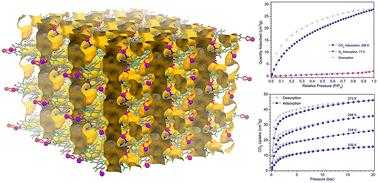
The solvothermal reactions of ZnCl2·6H2O, benzene-1,3,5-tribenzoic acid (H3btb), and N-heterocyclic ancillary imidazole (Im) or aminopyrimidine (a mp) ligands led to the creation of two-dimensional (2D) zinc(II) based metal–organic frameworks (MOFs), (Me2NH2)2[Zn2(btb)2(Im)2]·2DMF·3MeOH (1) and (Me2NH2)2[Zn2(btb)2(amp)]·H2O·2DMF·MeOH (2). The btb3− ligands in 1 and 2 form an anionic 2D layered structure with a (63) honeycomb (hcb) topology by linking to Zn(II) centres through their carboxylate groups. The incorporation of N-heterocyclic auxiliary ligands Im and amp into the hcb nets resulted in the formation of a 2D hydrogen-bonded and covalently pillared bilayer structure featuring two-fold interpenetrating networks. Each of these networks consists of small channels that are occupied by Me2NH2 cations and solvent molecules. Both 1 and 2 emit blue luminescence emissions in the solid state at room temperature and exhibit a great selectivity and sensitivity for the detection of acetone and multiple heavy metal ions including Hg2+, Cu2+, Fe2+, Pb2+, Cr3+, and Fe3+ ions. At 1 bar, activated 1 and 2 demonstrate moderate capacities for adsorbing CO2 at room temperature, with a preference for CO2 over N2. Notably, at higher pressures (up to 20 bar), their activated samples 1 and 2 show a temperature-dependent enhancement of CO2 uptake while retaining good stability.
期刊介绍:
Dalton Transactions is a journal for all areas of inorganic chemistry, which encompasses the organometallic, bioinorganic and materials chemistry of the elements, with applications including synthesis, catalysis, energy conversion/storage, electrical devices and medicine. Dalton Transactions welcomes high-quality, original submissions in all of these areas and more, where the advancement of knowledge in inorganic chemistry is significant.



 京公网安备 11010802042870号
京ICP备2023020795号-1
京公网安备 11010802042870号
京ICP备2023020795号-1

 分享
分享
 求助内容:
求助内容: 应助结果提醒方式:
 扫码关注我们
