Romana Smolková, Lukáš Smolko, Erika Samoľová, Ibrahim Morgan, Robert Rennert and Goran N. Kaluđerović
{"title":"Novel Zn(ii), Co(ii) and Cu(ii) diflunisalato complexes with neocuproine and their exceptional antiproliferative activity against cancer cell lines†","authors":"Romana Smolková, Lukáš Smolko, Erika Samoľová, Ibrahim Morgan, Robert Rennert and Goran N. Kaluđerović","doi":"10.1039/D4DT01736F","DOIUrl":null,"url":null,"abstract":"<p >Three novel complexes of deprotonated diflunisal (<em>dif</em>) with neocuproine (<em>neo</em>) were synthesized and characterized <em>via</em> elemental, spectral (UV-vis, FTIR, fluorescence, and mass spectrometry), and single-crystal X-ray diffraction analyses. Although the compounds shared a similar composition of [MCl(<em>dif</em>)(<em>neo</em>)], where M represents Zn(<small>II</small>) (<strong>1</strong>), Co(<small>II</small>) (<strong>2</strong>) and Cu(<small>II</small>) (<strong>3</strong>), only <strong>1</strong> and <strong>2</strong> were isostructural, while <strong>3</strong> differed in both the molecular and supramolecular structures. In all three complex molecules, the central atom is coordinated by two nitrogen atoms of <em>neo</em> in a bidentate chelate mode, and one chlorido ligand and <em>dif</em> is bonded in either a monodentate mode <em>via</em> one oxygen atom of the carboxylate in <strong>1</strong> and <strong>2</strong> or in a bidentate chelate mode <em>via</em> both carboxylate oxygen atoms in <strong>3</strong>. All three compounds demonstrated remarkable antiproliferative activity against human prostate (PC-3), colon (HCT116) and breast (MDA-MB-468) cancer cell lines with IC<small><sub>50</sub></small> values in the nanomolar range, with the lowest values observed in the case of PC-3 and MDA-MB-468 with <strong>2</strong> (20.0 nM) and <strong>3</strong> (31.1 nM), respectively. Moreover, complex <strong>2</strong>, as the most active, was further investigated for its potential to induce perturbations in the cell cycle of PC-3 cells. The results indicated an induction of caspase-independent apoptosis. The interaction of the complexes with genomic DNA isolated from the respective cancer cell lines was evaluated for the intercalative mode, with binding strength correlated with the antiproliferative activity against PC-3 and MDA-MB-468 cancer cell lines.</p>","PeriodicalId":71,"journal":{"name":"Dalton Transactions","volume":" 43","pages":" 17595-17607"},"PeriodicalIF":3.3000,"publicationDate":"2024-09-27","publicationTypes":"Journal Article","fieldsOfStudy":null,"isOpenAccess":false,"openAccessPdf":"","citationCount":"0","resultStr":null,"platform":"Semanticscholar","paperid":null,"PeriodicalName":"Dalton Transactions","FirstCategoryId":"92","ListUrlMain":"https://pubs.rsc.org/en/content/articlelanding/2024/dt/d4dt01736f","RegionNum":3,"RegionCategory":"化学","ArticlePicture":[],"TitleCN":null,"AbstractTextCN":null,"PMCID":null,"EPubDate":"","PubModel":"","JCR":"Q2","JCRName":"CHEMISTRY, INORGANIC & NUCLEAR","Score":null,"Total":0}
引用次数: 0
Abstract
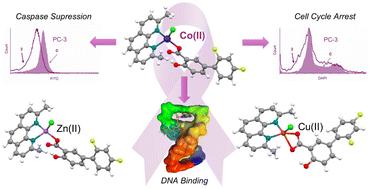
Three novel complexes of deprotonated diflunisal (dif) with neocuproine (neo) were synthesized and characterized via elemental, spectral (UV-vis, FTIR, fluorescence, and mass spectrometry), and single-crystal X-ray diffraction analyses. Although the compounds shared a similar composition of [MCl(dif)(neo)], where M represents Zn(II) (1), Co(II) (2) and Cu(II) (3), only 1 and 2 were isostructural, while 3 differed in both the molecular and supramolecular structures. In all three complex molecules, the central atom is coordinated by two nitrogen atoms of neo in a bidentate chelate mode, and one chlorido ligand and dif is bonded in either a monodentate mode via one oxygen atom of the carboxylate in 1 and 2 or in a bidentate chelate mode via both carboxylate oxygen atoms in 3. All three compounds demonstrated remarkable antiproliferative activity against human prostate (PC-3), colon (HCT116) and breast (MDA-MB-468) cancer cell lines with IC50 values in the nanomolar range, with the lowest values observed in the case of PC-3 and MDA-MB-468 with 2 (20.0 nM) and 3 (31.1 nM), respectively. Moreover, complex 2, as the most active, was further investigated for its potential to induce perturbations in the cell cycle of PC-3 cells. The results indicated an induction of caspase-independent apoptosis. The interaction of the complexes with genomic DNA isolated from the respective cancer cell lines was evaluated for the intercalative mode, with binding strength correlated with the antiproliferative activity against PC-3 and MDA-MB-468 cancer cell lines.
期刊介绍:
Dalton Transactions is a journal for all areas of inorganic chemistry, which encompasses the organometallic, bioinorganic and materials chemistry of the elements, with applications including synthesis, catalysis, energy conversion/storage, electrical devices and medicine. Dalton Transactions welcomes high-quality, original submissions in all of these areas and more, where the advancement of knowledge in inorganic chemistry is significant.



 京公网安备 11010802042870号
京ICP备2023020795号-1
京公网安备 11010802042870号
京ICP备2023020795号-1

 分享
分享
 求助内容:
求助内容: 应助结果提醒方式:
 扫码关注我们
