{"title":"Leaf mining induced chemical defense of a Late Triassic ginkgophyte plant","authors":"Tao Zhao, Sui Wan, Senleyi Li, Zhuo Feng","doi":"10.1111/nph.20154","DOIUrl":null,"url":null,"abstract":"<p>Leaf mining is a distinctive foliar feeding strategy employed by insect larvae in which they inhabit and feed on the internal tissues of leaves (Hering, <span>1951</span>). This strategy has independently evolved multiple times in four holometabolous insect orders: Coleoptera, Diptera, Lepidoptera, and Hymenoptera (Connor & Taverner, <span>1997</span>). Leaf mining offers several advantages to the insect larvae, including higher feeding efficiencies and protection from UV radiation, desiccation, and disease infection (Connor & Taverner, <span>1997</span>). Some species can even manipulate their host plants' metabolism to meet their nutritional needs (Zhang <i>et al</i>., <span>2017</span>). However, for the host plants, leaf mining can lead to increased water and nutrient loss, reduced photosynthesis, and increased/decreased defenses (Zhang <i>et al</i>., <span>2016</span>; Chen <i>et al</i>., <span>2017</span>).</p><p>Although insect damage traces of leaf mining are not commonly preserved in the fossil record, they indeed provide a critical window into the ancient relationships between endophytic insects and their host plants (Labandeira & Wappler, <span>2023</span>). The oldest unequivocal leaf mines date back to the Early Triassic, with diversification occurring in the Late Triassic (Cariglino <i>et al</i>., <span>2022</span>; Imada <i>et al</i>., <span>2022</span>; Xiao <i>et al</i>., <span>2024</span>). The preserved feeding traces of leaf mining provide valuable insights into the diversity of leaf miners in ancient terrestrial ecosystems, their host plants, and their responses to past climate and ecosystem changes (Wilf <i>et al</i>., <span>2001</span>, <span>2006</span>; Currano <i>et al</i>., <span>2010</span>). Despite the wealth of information derived from these insect damage traces, the impact of leaf mining on the chemistry of fossil leaves remains largely unexplored.</p><p>Plant cuticles, composed mainly of cutin, waxes, polysaccharides, and phenolic compounds, are valuable materials for palaeobotanical studies, due to their high preservation potential (Kerp, <span>1990</span>; Guignard, <span>2019</span>). Besides revealing morphological details of cells, recent studies suggest that fossil plant cuticles can even preserve chemical information that is informative for phylogenetic studies (Vajda <i>et al</i>., <span>2017</span>, <span>2021</span>). While interactions between plants and leaf miners primarily occur within the inner tissues of leaves, the resultant chemicals could potentially disperse and deposit into the cuticles (Müller, <span>2008</span>).</p><p>In this study, we utilized attenuated total reflectance-Fourier transform infrared spectroscopy (ATR-FTIR) to investigate whether leaf mining affects leaf chemistry in the extant plant <i>Hedera nepalensis</i> and if such impacts can be discerned in fossil ginkgophytes. ATR-FTIR allows the acquisition of spectra of cuticles without isolation (España <i>et al</i>., <span>2014</span>; Jardine <i>et al</i>., <span>2019</span>). We used leaves of <i>H. nepalensis</i> as a modern reference due to their availability and the scarcity of insect damage on the leaves of <i>Ginkgo biloba</i>, the only living representative of the Ginkgoales (Pan <i>et al</i>., <span>2016</span>). <i>Hedera nepalensis</i> is a widespread evergreen angiosperm in Asia and grows at elevations between 0 and 3500 m above sea level (Green <i>et al</i>., <span>2011</span>). Fossil ginkgophyte leaves (<i>Baiera multipartite</i>) obtained from the Upper Triassic in Southwest China were analyzed for their chemical characteristics.</p><p>Fourteen modern leaves of <i>H. nepalensis</i> K. Koch (Fig. 1a) were sampled between September and October 2023, comprising eight unmined leaves and six mined leaves. One yellow leaf of <i>G. biloba</i> L., was sampled for comparison.</p><p>Thirty-three fossil ginkgophyte leaves (<i>B. multipartite</i> Sze et Lee) (Fig. 1b,c) collected from the Upper Triassic Xujiahe Formation in Southwest China were sampled, consisting of 21 unmined leaves and 12 mined leaves. Among the mined leaves, eight were sampled from both the mined portions and unmined portions, while four were solely sampled from the mined portions. The Xujiahe Formation in the Sichuan Basin is a terrestrial sedimentary sequence with alternating lacustrine and fluvial depositional facies (Wang <i>et al</i>., <span>2010</span>). Specifically, in the Rongxian fossil site (29°27′11″ N, 104°18′02″ E) in the southeastern Sichuan Basin, the formation measures 532–764 m in thickness and is divided into six members. The specimens were collected from the roof-shale of a coal bed within the fifth member of the Xujiahe Formation (see Feng <i>et al</i>., <span>2022</span> for more details), and are housed at the Palaeobotanical Collections of Institute of Palaeontology, Yunnan University (YNUPB).</p><p>ATR-FTIR analysis was conducted using a Nicolet iS50 FTIR spectrometer equipped with a ZnSe crystal ATR accessory at the Institute of Palaeontology, Yunnan University. The instrumental setup included a spectral resolution of 4 cm<sup>−1</sup>, a wavenumber range of 4000–550 cm<sup>−1</sup>, and 64 scans. No chemical treatments were performed before the analysis. For modern leaves, only the adaxial (upper leaf surface) cuticles were analyzed. For each unmined leaf, 3 to 4 spectra were obtained, while for each mined leaf, 3 to 4 were obtained from both the mined and unmined portions, respectively. In the case of fossil leaves, both adaxial and abaxial (lower leaf surface) cuticles were analyzed, as they are difficult to distinguish visually. Then, the spectra of the adaxial cuticles were selected based on the relative intensity of the C=O band at 1700 cm<sup>−1</sup>, which is relatively higher in the spectra of the adaxial cuticles (Jardine <i>et al</i>., <span>2019</span>). Moreover, the associated sediment was analyzed for comparison.</p><p>Principal component analysis-linear discriminate analysis (PCA-LDA) was performed to obtain information about the spectra variation among the sample groups. First, PCA was performed to reduce the dimensionality of the data, and then LDA was performed on the PC scores to unveil differences among the sample groups. The number of principal components (PCs) used as the input for LDA was determined using leave-one-out cross-validation (LOOCV) (Supporting Information Fig. S1). Model performance was evaluated using Accuracy and Kappa (<i>κ</i>). Accuracy, the proportion of correctly predicted instances, is simple and intuitive but may be misleading in imbalanced datasets. Kappa, by contrast, accounts for chance agreement, providing a more robust assessment of model performance, particularly in imbalanced datasets.</p><p>For modern leaves, analyses were performed using the entire spectral range and the 3000–2800 cm<sup>−1</sup> range. For fossil leaves, analyses were restricted to the 3000–2800 cm<sup>−1</sup> range to avoid potential interference from sediment signals. Before analyzing the full spectra, the spectra were baseline-corrected using the ‘rubberband’ method in the R package <i>alkahest</i> and normalized to the C=O band between 1750 and 1680 cm<sup>−1</sup>. For the 3000–2800 cm<sup>−1</sup> spectral range, spectra were baseline-corrected using the “linear” method and normalized to the CH<sub>2</sub> band between 2940 and 2890 cm<sup>−1</sup>. All analyses were conducted in R 4.3.2 (R Core Team, <span>2023</span>).</p><p>The separation of mined portions from unmined leaves in our PCA-LDA of both modern and fossil leaves indicates that the chemical responses of leaves to leaf mining can be detected with ATR-FTIR.</p><p>Carboxylic acids play important roles in plant defenses, and many of them have aliphatic chains. For example, the jasmonic acid, which is derived from linolenic acid, regulates both direct and indirect plant defenses against insects (War <i>et al</i>., <span>2012</span>). Jasmonic acid can induce the synthesis of molecules in all three major classes of plant secondary metabolites: terpenoids, alkaloids, and phenolic compounds (Geyter <i>et al</i>., <span>2012</span>). C18 unsaturated fatty acids, such as linoleic acid and linolenic acids, can serve as precursors of green-leaf volatiles, which can attract the natural enemies of the herbivores (Aljbory & Chen, <span>2018</span>). The relatively higher content of carboxylic acids in the mined portions of modern leaves suggests that leaf mining activated the defense system in modern leaves. The relatively higher contents of polysaccharides in the mined portions of modern leaves align with previous studies that indicate leaf miners can manipulate plant physiology to accumulate sugars in the mines (Giron <i>et al</i>., <span>2013</span>). That is to say, the leaf miners manipulated plant physiology and suffered plant defense simultaneously. Similarly, Zhang <i>et al</i>. (<span>2016</span>) showed that leaf mining by <i>Phyllonorycter blancardella</i> was associated with enhanced biosynthesis of cytokinins, jasmonic acid, and phenolic compounds in apple trees. It has been demonstrated that leaf miners use cytokinins, a group of plant hormones, to manipulate plant physiology. Thus, the enhanced biosynthesis of cytokinins and jasmonic acid is consistent with our observation of higher contents of polysaccharides and carboxylic acids in mined portions of modern leaves. Our failure to detect an increased content of phenolic compounds in mined portions is likely due to the fact that the IR beam did not reach the induced phenolic compounds. Materska <i>et al</i>. (<span>2022</span>) showed that phenolic compounds accumulate mainly in tissues adjacent to the foraging sites of leaf miners in horse chestnut.</p><p>The incorporation of minerals into fossil cuticles constrains the usable spectral range for PCA-LDA. However, restricting the analyses to the 3000–2800 cm<sup>−1</sup> range still allows the detection of the effects of leaf mining in both modern and fossil leaves. This is because many carboxylic acids involved in plant defenses contain aliphatic chains that are detectable in this range. Although the fossil leaves analyzed in this study belong to a gymnosperm, it has been demonstrated that <i>G. biloba</i>, the only extant representative of the Ginkgoales, responds to herbivory with the same defense mechanisms adopted by the most recent angiosperms (Mohanta <i>et al</i>., <span>2012</span>). Moreover, a multispecies genome-wide analysis suggests that jasmonic acid, salicylic acid, and abscisic signaling pathways, all of which regulate plant defenses, might have emerged in the last common ancestor of land plants (Wang <i>et al</i>., <span>2015</span>). Interestingly, unlike in modern leaves, the unmined portions of fossil leaves appear to be similarly affected as the mined portions. This suggests that leaf mining may have induced both local and systemic defenses in the fossil ginkgophyte, while in the extant plant <i>H. nepalensis</i>, the responses appear to be more localized.</p><p><i>Ginkgo biloba</i> is renowned for its strong resistance to various insects and pathogens (Major, <span>1967</span>). It has been suggested that continuing herbivore pressure could result in an escalation of plant defenses (Futuyma & Agrawal, <span>2009</span>). Indeed, evidence of insect damage on fossil ginkgophytes is accumulating. Besides leaf mining, endophytic oviposition and external foliage feeding have been reported from Late Triassic ginkgophyte leaves (Feng <i>et al</i>., <span>2022</span>; Xu <i>et al</i>., <span>2024</span>). Xiao <i>et al</i>. (<span>2024</span>) documented three mines from Middle Jurassic ginkgophyte leaves. The evidence of chemical response to leaf mining in the Triassic leaves, as well as flavonoids in Cretaceous leaves (Zhao <i>et al</i>., <span>2006</span>), suggests that fossil materials may hold clues to the evolutionary history of defense mechanisms in the Ginkgoales.</p><p>The study of plant–insect interactions in the fossil record has provided valuable insights into the co-evolutionary dynamics between plants and insects through geological history (Labandeira & Wappler, <span>2023</span>). Although recent research has made significant progress in documenting various types of insect damage on plant tissues, there exists a notable bias in our understanding, with a predominant focus on the damage over plant defenses (McCoy <i>et al</i>., <span>2021</span>). Our knowledge of fossil plant defenses largely relies on fossilized structural defenses such as spines and trichomes and morphological evidence of chemical defenses such as amber and oil body cells (McCoy <i>et al</i>., <span>2021</span>). Our results highlight the potential of chemical analysis in gaining insights into plant defenses in deep time.</p><p>In summary, our research presents evidence for chemical defense of a Triassic ginkgophyte plant to leaf mining, and demonstrates the feasibility of gaining insights into plant defenses in deep time through chemical analysis.</p><p>None declared.</p><p>TZ and ZF conceived and designed this study. ZF and SW collected fossil specimens. ZF, SW and TZ collected modern specimens. TZ and SL conducted ATR-FTIR analysis. TZ analyzed the data. TZ wrote the manuscript with input from other authors. All authors read and approved the final manuscript.</p><p>The ATR-FTIR spectra and R code are available on the OSF (https://osf.io/eckgh/).</p>","PeriodicalId":214,"journal":{"name":"New Phytologist","volume":"245 1","pages":"27-32"},"PeriodicalIF":8.7000,"publicationDate":"2024-12-04","publicationTypes":"Journal Article","fieldsOfStudy":null,"isOpenAccess":false,"openAccessPdf":"https://onlinelibrary.wiley.com/doi/epdf/10.1111/nph.20154","citationCount":"0","resultStr":null,"platform":"Semanticscholar","paperid":null,"PeriodicalName":"New Phytologist","FirstCategoryId":"99","ListUrlMain":"https://onlinelibrary.wiley.com/doi/10.1111/nph.20154","RegionNum":1,"RegionCategory":"生物学","ArticlePicture":[],"TitleCN":null,"AbstractTextCN":null,"PMCID":null,"EPubDate":"2024/9/25 0:00:00","PubModel":"Epub","JCR":"Q1","JCRName":"PLANT SCIENCES","Score":null,"Total":0}
引用次数: 0
Abstract
Leaf mining is a distinctive foliar feeding strategy employed by insect larvae in which they inhabit and feed on the internal tissues of leaves (Hering, 1951). This strategy has independently evolved multiple times in four holometabolous insect orders: Coleoptera, Diptera, Lepidoptera, and Hymenoptera (Connor & Taverner, 1997). Leaf mining offers several advantages to the insect larvae, including higher feeding efficiencies and protection from UV radiation, desiccation, and disease infection (Connor & Taverner, 1997). Some species can even manipulate their host plants' metabolism to meet their nutritional needs (Zhang et al., 2017). However, for the host plants, leaf mining can lead to increased water and nutrient loss, reduced photosynthesis, and increased/decreased defenses (Zhang et al., 2016; Chen et al., 2017).
Although insect damage traces of leaf mining are not commonly preserved in the fossil record, they indeed provide a critical window into the ancient relationships between endophytic insects and their host plants (Labandeira & Wappler, 2023). The oldest unequivocal leaf mines date back to the Early Triassic, with diversification occurring in the Late Triassic (Cariglino et al., 2022; Imada et al., 2022; Xiao et al., 2024). The preserved feeding traces of leaf mining provide valuable insights into the diversity of leaf miners in ancient terrestrial ecosystems, their host plants, and their responses to past climate and ecosystem changes (Wilf et al., 2001, 2006; Currano et al., 2010). Despite the wealth of information derived from these insect damage traces, the impact of leaf mining on the chemistry of fossil leaves remains largely unexplored.
Plant cuticles, composed mainly of cutin, waxes, polysaccharides, and phenolic compounds, are valuable materials for palaeobotanical studies, due to their high preservation potential (Kerp, 1990; Guignard, 2019). Besides revealing morphological details of cells, recent studies suggest that fossil plant cuticles can even preserve chemical information that is informative for phylogenetic studies (Vajda et al., 2017, 2021). While interactions between plants and leaf miners primarily occur within the inner tissues of leaves, the resultant chemicals could potentially disperse and deposit into the cuticles (Müller, 2008).
In this study, we utilized attenuated total reflectance-Fourier transform infrared spectroscopy (ATR-FTIR) to investigate whether leaf mining affects leaf chemistry in the extant plant Hedera nepalensis and if such impacts can be discerned in fossil ginkgophytes. ATR-FTIR allows the acquisition of spectra of cuticles without isolation (España et al., 2014; Jardine et al., 2019). We used leaves of H. nepalensis as a modern reference due to their availability and the scarcity of insect damage on the leaves of Ginkgo biloba, the only living representative of the Ginkgoales (Pan et al., 2016). Hedera nepalensis is a widespread evergreen angiosperm in Asia and grows at elevations between 0 and 3500 m above sea level (Green et al., 2011). Fossil ginkgophyte leaves (Baiera multipartite) obtained from the Upper Triassic in Southwest China were analyzed for their chemical characteristics.
Fourteen modern leaves of H. nepalensis K. Koch (Fig. 1a) were sampled between September and October 2023, comprising eight unmined leaves and six mined leaves. One yellow leaf of G. biloba L., was sampled for comparison.
Thirty-three fossil ginkgophyte leaves (B. multipartite Sze et Lee) (Fig. 1b,c) collected from the Upper Triassic Xujiahe Formation in Southwest China were sampled, consisting of 21 unmined leaves and 12 mined leaves. Among the mined leaves, eight were sampled from both the mined portions and unmined portions, while four were solely sampled from the mined portions. The Xujiahe Formation in the Sichuan Basin is a terrestrial sedimentary sequence with alternating lacustrine and fluvial depositional facies (Wang et al., 2010). Specifically, in the Rongxian fossil site (29°27′11″ N, 104°18′02″ E) in the southeastern Sichuan Basin, the formation measures 532–764 m in thickness and is divided into six members. The specimens were collected from the roof-shale of a coal bed within the fifth member of the Xujiahe Formation (see Feng et al., 2022 for more details), and are housed at the Palaeobotanical Collections of Institute of Palaeontology, Yunnan University (YNUPB).
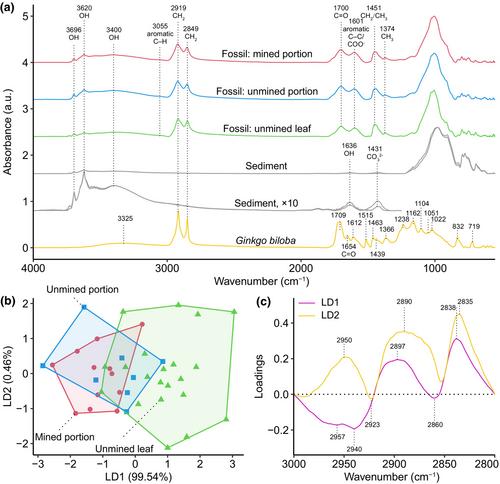
ATR-FTIR analysis was conducted using a Nicolet iS50 FTIR spectrometer equipped with a ZnSe crystal ATR accessory at the Institute of Palaeontology, Yunnan University. The instrumental setup included a spectral resolution of 4 cm−1, a wavenumber range of 4000–550 cm−1, and 64 scans. No chemical treatments were performed before the analysis. For modern leaves, only the adaxial (upper leaf surface) cuticles were analyzed. For each unmined leaf, 3 to 4 spectra were obtained, while for each mined leaf, 3 to 4 were obtained from both the mined and unmined portions, respectively. In the case of fossil leaves, both adaxial and abaxial (lower leaf surface) cuticles were analyzed, as they are difficult to distinguish visually. Then, the spectra of the adaxial cuticles were selected based on the relative intensity of the C=O band at 1700 cm−1, which is relatively higher in the spectra of the adaxial cuticles (Jardine et al., 2019). Moreover, the associated sediment was analyzed for comparison.
Principal component analysis-linear discriminate analysis (PCA-LDA) was performed to obtain information about the spectra variation among the sample groups. First, PCA was performed to reduce the dimensionality of the data, and then LDA was performed on the PC scores to unveil differences among the sample groups. The number of principal components (PCs) used as the input for LDA was determined using leave-one-out cross-validation (LOOCV) (Supporting Information Fig. S1). Model performance was evaluated using Accuracy and Kappa (κ). Accuracy, the proportion of correctly predicted instances, is simple and intuitive but may be misleading in imbalanced datasets. Kappa, by contrast, accounts for chance agreement, providing a more robust assessment of model performance, particularly in imbalanced datasets.
For modern leaves, analyses were performed using the entire spectral range and the 3000–2800 cm−1 range. For fossil leaves, analyses were restricted to the 3000–2800 cm−1 range to avoid potential interference from sediment signals. Before analyzing the full spectra, the spectra were baseline-corrected using the ‘rubberband’ method in the R package alkahest and normalized to the C=O band between 1750 and 1680 cm−1. For the 3000–2800 cm−1 spectral range, spectra were baseline-corrected using the “linear” method and normalized to the CH2 band between 2940 and 2890 cm−1. All analyses were conducted in R 4.3.2 (R Core Team, 2023).
The separation of mined portions from unmined leaves in our PCA-LDA of both modern and fossil leaves indicates that the chemical responses of leaves to leaf mining can be detected with ATR-FTIR.
Carboxylic acids play important roles in plant defenses, and many of them have aliphatic chains. For example, the jasmonic acid, which is derived from linolenic acid, regulates both direct and indirect plant defenses against insects (War et al., 2012). Jasmonic acid can induce the synthesis of molecules in all three major classes of plant secondary metabolites: terpenoids, alkaloids, and phenolic compounds (Geyter et al., 2012). C18 unsaturated fatty acids, such as linoleic acid and linolenic acids, can serve as precursors of green-leaf volatiles, which can attract the natural enemies of the herbivores (Aljbory & Chen, 2018). The relatively higher content of carboxylic acids in the mined portions of modern leaves suggests that leaf mining activated the defense system in modern leaves. The relatively higher contents of polysaccharides in the mined portions of modern leaves align with previous studies that indicate leaf miners can manipulate plant physiology to accumulate sugars in the mines (Giron et al., 2013). That is to say, the leaf miners manipulated plant physiology and suffered plant defense simultaneously. Similarly, Zhang et al. (2016) showed that leaf mining by Phyllonorycter blancardella was associated with enhanced biosynthesis of cytokinins, jasmonic acid, and phenolic compounds in apple trees. It has been demonstrated that leaf miners use cytokinins, a group of plant hormones, to manipulate plant physiology. Thus, the enhanced biosynthesis of cytokinins and jasmonic acid is consistent with our observation of higher contents of polysaccharides and carboxylic acids in mined portions of modern leaves. Our failure to detect an increased content of phenolic compounds in mined portions is likely due to the fact that the IR beam did not reach the induced phenolic compounds. Materska et al. (2022) showed that phenolic compounds accumulate mainly in tissues adjacent to the foraging sites of leaf miners in horse chestnut.
The incorporation of minerals into fossil cuticles constrains the usable spectral range for PCA-LDA. However, restricting the analyses to the 3000–2800 cm−1 range still allows the detection of the effects of leaf mining in both modern and fossil leaves. This is because many carboxylic acids involved in plant defenses contain aliphatic chains that are detectable in this range. Although the fossil leaves analyzed in this study belong to a gymnosperm, it has been demonstrated that G. biloba, the only extant representative of the Ginkgoales, responds to herbivory with the same defense mechanisms adopted by the most recent angiosperms (Mohanta et al., 2012). Moreover, a multispecies genome-wide analysis suggests that jasmonic acid, salicylic acid, and abscisic signaling pathways, all of which regulate plant defenses, might have emerged in the last common ancestor of land plants (Wang et al., 2015). Interestingly, unlike in modern leaves, the unmined portions of fossil leaves appear to be similarly affected as the mined portions. This suggests that leaf mining may have induced both local and systemic defenses in the fossil ginkgophyte, while in the extant plant H. nepalensis, the responses appear to be more localized.
Ginkgo biloba is renowned for its strong resistance to various insects and pathogens (Major, 1967). It has been suggested that continuing herbivore pressure could result in an escalation of plant defenses (Futuyma & Agrawal, 2009). Indeed, evidence of insect damage on fossil ginkgophytes is accumulating. Besides leaf mining, endophytic oviposition and external foliage feeding have been reported from Late Triassic ginkgophyte leaves (Feng et al., 2022; Xu et al., 2024). Xiao et al. (2024) documented three mines from Middle Jurassic ginkgophyte leaves. The evidence of chemical response to leaf mining in the Triassic leaves, as well as flavonoids in Cretaceous leaves (Zhao et al., 2006), suggests that fossil materials may hold clues to the evolutionary history of defense mechanisms in the Ginkgoales.
The study of plant–insect interactions in the fossil record has provided valuable insights into the co-evolutionary dynamics between plants and insects through geological history (Labandeira & Wappler, 2023). Although recent research has made significant progress in documenting various types of insect damage on plant tissues, there exists a notable bias in our understanding, with a predominant focus on the damage over plant defenses (McCoy et al., 2021). Our knowledge of fossil plant defenses largely relies on fossilized structural defenses such as spines and trichomes and morphological evidence of chemical defenses such as amber and oil body cells (McCoy et al., 2021). Our results highlight the potential of chemical analysis in gaining insights into plant defenses in deep time.
In summary, our research presents evidence for chemical defense of a Triassic ginkgophyte plant to leaf mining, and demonstrates the feasibility of gaining insights into plant defenses in deep time through chemical analysis.
None declared.
TZ and ZF conceived and designed this study. ZF and SW collected fossil specimens. ZF, SW and TZ collected modern specimens. TZ and SL conducted ATR-FTIR analysis. TZ analyzed the data. TZ wrote the manuscript with input from other authors. All authors read and approved the final manuscript.
The ATR-FTIR spectra and R code are available on the OSF (https://osf.io/eckgh/).
期刊介绍:
New Phytologist is an international electronic journal published 24 times a year. It is owned by the New Phytologist Foundation, a non-profit-making charitable organization dedicated to promoting plant science. The journal publishes excellent, novel, rigorous, and timely research and scholarship in plant science and its applications. The articles cover topics in five sections: Physiology & Development, Environment, Interaction, Evolution, and Transformative Plant Biotechnology. These sections encompass intracellular processes, global environmental change, and encourage cross-disciplinary approaches. The journal recognizes the use of techniques from molecular and cell biology, functional genomics, modeling, and system-based approaches in plant science. Abstracting and Indexing Information for New Phytologist includes Academic Search, AgBiotech News & Information, Agroforestry Abstracts, Biochemistry & Biophysics Citation Index, Botanical Pesticides, CAB Abstracts®, Environment Index, Global Health, and Plant Breeding Abstracts, and others.








 京公网安备 11010802042870号
京ICP备2023020795号-1
京公网安备 11010802042870号
京ICP备2023020795号-1

 分享
分享
 求助内容:
求助内容: 应助结果提醒方式:
 扫码关注我们
