Marek Jutel, Magdalena Zemelka-Wiacek, Oliver Pfaar
{"title":"Harnessing mass spectrometric methods for exquisite allergen product characterization","authors":"Marek Jutel, Magdalena Zemelka-Wiacek, Oliver Pfaar","doi":"10.1111/all.16340","DOIUrl":null,"url":null,"abstract":"<p>The standardization of allergen products is very challenging due to significant differences in quality and quantity, aggravated by the absence of uniform standards in Europe. This poses a difficulty for physicians in selecting an allergen product that meets specific patient's needs. Product reference standards throughout the European market would enable direct comparison of these products. Mass spectrometry (MS) is suggested to address gaps in further allergen characterization.</p><p>The utilization of MS in allergen product testing offers a nuanced approach to both allergenic and non-allergenic protein profile characteristics, significantly improving the precision of allergen identification and quantification. This method allows for the simultaneous detection of multiple allergens through label-free and absolute quantification via multiple reaction monitoring, eliminating the need for separate assays for each allergen.<span><sup>1</sup></span> The nuanced understanding of both allergenic and non-allergenic protein profiles through MS is underscored by recent advancements in food allergen quantification, which, beyond quantitation, involves protein and peptide target selection and peptide specificity verification.<span><sup>2</sup></span> Beyond clinical implications, the comprehensive analysis of protein profiles, including non-allergens, provides invaluable insights into product consistency, stability, and potential changes induced by raw material variability or manufacturing processes. The ability of MS to detect a wide array of proteins in native and modified forms underscores its critical role in ensuring the safety and efficacy of allergen products. MS showcases its versatility by effectively analyzing allergenic and non-allergenic components in various products, from native protein extracts to modified proteins, including recombinant molecules or allergoids. Future research should focus on integrating these techniques at strategic points under the surveillance of the regulatory framework to optimize allergen product development and quality control.</p><p>MS offers a very modern toolkit for allergen product testing, capable of addressing critical questions such as identifying allergen content, quantifying how much of each allergen is included, and determining biochemistry—oxidation or other modifications. Various MS technologies, each with unique features, enable a comprehensive approach to allergen characterization. These include high-resolution instruments ideal for identifying and confirming protein identities, medium-resolution systems like ion traps that excel in sequence elucidation and are suited for moderately complex samples, and low-resolution systems optimized for absolute quantification. The choice of MS technique depends on the specific requirements of the analysis, including the complexity of the sample involving the regulatory context.<span><sup>3</sup></span> This diversity in MS applications offers significantly improved capacity for the quality and safety of allergen products.</p><p>Divergent findings in allergen product composition underline the critical role of MS. MS investigations have exposed significant inconsistencies in allergen content, showing deficiencies in house dust mite allergen products in India.<span><sup>4</sup></span> In contrast, the presence of bee venom allergens in allergen immunotherapy (AIT) products was confirmed in contrast to IgG-immunoblotting analysis.<span><sup>5</sup></span> The adequacy of these allergen levels in inducing an immune response remains under investigation.</p><p>Interestingly Augustin et al. (article in this issue) demonstrated the presence of all major allergens across different batches from various European producers. Mid-tier and most minor allergens were detected in batches from one manufacturer. In addition, the study reveals significant batch-to-batch consistency in allergen composition for products from a single manufacturer. Variability in mid-tier and most minor allergen content among products from different suppliers was shown. These data highlight the method's reliability and high-throughput capabilities. Implementing this perspective, a practical application of high-resolution MS, assessing the allergen composition of skin prick tests and AIT products derived from various allergen sources can be postulated, which provides a standardized method to ensure the comprehensive representation of allergen composition with a great potential to improve quality control of allergen products, aiming to enhance the efficacy and safety of allergy diagnostics and treatments.<span><sup>6</sup></span></p><p>Allergen product manufacturers are required to adhere to established rules and guidelines for production, characterization, and quality control. However, the regulators usually mandate specific methods, leaving the choice of suitable techniques to the manufacturer's discretion. The integration of MS into regulatory frameworks for allergen product manufacturing underscores its pivotal role in ensuring product consistency and quality. As mandated by the European Pharmacopoeia (Ph.Eur.) and further emphasized by European Medicines Agency guidelines, MS serves as a useful tool for the in-depth characterization of allergen products, from raw material selection to final product release.<span><sup>7</sup></span> This analytical method facilitates the identification of allergens and the assessment of product modifications, thereby supporting manufacturers in meeting regulatory standards and enhancing patient safety. The application of MS, coupled with rigorous validation protocols, enables a comprehensive understanding of product characteristics and manufacturing processes, essential for regulatory approval and market access.<span><sup>8</sup></span> The dynamic evolution of Ph.Eur. Monographs, with their continuous refinement to reflect the latest scientific and pharmaceutical advancements, underscores the importance of adaptable analytical methods like MS. Particularly in the context of rare allergens or heterogeneous biological materials, MS emerges as a vital technique for ensuring compliance with the updated standards. Its application in characterizing complex allergen sources enhances the robustness of official batch testing. The broader integration of MS into regulatory frameworks is scientifically justified; however, its acceptance into the regulatory framework requires confirmation of its reliability across a wide array of studies. The regulatory mandate for any analytical technology and method necessitates solid evidence for the intended application. This forms a crucial factor in determining the eligibility of a medicinal product for market access.<span><sup>9</sup></span></p><p>MS emerges as a promising tool for addressing the challenges of allergen product standardization, precise identification, quantification, and analysis of both allergenic and non-allergenic components. In conclusion, the key advantage of MS is its adaptability across various product types and the ability to fill the gaps created by current methods, which underscores the essential role of MS in the evolution of regulatory standards (Scheme 1).</p><p>All authors contributed to the writing and editing of the manuscript. All authors have read and agreed to the published version of the manuscript.</p><p>None.</p><p><b>Marek Jutel</b> reports personal fees from ALK-Abello, Allergopharma, Stallergenes, Anergis, Allergy Therapeutics, Leti, HAL, during the conduct of the study; personal fees from GSK, Novartis, Teva, Takeda, Chiesi the submitted work; and is the Allergy Journal Deputy Editor. <b>Magdalena Zemelka-Wiacek</b> reports to be the EAACI Knowledge Hub Deputy Editor. <b>Oliver Pfaar</b> reports grants and/or personal fees and/or travel support from ALK-Abelló, Allergopharma, Stallergenes Greer, HAL Allergy Holding B.V./HAL Allergie GmbH, Bencard Allergie GmbH/Allergy Therapeutics, Laboratorios LETI/LETI Pharma, GlaxoSmithKline, ROXALL Medizin, Novartis, Sanofi-Aventis and Sanofi-Genzyme, Med Update Europe GmbH, streamedup! GmbH, Pohl-Boskamp, Inmunotek S.L., John Wiley and Sons/AS, Paul-Martini-Stiftung (PMS), Regeneron Pharmaceuticals Inc., RG Aerztefortbildung, Institut für Disease Management, Springer GmbH, AstraZeneca, IQVIA Commercial, Ingress Health, Wort&Bild Verlag, Verlag ME, Procter&Gamble, ALTAMIRA, Meinhardt Congress GmbH, Deutsche Forschungsgemeinschaft, Thieme, Deutsche AllergieLiga e.V., AeDA, Alfried-Krupp Krankenhaus, Red Maple Trials Inc., Königlich Dänisches Generalkonsulat, Medizinische Hochschule Hannover, ECM Expro&Conference Management, Technical University Dresden, Lilly, Japanese Society of Allergy, Forum für Medizinische Fortbildung, Dustri-Verlag, Pneumolive, ASIT Biotech, LOFARMA, Paul-Ehrlich-Institut, outside the submitted work; and he is member of EAACI Excom, member of ext. board of directors DGAKI; coordinator, main- or co-author of different position papers and guidelines in rhinology, allergology and allergen-immunotherapy; he is associate editor (AE) of Allergy and Clinical Translational Allergy.</p>","PeriodicalId":122,"journal":{"name":"Allergy","volume":"79 12","pages":"3189-3191"},"PeriodicalIF":12.0000,"publicationDate":"2024-09-26","publicationTypes":"Journal Article","fieldsOfStudy":null,"isOpenAccess":false,"openAccessPdf":"https://onlinelibrary.wiley.com/doi/epdf/10.1111/all.16340","citationCount":"0","resultStr":null,"platform":"Semanticscholar","paperid":null,"PeriodicalName":"Allergy","FirstCategoryId":"3","ListUrlMain":"https://onlinelibrary.wiley.com/doi/10.1111/all.16340","RegionNum":1,"RegionCategory":"医学","ArticlePicture":[],"TitleCN":null,"AbstractTextCN":null,"PMCID":null,"EPubDate":"","PubModel":"","JCR":"Q1","JCRName":"ALLERGY","Score":null,"Total":0}
引用次数: 0
Abstract
The standardization of allergen products is very challenging due to significant differences in quality and quantity, aggravated by the absence of uniform standards in Europe. This poses a difficulty for physicians in selecting an allergen product that meets specific patient's needs. Product reference standards throughout the European market would enable direct comparison of these products. Mass spectrometry (MS) is suggested to address gaps in further allergen characterization.
The utilization of MS in allergen product testing offers a nuanced approach to both allergenic and non-allergenic protein profile characteristics, significantly improving the precision of allergen identification and quantification. This method allows for the simultaneous detection of multiple allergens through label-free and absolute quantification via multiple reaction monitoring, eliminating the need for separate assays for each allergen.1 The nuanced understanding of both allergenic and non-allergenic protein profiles through MS is underscored by recent advancements in food allergen quantification, which, beyond quantitation, involves protein and peptide target selection and peptide specificity verification.2 Beyond clinical implications, the comprehensive analysis of protein profiles, including non-allergens, provides invaluable insights into product consistency, stability, and potential changes induced by raw material variability or manufacturing processes. The ability of MS to detect a wide array of proteins in native and modified forms underscores its critical role in ensuring the safety and efficacy of allergen products. MS showcases its versatility by effectively analyzing allergenic and non-allergenic components in various products, from native protein extracts to modified proteins, including recombinant molecules or allergoids. Future research should focus on integrating these techniques at strategic points under the surveillance of the regulatory framework to optimize allergen product development and quality control.
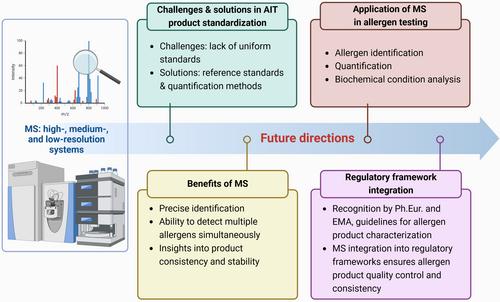
MS offers a very modern toolkit for allergen product testing, capable of addressing critical questions such as identifying allergen content, quantifying how much of each allergen is included, and determining biochemistry—oxidation or other modifications. Various MS technologies, each with unique features, enable a comprehensive approach to allergen characterization. These include high-resolution instruments ideal for identifying and confirming protein identities, medium-resolution systems like ion traps that excel in sequence elucidation and are suited for moderately complex samples, and low-resolution systems optimized for absolute quantification. The choice of MS technique depends on the specific requirements of the analysis, including the complexity of the sample involving the regulatory context.3 This diversity in MS applications offers significantly improved capacity for the quality and safety of allergen products.
Divergent findings in allergen product composition underline the critical role of MS. MS investigations have exposed significant inconsistencies in allergen content, showing deficiencies in house dust mite allergen products in India.4 In contrast, the presence of bee venom allergens in allergen immunotherapy (AIT) products was confirmed in contrast to IgG-immunoblotting analysis.5 The adequacy of these allergen levels in inducing an immune response remains under investigation.
Interestingly Augustin et al. (article in this issue) demonstrated the presence of all major allergens across different batches from various European producers. Mid-tier and most minor allergens were detected in batches from one manufacturer. In addition, the study reveals significant batch-to-batch consistency in allergen composition for products from a single manufacturer. Variability in mid-tier and most minor allergen content among products from different suppliers was shown. These data highlight the method's reliability and high-throughput capabilities. Implementing this perspective, a practical application of high-resolution MS, assessing the allergen composition of skin prick tests and AIT products derived from various allergen sources can be postulated, which provides a standardized method to ensure the comprehensive representation of allergen composition with a great potential to improve quality control of allergen products, aiming to enhance the efficacy and safety of allergy diagnostics and treatments.6
Allergen product manufacturers are required to adhere to established rules and guidelines for production, characterization, and quality control. However, the regulators usually mandate specific methods, leaving the choice of suitable techniques to the manufacturer's discretion. The integration of MS into regulatory frameworks for allergen product manufacturing underscores its pivotal role in ensuring product consistency and quality. As mandated by the European Pharmacopoeia (Ph.Eur.) and further emphasized by European Medicines Agency guidelines, MS serves as a useful tool for the in-depth characterization of allergen products, from raw material selection to final product release.7 This analytical method facilitates the identification of allergens and the assessment of product modifications, thereby supporting manufacturers in meeting regulatory standards and enhancing patient safety. The application of MS, coupled with rigorous validation protocols, enables a comprehensive understanding of product characteristics and manufacturing processes, essential for regulatory approval and market access.8 The dynamic evolution of Ph.Eur. Monographs, with their continuous refinement to reflect the latest scientific and pharmaceutical advancements, underscores the importance of adaptable analytical methods like MS. Particularly in the context of rare allergens or heterogeneous biological materials, MS emerges as a vital technique for ensuring compliance with the updated standards. Its application in characterizing complex allergen sources enhances the robustness of official batch testing. The broader integration of MS into regulatory frameworks is scientifically justified; however, its acceptance into the regulatory framework requires confirmation of its reliability across a wide array of studies. The regulatory mandate for any analytical technology and method necessitates solid evidence for the intended application. This forms a crucial factor in determining the eligibility of a medicinal product for market access.9
MS emerges as a promising tool for addressing the challenges of allergen product standardization, precise identification, quantification, and analysis of both allergenic and non-allergenic components. In conclusion, the key advantage of MS is its adaptability across various product types and the ability to fill the gaps created by current methods, which underscores the essential role of MS in the evolution of regulatory standards (Scheme 1).
All authors contributed to the writing and editing of the manuscript. All authors have read and agreed to the published version of the manuscript.
None.
Marek Jutel reports personal fees from ALK-Abello, Allergopharma, Stallergenes, Anergis, Allergy Therapeutics, Leti, HAL, during the conduct of the study; personal fees from GSK, Novartis, Teva, Takeda, Chiesi the submitted work; and is the Allergy Journal Deputy Editor. Magdalena Zemelka-Wiacek reports to be the EAACI Knowledge Hub Deputy Editor. Oliver Pfaar reports grants and/or personal fees and/or travel support from ALK-Abelló, Allergopharma, Stallergenes Greer, HAL Allergy Holding B.V./HAL Allergie GmbH, Bencard Allergie GmbH/Allergy Therapeutics, Laboratorios LETI/LETI Pharma, GlaxoSmithKline, ROXALL Medizin, Novartis, Sanofi-Aventis and Sanofi-Genzyme, Med Update Europe GmbH, streamedup! GmbH, Pohl-Boskamp, Inmunotek S.L., John Wiley and Sons/AS, Paul-Martini-Stiftung (PMS), Regeneron Pharmaceuticals Inc., RG Aerztefortbildung, Institut für Disease Management, Springer GmbH, AstraZeneca, IQVIA Commercial, Ingress Health, Wort&Bild Verlag, Verlag ME, Procter&Gamble, ALTAMIRA, Meinhardt Congress GmbH, Deutsche Forschungsgemeinschaft, Thieme, Deutsche AllergieLiga e.V., AeDA, Alfried-Krupp Krankenhaus, Red Maple Trials Inc., Königlich Dänisches Generalkonsulat, Medizinische Hochschule Hannover, ECM Expro&Conference Management, Technical University Dresden, Lilly, Japanese Society of Allergy, Forum für Medizinische Fortbildung, Dustri-Verlag, Pneumolive, ASIT Biotech, LOFARMA, Paul-Ehrlich-Institut, outside the submitted work; and he is member of EAACI Excom, member of ext. board of directors DGAKI; coordinator, main- or co-author of different position papers and guidelines in rhinology, allergology and allergen-immunotherapy; he is associate editor (AE) of Allergy and Clinical Translational Allergy.
期刊介绍:
Allergy is an international and multidisciplinary journal that aims to advance, impact, and communicate all aspects of the discipline of Allergy/Immunology. It publishes original articles, reviews, position papers, guidelines, editorials, news and commentaries, letters to the editors, and correspondences. The journal accepts articles based on their scientific merit and quality.
Allergy seeks to maintain contact between basic and clinical Allergy/Immunology and encourages contributions from contributors and readers from all countries. In addition to its publication, Allergy also provides abstracting and indexing information. Some of the databases that include Allergy abstracts are Abstracts on Hygiene & Communicable Disease, Academic Search Alumni Edition, AgBiotech News & Information, AGRICOLA Database, Biological Abstracts, PubMed Dietary Supplement Subset, and Global Health, among others.




 京公网安备 11010802042870号
京ICP备2023020795号-1
京公网安备 11010802042870号
京ICP备2023020795号-1

 分享
分享
 求助内容:
求助内容: 应助结果提醒方式:
 扫码关注我们
