{"title":"Rare earth recycling and remanufacturing: Impacts on oligopoly markets and industry development from a closed-loop supply chain perspective","authors":"Chenghao Lai , Xiuli Wang , Hengkai Li , Huan Tao","doi":"10.1016/j.jclepro.2024.143773","DOIUrl":null,"url":null,"abstract":"<div><div>The recycling of rare earth elements (REEs) yielded a dual benefit by alleviating supply constraints and contributing to environmental preservation. Independent recyclers (IRs), upon extracting REEs from waste materials, not only supplied the recovered REEs to the REE conglomerates but also engaged in competitive relationships by remanufacturing REE products. This study established a closed-loop supply framework, allowing the IR flexibly to choose between remanufacturing or direct sales strategies. Using the Cournot model under inequation constraints and real market data, to explores the impact of REE acquisition prices and recycling technologies on the closed-loop supply chain (CLSC) and society. The results indicated that: (1) The recycling mode and technology do not affect market share. Compared to the IR, REE conglomerate exhibit significant monopolistic advantages, occupying at least 85.1% of the market share, which can increase to a maximum of 98% as acquisition prices rise. (2) The acquisition price of recycled REE has an “inverse U-shaped” relationship with the profits of REE conglomerate and a positive relationship with the profits of IR. (3) The recovery rate is negatively related to the profits of REE conglomerate and positively related to the profits of IR. Increasing the REE recovery rate will enhance the profitability of the IR. (4) In terms of social effects, higher acquisition price of recycled REE continuously reduce consumer surplus and social welfare. Although the REE recovery rate does not affect consumer surplus, it has a significant positive impact on social welfare.</div></div>","PeriodicalId":349,"journal":{"name":"Journal of Cleaner Production","volume":"476 ","pages":"Article 143773"},"PeriodicalIF":10.0000,"publicationDate":"2024-10-15","publicationTypes":"Journal Article","fieldsOfStudy":null,"isOpenAccess":false,"openAccessPdf":"","citationCount":"0","resultStr":null,"platform":"Semanticscholar","paperid":null,"PeriodicalName":"Journal of Cleaner Production","FirstCategoryId":"93","ListUrlMain":"https://www.sciencedirect.com/science/article/pii/S0959652624032220","RegionNum":1,"RegionCategory":"环境科学与生态学","ArticlePicture":[],"TitleCN":null,"AbstractTextCN":null,"PMCID":null,"EPubDate":"2024/9/25 0:00:00","PubModel":"Epub","JCR":"Q1","JCRName":"ENGINEERING, ENVIRONMENTAL","Score":null,"Total":0}
引用次数: 0
Abstract
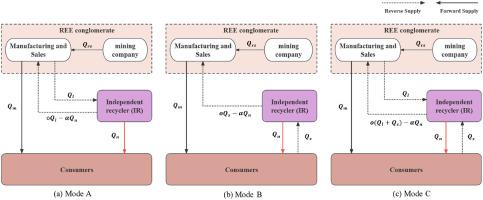
The recycling of rare earth elements (REEs) yielded a dual benefit by alleviating supply constraints and contributing to environmental preservation. Independent recyclers (IRs), upon extracting REEs from waste materials, not only supplied the recovered REEs to the REE conglomerates but also engaged in competitive relationships by remanufacturing REE products. This study established a closed-loop supply framework, allowing the IR flexibly to choose between remanufacturing or direct sales strategies. Using the Cournot model under inequation constraints and real market data, to explores the impact of REE acquisition prices and recycling technologies on the closed-loop supply chain (CLSC) and society. The results indicated that: (1) The recycling mode and technology do not affect market share. Compared to the IR, REE conglomerate exhibit significant monopolistic advantages, occupying at least 85.1% of the market share, which can increase to a maximum of 98% as acquisition prices rise. (2) The acquisition price of recycled REE has an “inverse U-shaped” relationship with the profits of REE conglomerate and a positive relationship with the profits of IR. (3) The recovery rate is negatively related to the profits of REE conglomerate and positively related to the profits of IR. Increasing the REE recovery rate will enhance the profitability of the IR. (4) In terms of social effects, higher acquisition price of recycled REE continuously reduce consumer surplus and social welfare. Although the REE recovery rate does not affect consumer surplus, it has a significant positive impact on social welfare.
期刊介绍:
The Journal of Cleaner Production is an international, transdisciplinary journal that addresses and discusses theoretical and practical Cleaner Production, Environmental, and Sustainability issues. It aims to help societies become more sustainable by focusing on the concept of 'Cleaner Production', which aims at preventing waste production and increasing efficiencies in energy, water, resources, and human capital use. The journal serves as a platform for corporations, governments, education institutions, regions, and societies to engage in discussions and research related to Cleaner Production, environmental, and sustainability practices.



 京公网安备 11010802042870号
京ICP备2023020795号-1
京公网安备 11010802042870号
京ICP备2023020795号-1

 分享
分享
 求助内容:
求助内容: 应助结果提醒方式:
 扫码关注我们
