Selective upcycling of brominated epoxy resin by subcritical water ammonia process with waste copper-based catalyst: Production of high purity methyl pyrimidine/phenols and copper recovery
{"title":"Selective upcycling of brominated epoxy resin by subcritical water ammonia process with waste copper-based catalyst: Production of high purity methyl pyrimidine/phenols and copper recovery","authors":"Fu-Rong Xiu, Jiali Wang, Yingying Qi","doi":"10.1016/j.seppur.2024.129827","DOIUrl":null,"url":null,"abstract":"<div><div>Tetrabromobisphenol A epoxy resin (TBBPAER) is the main non-metallic component of electronic waste. The scale of electronic waste production and the accompanying TBBPAER waste disposal problems represent a great opportunity for chemical upcycling. But the chemical upcycling of TBBPAER faces great challenges due to its high bromine content and thermally stability. In this study, a subcritical water ammonia (SWA) process combined with waste copper-based catalyst (WCC) selectively converted TBBPAER in high yields (63.46 % at 300°C for 15 min and 73.66 % for 60 min) to low molecular-weight liquid products including high value-added methyl pyrimidine and phenols. The electron transfer among multivalent copper species contained in the WCC promoted the production of free radicals <img>OH, <img>O<sub>2</sub><sup>−</sup>, <img>NH<sub>2</sub>, and :NH, which resulted in the efficient conversion of TBBPAER and a 99.29 % of debromination ratio. The molecular chain of TBBPAER was snipped by <img>OH and <img>NH<sub>2</sub> to produce tetrabromobisphenol A groups (TAG) and ternary carbon groups (TCG). The further degradation of TAG resulted in the producing of phenol chemicals with a purity of 91.8 % (GC peak area%). The further cyclization of TCG induced by :NH produced methyl pyrimidine with a purity of 91.9 % (GC peak area%). The formation of copper ammonia complex led to the leaching/recovery of 86.6 % of copper from the WCC. The SWA-WCC approach demonstrated how TBBPAER waste could be a viable feedstock for the producing of high value-added methyl pyrimidine and phenol chemicals. This study provided a novel sustainable strategy for synchronous treatment/upcycling of the two different wastes of TBBPAER and WCC. The leaching toxicity test of Cu and Zn for the solid residue after the co-treatment showed that their leaching concentrations were much lower than the hazardous waste standard.</div></div>","PeriodicalId":427,"journal":{"name":"Separation and Purification Technology","volume":"356 ","pages":"Article 129827"},"PeriodicalIF":9.0000,"publicationDate":"2025-04-01","publicationTypes":"Journal Article","fieldsOfStudy":null,"isOpenAccess":false,"openAccessPdf":"","citationCount":"0","resultStr":null,"platform":"Semanticscholar","paperid":null,"PeriodicalName":"Separation and Purification Technology","FirstCategoryId":"5","ListUrlMain":"https://www.sciencedirect.com/science/article/pii/S1383586624035664","RegionNum":1,"RegionCategory":"工程技术","ArticlePicture":[],"TitleCN":null,"AbstractTextCN":null,"PMCID":null,"EPubDate":"2024/9/21 0:00:00","PubModel":"Epub","JCR":"Q1","JCRName":"ENGINEERING, CHEMICAL","Score":null,"Total":0}
引用次数: 0
Abstract
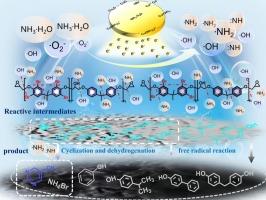
Tetrabromobisphenol A epoxy resin (TBBPAER) is the main non-metallic component of electronic waste. The scale of electronic waste production and the accompanying TBBPAER waste disposal problems represent a great opportunity for chemical upcycling. But the chemical upcycling of TBBPAER faces great challenges due to its high bromine content and thermally stability. In this study, a subcritical water ammonia (SWA) process combined with waste copper-based catalyst (WCC) selectively converted TBBPAER in high yields (63.46 % at 300°C for 15 min and 73.66 % for 60 min) to low molecular-weight liquid products including high value-added methyl pyrimidine and phenols. The electron transfer among multivalent copper species contained in the WCC promoted the production of free radicals OH, O2−, NH2, and :NH, which resulted in the efficient conversion of TBBPAER and a 99.29 % of debromination ratio. The molecular chain of TBBPAER was snipped by OH and NH2 to produce tetrabromobisphenol A groups (TAG) and ternary carbon groups (TCG). The further degradation of TAG resulted in the producing of phenol chemicals with a purity of 91.8 % (GC peak area%). The further cyclization of TCG induced by :NH produced methyl pyrimidine with a purity of 91.9 % (GC peak area%). The formation of copper ammonia complex led to the leaching/recovery of 86.6 % of copper from the WCC. The SWA-WCC approach demonstrated how TBBPAER waste could be a viable feedstock for the producing of high value-added methyl pyrimidine and phenol chemicals. This study provided a novel sustainable strategy for synchronous treatment/upcycling of the two different wastes of TBBPAER and WCC. The leaching toxicity test of Cu and Zn for the solid residue after the co-treatment showed that their leaching concentrations were much lower than the hazardous waste standard.
期刊介绍:
Separation and Purification Technology is a premier journal committed to sharing innovative methods for separation and purification in chemical and environmental engineering, encompassing both homogeneous solutions and heterogeneous mixtures. Our scope includes the separation and/or purification of liquids, vapors, and gases, as well as carbon capture and separation techniques. However, it's important to note that methods solely intended for analytical purposes are not within the scope of the journal. Additionally, disciplines such as soil science, polymer science, and metallurgy fall outside the purview of Separation and Purification Technology. Join us in advancing the field of separation and purification methods for sustainable solutions in chemical and environmental engineering.



 京公网安备 11010802042870号
京ICP备2023020795号-1
京公网安备 11010802042870号
京ICP备2023020795号-1

 分享
分享
 求助内容:
求助内容: 应助结果提醒方式:
 扫码关注我们
