{"title":"Do invasive plant species profit from pollution with synthetic organic chemicals?","authors":"Yudi M. Lozano, Matthias C. Rillig","doi":"10.1111/nph.20155","DOIUrl":null,"url":null,"abstract":"<p>Synthetic organic chemicals are a hallmark of the Anthropocene (Waters <i>et al</i>., <span>2016</span>). The diversity and quantity of synthetic chemicals have surged dramatically, with over 350 000 chemicals and chemical mixtures registered for commercial application world-wide, the vast majority organic chemicals (Wang <i>et al</i>., <span>2020</span>). Given this, it has been argued that synthetic chemicals are agents of global change (Bernhardt <i>et al</i>., <span>2017</span>) with different potential effects on terrestrial systems. Specifically, synthetic organic chemicals are increasingly recognized as an important threat to biodiversity and ecosystems (Sigmund <i>et al</i>., <span>2023</span>). Fertilizers, pesticides, surfactants, persistent organic pollutants, pharmaceutical and personal care products, per- and polyfluoroalkyl substances (PFAS), micro/nano plastics, organic solvents, antibiotics, endocrine-disrupting compounds, engineered nanoparticles, food and feed additives, among others, are widely employed in manufacturing, medicine and agriculture. These substances pollute terrestrial ecosystems via industrial discharges, spills, leaks, agricultural runoff, household products, and improper waste disposal (Wang <i>et al</i>., <span>2024</span>).</p><p>Synthetic organic chemicals exert negative effects on soil biota and plant performance. For instance, pesticides are produced to prevent the growth of unwanted organisms such as weeds or pathogens. However, they also kill or affect the reproductive potential of nontarget organisms like beneficial nematodes or earthworms with negative consequences on plant–soil systems (Ankit <i>et al</i>., <span>2020</span>). However, could some plants profit from this widespread pollution with synthetic organic chemicals? While various plant species might take advantage of this new situation, invasive species, with their set of characteristics, seem particularly well-suited. We consider that the diversity of these pollutants, their varying concentration, and their world-wide distribution create numerous novel environments from which invasive species could potentially benefit.</p><p>What would be the different mechanisms that may enable plant invasiveness in chemically polluted soils? (Fig. 1). Different competitive characteristics can enable certain alien or native plants to become invasive, and these traits may also contribute to a plant's ability to tolerate polluted environments. For example, traits related to growth rate, physiology, size, and fitness – such as rapid growth – are commonly observed in invasive species and could similarly enhance a plant's capacity to survive in polluted soils. However, we acknowledge that this relationship is not universally applicable to all invasive plants (van Kleunen <i>et al</i>., <span>2010b</span>). While there may be some overlap, the presence of these traits does not necessarily imply pollution tolerance across all species.</p><p>Plant invasion is often driven by specific traits, leading to high dominance within the community. However, the mechanisms underlying plant invasion in the context of soil chemical pollution remain largely unexplored. Invasive species can possess advantageous traits that might enable them to avoid or better tolerate chemical pollution, potentially making them less susceptible to pollutants than their noninvasive counterparts. Plants can invade vegetation in various ways, likely relying on different traits to do so (Lai <i>et al</i>., <span>2015</span>). For instance, invasive species might have favorable root traits making them less susceptible to chemical pollution. Roots are often the first tissue that comes in contact with soil pollutants, and therefore absorption via roots is the most common method of uptake. Invasive species often exhibit faster and greater biomass allocation to roots compared to native species (van Kleunen <i>et al</i>., <span>2010</span>; Keser <i>et al</i>., <span>2014</span>). Indeed, invasive species have been observed to develop deep roots in polluted roadside environments (Brisson <i>et al</i>., <span>2010</span>), which potentially allows them to avoid stress from contamination by accessing deeper soil layers that are less affected by pollutants or by extending their roots laterally. Likewise, invasive species can produce thicker roots that are often less absorptive, which appears to contribute to their competitive advantage over noninvasives in polluted soils (Fu <i>et al</i>., <span>2022</span>). This would help them reduce the sorption of soil pollutants, thus reducing their exposure to pollutants in soil. Likewise, invasive species could also be able to escape from chemical pollution due to phytovolatilization. That is, invasive species can uptake contaminants from the soil and subsequently convert and release them as less toxic vapors into the atmosphere through transpiration (Prabakaran <i>et al</i>., <span>2019</span>). Poplar trees, invasive plants in South Africa (Robinson <i>et al</i>., <span>2017</span>), were capable of taking up trichloroethylene, an industrial halocarbon, and phytovolatilizing it in measurable amounts in its introduced range (Newman <i>et al</i>., <span>1997</span>). By doing so, invasive species can reduce their own exposure to toxic substances, partially escaping from chemical pollution. Such a phenomenon is also plausible in its native range (Strycharz & Newman, <span>2009</span>), and it is thus an example of a plant trait that may provide additional benefit in polluted areas outside of the native range of the plant. While this specific trait may not be common in many invasive species, the presence of such plants could increase local richness, increasing the likelihood of finding unique traits. Additionally, due to the relatively low-host specificity of arbuscular mycorrhizal fungi (AMF), AM symbioses could support the success of invasives such as the shrub <i>Corchotus capsulari</i>; besides improving plant nutrition, AMF may lower soil anthracene concentrations by boosting root oxidoreductase activity (Cheung <i>et al</i>., <span>2008</span>).</p><p>Other traits such as height, specific leaf area, seed mass, and reproductive type have a complex relation with plant invasion as they can show positive, negative, or no relationship across different invasion dimensions such as spread rate, local abundance, or geographic and environmental range sizes (Palma <i>et al</i>., <span>2021</span>). However, the specific response of these traits in chemically polluted soils needs to be evaluated. For instance, invasive plants with large seeds (Daws <i>et al</i>., <span>2007</span>), may escape from pollutants and maintain better germination rates than noninvasive species with typically smaller seeds. This is because larger seeds normally have larger endosperms, which serve as energy reserves for germination (Valencia-Díaz <i>et al</i>., <span>2015</span>), allowing these plants to initially depend less on external resources. Additionally, the thicker seed coat helps reduce water permeability (Souza & Fagundes, <span>2014</span>), which together, may help seeds to avoid pollutants. By contrast, invasive species with smaller seeds can increase their chances of germination, potentially even in polluted soils (Lake & Leishman, <span>2004</span>), or avoid these pollutants by dispersing over large distances.</p><p>Invasive species can possess antioxidant systems that potentially could mitigate the oxidative stress induced by chemical pollution, as these antioxidants offer superior protection against stress (Pintó-Marijuan & Munné-Bosch, <span>2013</span>). For instance, the invasive forb <i>Wedelia trilobata</i> has greater tolerance to the antibiotic Levofloxacin hydrochloride compared to its native noninvasive counterpart <i>Wedelia chinensis</i>, largely due to its robust antioxidant system (Huang <i>et al</i>., <span>2023</span>). Indeed, invasive plants often exhibit broad environmental tolerance (Moura <i>et al</i>., <span>2021</span>), which may allow them to thrive in polluted soils. For instance, invasive aquatic plants have shown greater tolerance to the antibiotic ciprofloxacin compared to noninvasive plants (Fan <i>et al</i>., <span>2024</span>). Additionally, populations of invasive plants evolve greater tolerance to biotic and abiotic stressors (Gong <i>et al</i>., <span>2022</span>). This may suggest evolving a greater tolerance to synthetic pollutants, which in the end helps to promote plant invasiveness. Importantly, the mechanisms behind this process for such specific stressors are still unknown.</p><p>Phenotypic plasticity, the ability of a plant to manifest varying phenotypes in response to different environmental conditions (Bradshaw, <span>1965</span>), enhances the invasiveness of plants, aiding their spread and establishment in new environments (Zenni <i>et al</i>., <span>2014</span>). Invasive species exhibit higher phenotypic plasticity compared to noninvasive species (Davidson <i>et al</i>., <span>2011</span>). However, such a response depends on the environmental stressor and the phenotypic trait (Zhang <i>et al</i>., <span>2023</span>). Thus, whether invasive plants exhibit higher phenotypic plasticity that noninvasives to chemically polluted soils may be evaluated based on the trait and the specific pollutant.</p><p>We explored potential traits through which invasive plants might outcompete noninvasive species in soils polluted with synthetic organic chemicals. We highlighted some common traits shared by various invasive plants, but the literature shows that invasive species can have a wide variety of traits, in many cases contrasting. Therefore, clearly more studies are needed to test if such effects hold when a greater variety of cases (in terms of plants, traits, and pollutants) are considered. Species with these traits could positively impact heavily polluted soils such as lead and zinc mining areas or toxic waste dumps, where vegetation is absent and unlikely to flourish. In such environments, species of invasive character may act as early colonizers rather than being viewed as invaders, helping to initiate the recovery of these areas. However, to use them effectively, it is crucial to control their spread beyond these specific soils to avoid them from dominating surrounding plant communities. Therefore, thorough research is essential before considering the use of invasive species for this purpose.</p><p>Overall, we foresee the need for more experimental work, for tapping existing databases and for targeted observational studies. A priority should be conducting toxicity assays using individual chemicals, in mixture, and at different concentrations, to assess the potential competitive advantage of invasive species over noninvasive in terms of root development, reproductive capacity, and mycorrhizal associations, among other plant traits. Collating already existing data on invasive plant traits – such as root growth, exudates, seed germination, offspring survival, AMF structures – along with bioaccumulation studies on plant tissues, will help predict invasiveness patterns in polluted soils. Factorial experiments can be performed to assess the potential synergistic or antagonistic effects between synthetic organic chemicals and/or in combination with other global change drivers, such as drought and temperature. Importantly, variables such as high-nutrient availability or disturbance could covary with high-pollutant concentrations. Therefore, experiments should be designed to avoid these confounding factors and distinguish them from the direct effects of pollutants as a potential causal effect promoting plant invasiveness. Observational studies can be used to find patterns linking soil pollution with invasive plant success. Many of these studies can be performed in the invasive range of the plants, but experiments should also test whether there is a difference compared to plant performance in their native range, in case enhanced performance under pollution has evolved in the invaded range. Additionally, identifying whether a species is invasive or noninvasive can be complex. Thus, in agreement with Palma <i>et al</i>. (<span>2021</span>), we consider it to be more informative to study the dimensions of invasiveness, such as the rate of spread, environmental and geographic range sizes, and relative local abundance (i.e. dominance) of the plants, rather than relying on binary classifications.</p><p>Plant invasion and soil pollution by synthetic organic chemicals are currently mostly tackled separately by different scientific groups. In agreement with Sigmund <i>et al</i>. (<span>2023</span>), we suggest that success in addressing these issues requires collaboration across disciplines, including ecology, ecotoxicology, and environmental chemistry. While we need a more comprehensive analysis of the effects of synthetic organic pollutants on the full range of plant traits and life history characteristics of our plant communities, focusing initially on invasive plants is crucial. If increasing soil pollution with synthetic organic chemicals indeed broadly favors invasive species, then we have been underestimating the true effects of such substances on the environment.</p><p>None declared.</p><p>YML and MCR contributed equally to this work.</p>","PeriodicalId":214,"journal":{"name":"New Phytologist","volume":"244 6","pages":"2137-2140"},"PeriodicalIF":8.1000,"publicationDate":"2024-09-27","publicationTypes":"Journal Article","fieldsOfStudy":null,"isOpenAccess":false,"openAccessPdf":"https://onlinelibrary.wiley.com/doi/epdf/10.1111/nph.20155","citationCount":"0","resultStr":null,"platform":"Semanticscholar","paperid":null,"PeriodicalName":"New Phytologist","FirstCategoryId":"99","ListUrlMain":"https://nph.onlinelibrary.wiley.com/doi/10.1111/nph.20155","RegionNum":1,"RegionCategory":"生物学","ArticlePicture":[],"TitleCN":null,"AbstractTextCN":null,"PMCID":null,"EPubDate":"","PubModel":"","JCR":"Q1","JCRName":"PLANT SCIENCES","Score":null,"Total":0}
引用次数: 0
Abstract
Synthetic organic chemicals are a hallmark of the Anthropocene (Waters et al., 2016). The diversity and quantity of synthetic chemicals have surged dramatically, with over 350 000 chemicals and chemical mixtures registered for commercial application world-wide, the vast majority organic chemicals (Wang et al., 2020). Given this, it has been argued that synthetic chemicals are agents of global change (Bernhardt et al., 2017) with different potential effects on terrestrial systems. Specifically, synthetic organic chemicals are increasingly recognized as an important threat to biodiversity and ecosystems (Sigmund et al., 2023). Fertilizers, pesticides, surfactants, persistent organic pollutants, pharmaceutical and personal care products, per- and polyfluoroalkyl substances (PFAS), micro/nano plastics, organic solvents, antibiotics, endocrine-disrupting compounds, engineered nanoparticles, food and feed additives, among others, are widely employed in manufacturing, medicine and agriculture. These substances pollute terrestrial ecosystems via industrial discharges, spills, leaks, agricultural runoff, household products, and improper waste disposal (Wang et al., 2024).
Synthetic organic chemicals exert negative effects on soil biota and plant performance. For instance, pesticides are produced to prevent the growth of unwanted organisms such as weeds or pathogens. However, they also kill or affect the reproductive potential of nontarget organisms like beneficial nematodes or earthworms with negative consequences on plant–soil systems (Ankit et al., 2020). However, could some plants profit from this widespread pollution with synthetic organic chemicals? While various plant species might take advantage of this new situation, invasive species, with their set of characteristics, seem particularly well-suited. We consider that the diversity of these pollutants, their varying concentration, and their world-wide distribution create numerous novel environments from which invasive species could potentially benefit.
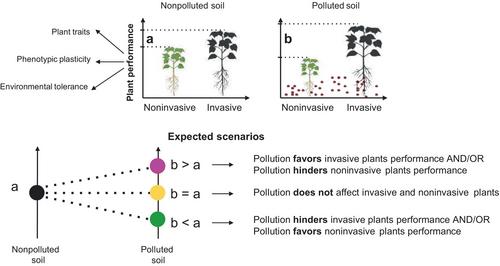
What would be the different mechanisms that may enable plant invasiveness in chemically polluted soils? (Fig. 1). Different competitive characteristics can enable certain alien or native plants to become invasive, and these traits may also contribute to a plant's ability to tolerate polluted environments. For example, traits related to growth rate, physiology, size, and fitness – such as rapid growth – are commonly observed in invasive species and could similarly enhance a plant's capacity to survive in polluted soils. However, we acknowledge that this relationship is not universally applicable to all invasive plants (van Kleunen et al., 2010b). While there may be some overlap, the presence of these traits does not necessarily imply pollution tolerance across all species.
Plant invasion is often driven by specific traits, leading to high dominance within the community. However, the mechanisms underlying plant invasion in the context of soil chemical pollution remain largely unexplored. Invasive species can possess advantageous traits that might enable them to avoid or better tolerate chemical pollution, potentially making them less susceptible to pollutants than their noninvasive counterparts. Plants can invade vegetation in various ways, likely relying on different traits to do so (Lai et al., 2015). For instance, invasive species might have favorable root traits making them less susceptible to chemical pollution. Roots are often the first tissue that comes in contact with soil pollutants, and therefore absorption via roots is the most common method of uptake. Invasive species often exhibit faster and greater biomass allocation to roots compared to native species (van Kleunen et al., 2010; Keser et al., 2014). Indeed, invasive species have been observed to develop deep roots in polluted roadside environments (Brisson et al., 2010), which potentially allows them to avoid stress from contamination by accessing deeper soil layers that are less affected by pollutants or by extending their roots laterally. Likewise, invasive species can produce thicker roots that are often less absorptive, which appears to contribute to their competitive advantage over noninvasives in polluted soils (Fu et al., 2022). This would help them reduce the sorption of soil pollutants, thus reducing their exposure to pollutants in soil. Likewise, invasive species could also be able to escape from chemical pollution due to phytovolatilization. That is, invasive species can uptake contaminants from the soil and subsequently convert and release them as less toxic vapors into the atmosphere through transpiration (Prabakaran et al., 2019). Poplar trees, invasive plants in South Africa (Robinson et al., 2017), were capable of taking up trichloroethylene, an industrial halocarbon, and phytovolatilizing it in measurable amounts in its introduced range (Newman et al., 1997). By doing so, invasive species can reduce their own exposure to toxic substances, partially escaping from chemical pollution. Such a phenomenon is also plausible in its native range (Strycharz & Newman, 2009), and it is thus an example of a plant trait that may provide additional benefit in polluted areas outside of the native range of the plant. While this specific trait may not be common in many invasive species, the presence of such plants could increase local richness, increasing the likelihood of finding unique traits. Additionally, due to the relatively low-host specificity of arbuscular mycorrhizal fungi (AMF), AM symbioses could support the success of invasives such as the shrub Corchotus capsulari; besides improving plant nutrition, AMF may lower soil anthracene concentrations by boosting root oxidoreductase activity (Cheung et al., 2008).
Other traits such as height, specific leaf area, seed mass, and reproductive type have a complex relation with plant invasion as they can show positive, negative, or no relationship across different invasion dimensions such as spread rate, local abundance, or geographic and environmental range sizes (Palma et al., 2021). However, the specific response of these traits in chemically polluted soils needs to be evaluated. For instance, invasive plants with large seeds (Daws et al., 2007), may escape from pollutants and maintain better germination rates than noninvasive species with typically smaller seeds. This is because larger seeds normally have larger endosperms, which serve as energy reserves for germination (Valencia-Díaz et al., 2015), allowing these plants to initially depend less on external resources. Additionally, the thicker seed coat helps reduce water permeability (Souza & Fagundes, 2014), which together, may help seeds to avoid pollutants. By contrast, invasive species with smaller seeds can increase their chances of germination, potentially even in polluted soils (Lake & Leishman, 2004), or avoid these pollutants by dispersing over large distances.
Invasive species can possess antioxidant systems that potentially could mitigate the oxidative stress induced by chemical pollution, as these antioxidants offer superior protection against stress (Pintó-Marijuan & Munné-Bosch, 2013). For instance, the invasive forb Wedelia trilobata has greater tolerance to the antibiotic Levofloxacin hydrochloride compared to its native noninvasive counterpart Wedelia chinensis, largely due to its robust antioxidant system (Huang et al., 2023). Indeed, invasive plants often exhibit broad environmental tolerance (Moura et al., 2021), which may allow them to thrive in polluted soils. For instance, invasive aquatic plants have shown greater tolerance to the antibiotic ciprofloxacin compared to noninvasive plants (Fan et al., 2024). Additionally, populations of invasive plants evolve greater tolerance to biotic and abiotic stressors (Gong et al., 2022). This may suggest evolving a greater tolerance to synthetic pollutants, which in the end helps to promote plant invasiveness. Importantly, the mechanisms behind this process for such specific stressors are still unknown.
Phenotypic plasticity, the ability of a plant to manifest varying phenotypes in response to different environmental conditions (Bradshaw, 1965), enhances the invasiveness of plants, aiding their spread and establishment in new environments (Zenni et al., 2014). Invasive species exhibit higher phenotypic plasticity compared to noninvasive species (Davidson et al., 2011). However, such a response depends on the environmental stressor and the phenotypic trait (Zhang et al., 2023). Thus, whether invasive plants exhibit higher phenotypic plasticity that noninvasives to chemically polluted soils may be evaluated based on the trait and the specific pollutant.
We explored potential traits through which invasive plants might outcompete noninvasive species in soils polluted with synthetic organic chemicals. We highlighted some common traits shared by various invasive plants, but the literature shows that invasive species can have a wide variety of traits, in many cases contrasting. Therefore, clearly more studies are needed to test if such effects hold when a greater variety of cases (in terms of plants, traits, and pollutants) are considered. Species with these traits could positively impact heavily polluted soils such as lead and zinc mining areas or toxic waste dumps, where vegetation is absent and unlikely to flourish. In such environments, species of invasive character may act as early colonizers rather than being viewed as invaders, helping to initiate the recovery of these areas. However, to use them effectively, it is crucial to control their spread beyond these specific soils to avoid them from dominating surrounding plant communities. Therefore, thorough research is essential before considering the use of invasive species for this purpose.
Overall, we foresee the need for more experimental work, for tapping existing databases and for targeted observational studies. A priority should be conducting toxicity assays using individual chemicals, in mixture, and at different concentrations, to assess the potential competitive advantage of invasive species over noninvasive in terms of root development, reproductive capacity, and mycorrhizal associations, among other plant traits. Collating already existing data on invasive plant traits – such as root growth, exudates, seed germination, offspring survival, AMF structures – along with bioaccumulation studies on plant tissues, will help predict invasiveness patterns in polluted soils. Factorial experiments can be performed to assess the potential synergistic or antagonistic effects between synthetic organic chemicals and/or in combination with other global change drivers, such as drought and temperature. Importantly, variables such as high-nutrient availability or disturbance could covary with high-pollutant concentrations. Therefore, experiments should be designed to avoid these confounding factors and distinguish them from the direct effects of pollutants as a potential causal effect promoting plant invasiveness. Observational studies can be used to find patterns linking soil pollution with invasive plant success. Many of these studies can be performed in the invasive range of the plants, but experiments should also test whether there is a difference compared to plant performance in their native range, in case enhanced performance under pollution has evolved in the invaded range. Additionally, identifying whether a species is invasive or noninvasive can be complex. Thus, in agreement with Palma et al. (2021), we consider it to be more informative to study the dimensions of invasiveness, such as the rate of spread, environmental and geographic range sizes, and relative local abundance (i.e. dominance) of the plants, rather than relying on binary classifications.
Plant invasion and soil pollution by synthetic organic chemicals are currently mostly tackled separately by different scientific groups. In agreement with Sigmund et al. (2023), we suggest that success in addressing these issues requires collaboration across disciplines, including ecology, ecotoxicology, and environmental chemistry. While we need a more comprehensive analysis of the effects of synthetic organic pollutants on the full range of plant traits and life history characteristics of our plant communities, focusing initially on invasive plants is crucial. If increasing soil pollution with synthetic organic chemicals indeed broadly favors invasive species, then we have been underestimating the true effects of such substances on the environment.
期刊介绍:
New Phytologist is an international electronic journal published 24 times a year. It is owned by the New Phytologist Foundation, a non-profit-making charitable organization dedicated to promoting plant science. The journal publishes excellent, novel, rigorous, and timely research and scholarship in plant science and its applications. The articles cover topics in five sections: Physiology & Development, Environment, Interaction, Evolution, and Transformative Plant Biotechnology. These sections encompass intracellular processes, global environmental change, and encourage cross-disciplinary approaches. The journal recognizes the use of techniques from molecular and cell biology, functional genomics, modeling, and system-based approaches in plant science. Abstracting and Indexing Information for New Phytologist includes Academic Search, AgBiotech News & Information, Agroforestry Abstracts, Biochemistry & Biophysics Citation Index, Botanical Pesticides, CAB Abstracts®, Environment Index, Global Health, and Plant Breeding Abstracts, and others.





 京公网安备 11010802042870号
京ICP备2023020795号-1
京公网安备 11010802042870号
京ICP备2023020795号-1

 分享
分享
 求助内容:
求助内容: 应助结果提醒方式:
 扫码关注我们
