{"title":"Synthesis, Surface Chemistry, and Applications of Non-Zero-Dimensional Diamond Nanostructures","authors":"Changli Li, Xin Jiang, Nianjun Yang","doi":"10.1002/smll.202400798","DOIUrl":null,"url":null,"abstract":"<p>Diamond nanomaterials are renowned for their exceptional properties, which include the inherent attributes of bulk diamond. Additionally, they exhibit unique characteristics at the nanoscale, including high specific surface areas, tunable surface structure, and excellent biocompatibility. These multifaceted attributes have piqued the interest of researchers globally, leading to an extensive exploration of various diamond nanostructures in a myriad of applications. This review focuses on non-zero-dimensional (non-0D) diamond nanostructures including diamond films and extended diamond nanostructures, such as diamond nanowires, nanoplatelets, and diamond foams. It delves into the fabrication, modification, and diverse applications of non-0D diamond nanostructures. This review begins with a concise review of the preparation methods for different types of diamond films and extended nanostructures, followed by an exploration of the intricacies of surface termination and the process of immobilizing target moieties of interest. It then transitions into an exploration of the applications of diamond films and extended nanostructures in the fields of biomedicine and electrochemistry. In the concluding section, this article provides a forward-looking perspective on the current state and future directions of diamond films and extended nanostructures research, offering insights into the opportunities and challenges that lie ahead in this exciting field.</p>","PeriodicalId":228,"journal":{"name":"Small","volume":"20 50","pages":""},"PeriodicalIF":12.1000,"publicationDate":"2024-09-28","publicationTypes":"Journal Article","fieldsOfStudy":null,"isOpenAccess":false,"openAccessPdf":"","citationCount":"0","resultStr":null,"platform":"Semanticscholar","paperid":null,"PeriodicalName":"Small","FirstCategoryId":"88","ListUrlMain":"https://onlinelibrary.wiley.com/doi/10.1002/smll.202400798","RegionNum":2,"RegionCategory":"材料科学","ArticlePicture":[],"TitleCN":null,"AbstractTextCN":null,"PMCID":null,"EPubDate":"","PubModel":"","JCR":"Q1","JCRName":"CHEMISTRY, MULTIDISCIPLINARY","Score":null,"Total":0}
引用次数: 0
Abstract
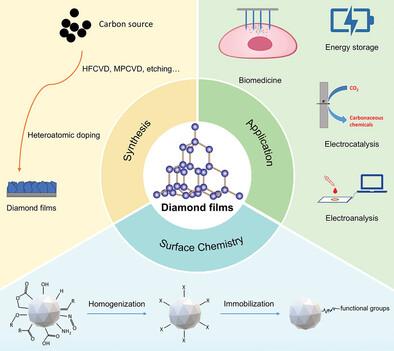
Diamond nanomaterials are renowned for their exceptional properties, which include the inherent attributes of bulk diamond. Additionally, they exhibit unique characteristics at the nanoscale, including high specific surface areas, tunable surface structure, and excellent biocompatibility. These multifaceted attributes have piqued the interest of researchers globally, leading to an extensive exploration of various diamond nanostructures in a myriad of applications. This review focuses on non-zero-dimensional (non-0D) diamond nanostructures including diamond films and extended diamond nanostructures, such as diamond nanowires, nanoplatelets, and diamond foams. It delves into the fabrication, modification, and diverse applications of non-0D diamond nanostructures. This review begins with a concise review of the preparation methods for different types of diamond films and extended nanostructures, followed by an exploration of the intricacies of surface termination and the process of immobilizing target moieties of interest. It then transitions into an exploration of the applications of diamond films and extended nanostructures in the fields of biomedicine and electrochemistry. In the concluding section, this article provides a forward-looking perspective on the current state and future directions of diamond films and extended nanostructures research, offering insights into the opportunities and challenges that lie ahead in this exciting field.
期刊介绍:
Small serves as an exceptional platform for both experimental and theoretical studies in fundamental and applied interdisciplinary research at the nano- and microscale. The journal offers a compelling mix of peer-reviewed Research Articles, Reviews, Perspectives, and Comments.
With a remarkable 2022 Journal Impact Factor of 13.3 (Journal Citation Reports from Clarivate Analytics, 2023), Small remains among the top multidisciplinary journals, covering a wide range of topics at the interface of materials science, chemistry, physics, engineering, medicine, and biology.
Small's readership includes biochemists, biologists, biomedical scientists, chemists, engineers, information technologists, materials scientists, physicists, and theoreticians alike.



 京公网安备 11010802042870号
京ICP备2023020795号-1
京公网安备 11010802042870号
京ICP备2023020795号-1

 分享
分享
 求助内容:
求助内容: 应助结果提醒方式:
 扫码关注我们
