Saisai Li, Yuanzhi Jiang, Jian Xu, Di Wang, Zijin Ding, Tong Zhu, Bin Chen, Yingguo Yang, Mingyang Wei, Renjun Guo, Yi Hou, Yu Chen, Changjiu Sun, Keyu Wei, Saif M. H. Qaid, Haizhou Lu, Hairen Tan, Dawei Di, Jun Chen, Michael Grätzel, Edward H. Sargent, Mingjian Yuan
{"title":"High-efficiency and thermally stable FACsPbI3 perovskite photovoltaics","authors":"Saisai Li, Yuanzhi Jiang, Jian Xu, Di Wang, Zijin Ding, Tong Zhu, Bin Chen, Yingguo Yang, Mingyang Wei, Renjun Guo, Yi Hou, Yu Chen, Changjiu Sun, Keyu Wei, Saif M. H. Qaid, Haizhou Lu, Hairen Tan, Dawei Di, Jun Chen, Michael Grätzel, Edward H. Sargent, Mingjian Yuan","doi":"10.1038/s41586-024-08103-7","DOIUrl":null,"url":null,"abstract":"α-FA1−xCsxPbI3 is a promising absorbent material for efficient and stable perovskite solar cells (PSCs)1,2. However, the most efficient α-FA1−xCsxPbI3 PSCs require the inclusion of the additive methylammonium chloride3,4, which generates volatile organic residues (methylammonium) that limit device stability at elevated temperatures5. Previously, the highest certified power-conversion efficiency of α-FA1−xCsxPbI3 PSCs without methylammonium chloride was only approximately 24% (refs. 6,7), and these PSCs have yet to exhibit any stability advantages. Here we identify interfacial contact loss caused by the accumulation of Cs+ in conventional α-FA1−xCsxPbI3 PSCs, which deteriorates device performance and stability. Through in situ grazing-incidence wide-angle X-ray scattering analysis and density functional theory calculations, we demonstrate an intermediate-phase-assisted crystallization pathway enabled by acetate surface coordination to fabricate high-quality α-FA1−xCsxPbI3 films, without using the methylammonium additive. We herein report a certified stabilized power output efficiency of 25.94% and a reverse-scanning power-conversion efficiency of 26.64% for α-FA1−xCsxPbI3 PSCs. Moreover, the devices exhibited negligible contact losses and enhanced operational stability. They retained over 95% of their initial power-conversion efficiency after operating for over 2,000 h at the maximum power point under 1 sun, 85 °C and 60% relative humidity (ISOS-L-3). Suppressing surface Cs+ accumulation in methylammonium-free α-FA1−xCsxPbI3 perovskite with an intermediate phase-assisted strategy enables high-efficiency and thermally stable photovoltaics.","PeriodicalId":18787,"journal":{"name":"Nature","volume":"635 8037","pages":"82-88"},"PeriodicalIF":48.5000,"publicationDate":"2024-09-30","publicationTypes":"Journal Article","fieldsOfStudy":null,"isOpenAccess":false,"openAccessPdf":"","citationCount":"0","resultStr":null,"platform":"Semanticscholar","paperid":null,"PeriodicalName":"Nature","FirstCategoryId":"103","ListUrlMain":"https://www.nature.com/articles/s41586-024-08103-7","RegionNum":1,"RegionCategory":"综合性期刊","ArticlePicture":[],"TitleCN":null,"AbstractTextCN":null,"PMCID":null,"EPubDate":"","PubModel":"","JCR":"Q1","JCRName":"MULTIDISCIPLINARY SCIENCES","Score":null,"Total":0}
引用次数: 0
Abstract
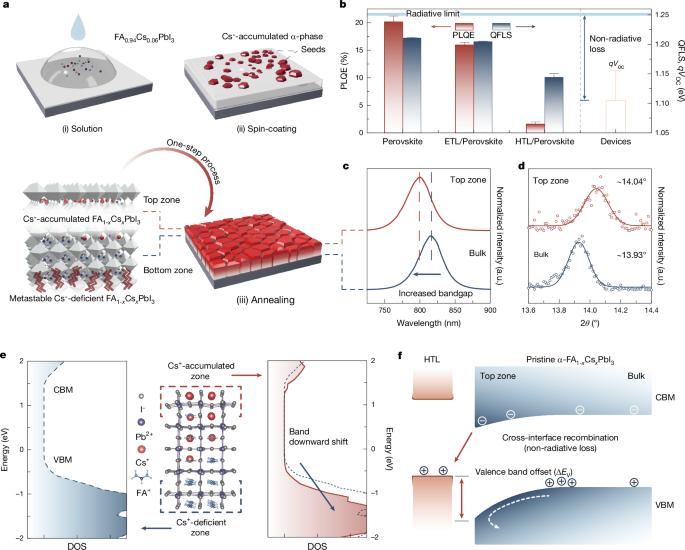
α-FA1−xCsxPbI3 is a promising absorbent material for efficient and stable perovskite solar cells (PSCs)1,2. However, the most efficient α-FA1−xCsxPbI3 PSCs require the inclusion of the additive methylammonium chloride3,4, which generates volatile organic residues (methylammonium) that limit device stability at elevated temperatures5. Previously, the highest certified power-conversion efficiency of α-FA1−xCsxPbI3 PSCs without methylammonium chloride was only approximately 24% (refs. 6,7), and these PSCs have yet to exhibit any stability advantages. Here we identify interfacial contact loss caused by the accumulation of Cs+ in conventional α-FA1−xCsxPbI3 PSCs, which deteriorates device performance and stability. Through in situ grazing-incidence wide-angle X-ray scattering analysis and density functional theory calculations, we demonstrate an intermediate-phase-assisted crystallization pathway enabled by acetate surface coordination to fabricate high-quality α-FA1−xCsxPbI3 films, without using the methylammonium additive. We herein report a certified stabilized power output efficiency of 25.94% and a reverse-scanning power-conversion efficiency of 26.64% for α-FA1−xCsxPbI3 PSCs. Moreover, the devices exhibited negligible contact losses and enhanced operational stability. They retained over 95% of their initial power-conversion efficiency after operating for over 2,000 h at the maximum power point under 1 sun, 85 °C and 60% relative humidity (ISOS-L-3). Suppressing surface Cs+ accumulation in methylammonium-free α-FA1−xCsxPbI3 perovskite with an intermediate phase-assisted strategy enables high-efficiency and thermally stable photovoltaics.
期刊介绍:
Nature is a prestigious international journal that publishes peer-reviewed research in various scientific and technological fields. The selection of articles is based on criteria such as originality, importance, interdisciplinary relevance, timeliness, accessibility, elegance, and surprising conclusions. In addition to showcasing significant scientific advances, Nature delivers rapid, authoritative, insightful news, and interpretation of current and upcoming trends impacting science, scientists, and the broader public. The journal serves a dual purpose: firstly, to promptly share noteworthy scientific advances and foster discussions among scientists, and secondly, to ensure the swift dissemination of scientific results globally, emphasizing their significance for knowledge, culture, and daily life.



 京公网安备 11010802042870号
京ICP备2023020795号-1
京公网安备 11010802042870号
京ICP备2023020795号-1

 分享
分享
 求助内容:
求助内容: 应助结果提醒方式:
 扫码关注我们
