Shi Zhang, Xiao Han, Xiaocheng Liu, Zixiang Huang, Pinyi Wang, Sizhe Sheng, Geng Wu, Jiachuan He, Jingjing Guo, Xusheng Zheng, Hai Li, Jian-Wei Liu, Xun Hong
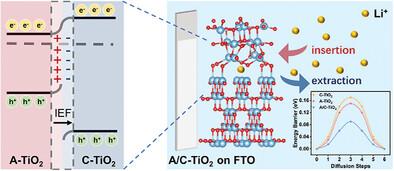
{"title":"Amorphous-Crystalline Interface Induced Internal Electric Fields for Electrochromic Smart Window","authors":"Shi Zhang, Xiao Han, Xiaocheng Liu, Zixiang Huang, Pinyi Wang, Sizhe Sheng, Geng Wu, Jiachuan He, Jingjing Guo, Xusheng Zheng, Hai Li, Jian-Wei Liu, Xun Hong","doi":"10.1002/adma.202410355","DOIUrl":null,"url":null,"abstract":"<p>Balancing optical modulation and response time is crucial for achieving high coloration efficiency in electrochromic materials. Here, internal electric fields are introduced to titanium dioxide nanosheets by constructing abundant amorphous-crystalline interfaces, ensuring large optical modulation while reducing response time and therefore improving coloration efficiency. Aberration-corrected high-angle annular dark-field scanning transmission electron microscopy (HAADF-STEM) reveals the presence of numerous amorphous-crystalline phase boundaries in titanium dioxide nanosheets. Kelvin probe force microscopy (KPFM) exhibits an intense surface potential distribution, demonstrating the presence of internal electric fields. Density functional theory (DFT) calculations confirm that the amorphous-crystalline heterointerfaces can generate internal electric fields and reduce diffusion barriers of lithium ions. As a result, the amorphous-crystalline titanium dioxide nanosheets exhibit better coloration efficiency (35.1 cm<sup>2</sup> C<sup>−1</sup>) than pure amorphous and crystalline titanium dioxide nanosheets.</p>","PeriodicalId":114,"journal":{"name":"Advanced Materials","volume":"36 47","pages":""},"PeriodicalIF":26.8000,"publicationDate":"2024-09-30","publicationTypes":"Journal Article","fieldsOfStudy":null,"isOpenAccess":false,"openAccessPdf":"","citationCount":"0","resultStr":null,"platform":"Semanticscholar","paperid":null,"PeriodicalName":"Advanced Materials","FirstCategoryId":"88","ListUrlMain":"https://advanced.onlinelibrary.wiley.com/doi/10.1002/adma.202410355","RegionNum":1,"RegionCategory":"材料科学","ArticlePicture":[],"TitleCN":null,"AbstractTextCN":null,"PMCID":null,"EPubDate":"","PubModel":"","JCR":"Q1","JCRName":"CHEMISTRY, MULTIDISCIPLINARY","Score":null,"Total":0}
引用次数: 0
Abstract
Balancing optical modulation and response time is crucial for achieving high coloration efficiency in electrochromic materials. Here, internal electric fields are introduced to titanium dioxide nanosheets by constructing abundant amorphous-crystalline interfaces, ensuring large optical modulation while reducing response time and therefore improving coloration efficiency. Aberration-corrected high-angle annular dark-field scanning transmission electron microscopy (HAADF-STEM) reveals the presence of numerous amorphous-crystalline phase boundaries in titanium dioxide nanosheets. Kelvin probe force microscopy (KPFM) exhibits an intense surface potential distribution, demonstrating the presence of internal electric fields. Density functional theory (DFT) calculations confirm that the amorphous-crystalline heterointerfaces can generate internal electric fields and reduce diffusion barriers of lithium ions. As a result, the amorphous-crystalline titanium dioxide nanosheets exhibit better coloration efficiency (35.1 cm2 C−1) than pure amorphous and crystalline titanium dioxide nanosheets.
期刊介绍:
Advanced Materials, one of the world's most prestigious journals and the foundation of the Advanced portfolio, is the home of choice for best-in-class materials science for more than 30 years. Following this fast-growing and interdisciplinary field, we are considering and publishing the most important discoveries on any and all materials from materials scientists, chemists, physicists, engineers as well as health and life scientists and bringing you the latest results and trends in modern materials-related research every week.



 京公网安备 11010802042870号
京ICP备2023020795号-1
京公网安备 11010802042870号
京ICP备2023020795号-1

 分享
分享
 求助内容:
求助内容: 应助结果提醒方式:
 扫码关注我们
