{"title":"Bas Bargmann","authors":"","doi":"10.1111/nph.20163","DOIUrl":null,"url":null,"abstract":"<p>Like many of us, I used to take plants for granted. If you don't take a closer look, it seems they are just there, almost inanimate, and just playing second fiddle when compared to animals. I became inspired by the knowledge that, essentially, all we, as humans, consume on Earth (including much of the energy we use) originates from plants converting sunlight. The more I got to know about plants, the more I came to appreciate their amazing physiology and development. The myriad of metabolites that plants produce that provide the basis for essential elements of our society (such as food and medicine) are, to me, a mesmerizing result of evolution. The plasticity of plant growth and the variety of shapes and structures it can bring into being persistently stimulates my imagination and motivation to dig deeper. Having found a home in the plant science community, I continue to be inspired by my colleagues and students.</p><p>I could not imagine, for me personally, a more fulfilling career than (academic) research. I remember growing up I wanted to be an inventor, I was inspired by the Donald Duck comic character Gyro Gearloose (I just had to look up his name in English, in the Dutch version he is called Willie Wortel). In high school, biology was the subject I loved the most, by far. I was intrigued by the microscopic, subcellular, molecular workings of life. Naturally, when the time came to choose what I wanted to study at college (Universiteit van Amsterdam, the Netherlands), biology was the clear selection. Eventually, around the start of the third year, I had to find a lab for a research thesis and ended up, more by chance than anything else, in a laboratory in the Plant Physiology department that studied cell-wall stress in yeast. Once I got a taste of wet-lab work, I was hooked, I knew that this was what I wanted to keep pursuing and I have never looked back. The thrill of discovery, problem solving, and invention keep me satisfied to this day and working in a public research and education institution fills me with pride and belonging.</p><p>I am motivated daily by interactions with the students I have the pleasure of advising. Seeing them be inspired to conduct research and ask questions that lead to the next logical steps is what gets me out of bed with a spring in my step. When a student shows me their latest results, be they what we were expecting or something altogether befuddling, and they have new ideas based on those results, I am filled with pride and so happy to help them interpret and deduce the inferences. In a way, I get to live vicariously through their academic adventures. That being said, I do still find the time to occasionally get my own hands dirty in the lab and that certainly also motivates me to come in to ‘work’ every day.</p><p>I would prefer not to name any specific individuals here, but I can enumerate some of the characteristics that are commonly found in people that I would consider role models. Throughout my career, I have encountered several teachers/mentors/advisors whose enthusiasm for educating and advancing the next generation is so brimming that one cannot help but be inspired. I hope to one day even come close to meaning to others what these people have meant to me. Generosity is key and time is the greatest gift. These are some of the qualities I hope to emulate and know will have the greatest return on investment for the soul.</p><p>I really enjoyed the recent paper from the Walley lab titled ‘Single-cell proteomics differentiates Arabidopsis root cell types’ by Montes <i>et al</i>. (<span>2024</span>, pp. 1750–1759, in this issue of <i>New Phytologist</i>). Although much of the technical details on proteomics are ‘above my paygrade’, it was immediately clear to me that this is a breakthrough advance that opens up new avenues with exciting possibilities. The pioneering work is laid out with a nice proof-of-principle analysis that showcases the potential of this novel technique and only just lifts the veil of what must be to come. I am excited about the next discoveries that can be unearthed based on this work and further technical improvements based on this methodology.</p><p>There are so many plants close to my heart. The ones we work with in the lab, Arabidopsis (of course!), tomato, cannabis, wheat, and soon to be potato; the chili peppers I grow on my deck with much love and fearful anticipation, and many more! But recently, I have rekindled my love affair with cassava, and I am very excited to be picking up work with this species again. Our work focuses on regeneration through tissue culture and especially regeneration from protoplasts. So, here I present to you a germinated cassava embryo that just 11 weeks earlier was a single cell in <i>in vitro</i> culture! (Fig. 1).</p>","PeriodicalId":214,"journal":{"name":"New Phytologist","volume":"244 5","pages":"1692-1693"},"PeriodicalIF":8.7000,"publicationDate":"2024-10-01","publicationTypes":"Journal Article","fieldsOfStudy":null,"isOpenAccess":false,"openAccessPdf":"https://onlinelibrary.wiley.com/doi/epdf/10.1111/nph.20163","citationCount":"0","resultStr":null,"platform":"Semanticscholar","paperid":null,"PeriodicalName":"New Phytologist","FirstCategoryId":"99","ListUrlMain":"https://nph.onlinelibrary.wiley.com/doi/10.1111/nph.20163","RegionNum":1,"RegionCategory":"生物学","ArticlePicture":[],"TitleCN":null,"AbstractTextCN":null,"PMCID":null,"EPubDate":"","PubModel":"","JCR":"Q1","JCRName":"PLANT SCIENCES","Score":null,"Total":0}
引用次数: 0
Abstract
Like many of us, I used to take plants for granted. If you don't take a closer look, it seems they are just there, almost inanimate, and just playing second fiddle when compared to animals. I became inspired by the knowledge that, essentially, all we, as humans, consume on Earth (including much of the energy we use) originates from plants converting sunlight. The more I got to know about plants, the more I came to appreciate their amazing physiology and development. The myriad of metabolites that plants produce that provide the basis for essential elements of our society (such as food and medicine) are, to me, a mesmerizing result of evolution. The plasticity of plant growth and the variety of shapes and structures it can bring into being persistently stimulates my imagination and motivation to dig deeper. Having found a home in the plant science community, I continue to be inspired by my colleagues and students.
I could not imagine, for me personally, a more fulfilling career than (academic) research. I remember growing up I wanted to be an inventor, I was inspired by the Donald Duck comic character Gyro Gearloose (I just had to look up his name in English, in the Dutch version he is called Willie Wortel). In high school, biology was the subject I loved the most, by far. I was intrigued by the microscopic, subcellular, molecular workings of life. Naturally, when the time came to choose what I wanted to study at college (Universiteit van Amsterdam, the Netherlands), biology was the clear selection. Eventually, around the start of the third year, I had to find a lab for a research thesis and ended up, more by chance than anything else, in a laboratory in the Plant Physiology department that studied cell-wall stress in yeast. Once I got a taste of wet-lab work, I was hooked, I knew that this was what I wanted to keep pursuing and I have never looked back. The thrill of discovery, problem solving, and invention keep me satisfied to this day and working in a public research and education institution fills me with pride and belonging.
I am motivated daily by interactions with the students I have the pleasure of advising. Seeing them be inspired to conduct research and ask questions that lead to the next logical steps is what gets me out of bed with a spring in my step. When a student shows me their latest results, be they what we were expecting or something altogether befuddling, and they have new ideas based on those results, I am filled with pride and so happy to help them interpret and deduce the inferences. In a way, I get to live vicariously through their academic adventures. That being said, I do still find the time to occasionally get my own hands dirty in the lab and that certainly also motivates me to come in to ‘work’ every day.
I would prefer not to name any specific individuals here, but I can enumerate some of the characteristics that are commonly found in people that I would consider role models. Throughout my career, I have encountered several teachers/mentors/advisors whose enthusiasm for educating and advancing the next generation is so brimming that one cannot help but be inspired. I hope to one day even come close to meaning to others what these people have meant to me. Generosity is key and time is the greatest gift. These are some of the qualities I hope to emulate and know will have the greatest return on investment for the soul.
I really enjoyed the recent paper from the Walley lab titled ‘Single-cell proteomics differentiates Arabidopsis root cell types’ by Montes et al. (2024, pp. 1750–1759, in this issue of New Phytologist). Although much of the technical details on proteomics are ‘above my paygrade’, it was immediately clear to me that this is a breakthrough advance that opens up new avenues with exciting possibilities. The pioneering work is laid out with a nice proof-of-principle analysis that showcases the potential of this novel technique and only just lifts the veil of what must be to come. I am excited about the next discoveries that can be unearthed based on this work and further technical improvements based on this methodology.
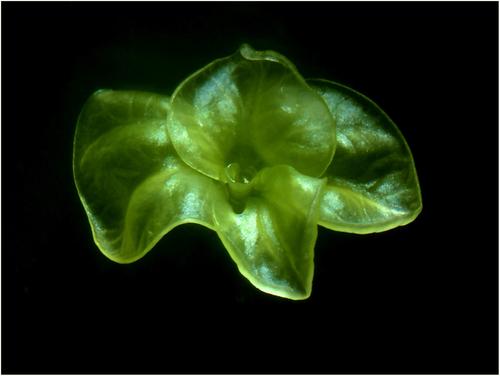
There are so many plants close to my heart. The ones we work with in the lab, Arabidopsis (of course!), tomato, cannabis, wheat, and soon to be potato; the chili peppers I grow on my deck with much love and fearful anticipation, and many more! But recently, I have rekindled my love affair with cassava, and I am very excited to be picking up work with this species again. Our work focuses on regeneration through tissue culture and especially regeneration from protoplasts. So, here I present to you a germinated cassava embryo that just 11 weeks earlier was a single cell in in vitro culture! (Fig. 1).
期刊介绍:
New Phytologist is an international electronic journal published 24 times a year. It is owned by the New Phytologist Foundation, a non-profit-making charitable organization dedicated to promoting plant science. The journal publishes excellent, novel, rigorous, and timely research and scholarship in plant science and its applications. The articles cover topics in five sections: Physiology & Development, Environment, Interaction, Evolution, and Transformative Plant Biotechnology. These sections encompass intracellular processes, global environmental change, and encourage cross-disciplinary approaches. The journal recognizes the use of techniques from molecular and cell biology, functional genomics, modeling, and system-based approaches in plant science. Abstracting and Indexing Information for New Phytologist includes Academic Search, AgBiotech News & Information, Agroforestry Abstracts, Biochemistry & Biophysics Citation Index, Botanical Pesticides, CAB Abstracts®, Environment Index, Global Health, and Plant Breeding Abstracts, and others.





 京公网安备 11010802042870号
京ICP备2023020795号-1
京公网安备 11010802042870号
京ICP备2023020795号-1

 分享
分享
 求助内容:
求助内容: 应助结果提醒方式:
 扫码关注我们
