Roseobacter weihaiensis sp. nov., a cellulose-degrading bacterium isolated from intestinal content of Nipponacmea schrenckii collected from golden beach in Weihai, China
{"title":"Roseobacter weihaiensis sp. nov., a cellulose-degrading bacterium isolated from intestinal content of Nipponacmea schrenckii collected from golden beach in Weihai, China","authors":"Yu-Rui Li, Ming-Jing Zhang, Yan-Jun Yi, Xiao-Chen Wang, Dong-Mei San, Yan-Xia Zhou","doi":"10.1007/s10482-024-02009-0","DOIUrl":null,"url":null,"abstract":"<div><p>A Gram-staining-negative, dark pink, rod-shaped, amastigote and cellulose-degrading strain, designated H9<sup>T</sup>, was isolated from intestinal contents of <i>Nipponacmea schrenckii</i>. The isolate was able to grow at 4–42 °C (optimum, 25 °C), at pH 6.5–9.0 (optimum, pH 7.0), and with 0.0–11.0% (w/v) NaCl (optimum, 3.0–5.0%). Phylogenetic analysis of the 16S rRNA gene sequence suggested that isolate H9<sup>T</sup> belongs to the genus <i>Roseobacter</i>, neighboring <i>Roseobacter insulae</i> YSTF-M11<sup><i>T</i></sup>, <i>Roseobacter cerasinus</i> AI77<sup>T</sup> and <i>Roseobacter ponti</i> MM-7<sup> T</sup>, and the pairwise sequence showed the highest similarity of 99.1% to <i>Roseobacter insulae</i> YSTF-M11<sup><i>T</i></sup>. The major fatty acid was summed feature 8 (C<sub>18:1</sub><i>ω</i>7<i>c</i> and/or C<sub>18:1</sub><i>ω</i>6<i>c</i>; 81.08%). The predominant respiratory quinone was Q-10. The polar lipids consisted of phosphatidylcholine, phosphatidylglycerol, an unknown lipid, and a small amount of an unknown phospholipid. The genome of strain H9<sup>T</sup> was 5,351,685 bp in length, and the DNA G + C content was 59.8%. The average amino acid identity (AAI), average nucleotide identity (ANI), and digital DNA hybridization (dDDH) values between strain H9<sup>T</sup> and closely related strains were 63.4–76.8%, 74.7–78.8%, and 13.4–19.7%, respectively. On the basis of the phenotypic, chemical taxonomic, and phylogenetic data, it is suggested that strain H9<sup>T</sup> should represent a novel species in the genus <i>Roseobacter</i>, for which the name <i>Roseobacter weihaiensis</i> sp. nov. is proposed. The type strain is H9<sup>T</sup> (= KCTC 82507<sup> T</sup> = MCCC 1K04354<sup>T</sup>).</p></div>","PeriodicalId":50746,"journal":{"name":"Antonie Van Leeuwenhoek International Journal of General and Molecular Microbiology","volume":"118 1","pages":""},"PeriodicalIF":1.8000,"publicationDate":"2024-09-28","publicationTypes":"Journal Article","fieldsOfStudy":null,"isOpenAccess":false,"openAccessPdf":"","citationCount":"0","resultStr":null,"platform":"Semanticscholar","paperid":null,"PeriodicalName":"Antonie Van Leeuwenhoek International Journal of General and Molecular Microbiology","FirstCategoryId":"99","ListUrlMain":"https://link.springer.com/article/10.1007/s10482-024-02009-0","RegionNum":3,"RegionCategory":"生物学","ArticlePicture":[],"TitleCN":null,"AbstractTextCN":null,"PMCID":null,"EPubDate":"","PubModel":"","JCR":"Q4","JCRName":"MICROBIOLOGY","Score":null,"Total":0}
引用次数: 0
Abstract
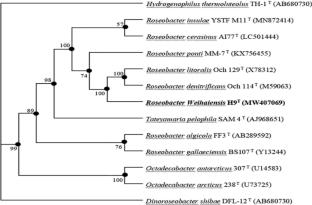
A Gram-staining-negative, dark pink, rod-shaped, amastigote and cellulose-degrading strain, designated H9T, was isolated from intestinal contents of Nipponacmea schrenckii. The isolate was able to grow at 4–42 °C (optimum, 25 °C), at pH 6.5–9.0 (optimum, pH 7.0), and with 0.0–11.0% (w/v) NaCl (optimum, 3.0–5.0%). Phylogenetic analysis of the 16S rRNA gene sequence suggested that isolate H9T belongs to the genus Roseobacter, neighboring Roseobacter insulae YSTF-M11T, Roseobacter cerasinus AI77T and Roseobacter ponti MM-7 T, and the pairwise sequence showed the highest similarity of 99.1% to Roseobacter insulae YSTF-M11T. The major fatty acid was summed feature 8 (C18:1ω7c and/or C18:1ω6c; 81.08%). The predominant respiratory quinone was Q-10. The polar lipids consisted of phosphatidylcholine, phosphatidylglycerol, an unknown lipid, and a small amount of an unknown phospholipid. The genome of strain H9T was 5,351,685 bp in length, and the DNA G + C content was 59.8%. The average amino acid identity (AAI), average nucleotide identity (ANI), and digital DNA hybridization (dDDH) values between strain H9T and closely related strains were 63.4–76.8%, 74.7–78.8%, and 13.4–19.7%, respectively. On the basis of the phenotypic, chemical taxonomic, and phylogenetic data, it is suggested that strain H9T should represent a novel species in the genus Roseobacter, for which the name Roseobacter weihaiensis sp. nov. is proposed. The type strain is H9T (= KCTC 82507 T = MCCC 1K04354T).
期刊介绍:
Antonie van Leeuwenhoek publishes papers on fundamental and applied aspects of microbiology. Topics of particular interest include: taxonomy, structure & development; biochemistry & molecular biology; physiology & metabolic studies; genetics; ecological studies; especially molecular ecology; marine microbiology; medical microbiology; molecular biological aspects of microbial pathogenesis and bioinformatics.




 京公网安备 11010802042870号
京ICP备2023020795号-1
京公网安备 11010802042870号
京ICP备2023020795号-1

 分享
分享
 求助内容:
求助内容: 应助结果提醒方式:
 扫码关注我们
