Kiersten J Garcia, Grace Brolly, Daniel Ng, Maria Bederson, Pedro Martinez, Mark D Whiting
{"title":"Lifetime history of head injury is associated with reduced perivascular space number in acute mild traumatic brain injury.","authors":"Kiersten J Garcia, Grace Brolly, Daniel Ng, Maria Bederson, Pedro Martinez, Mark D Whiting","doi":"10.1093/braincomms/fcae314","DOIUrl":null,"url":null,"abstract":"<p><p>Traumatic brain injury impairs function of the glymphatic system, a perivascular network involved in waste clearance. Enlarged perivascular spaces visible on MRI are an emerging biomarker of glymphatic function. This study characterized enlarged perivascular spaces in acute head injury with 7 T MRI. Healthy controls (<i>n</i> = 8) and patients (<i>n</i> = 11) with mild traumatic brain injury underwent MRI within 7 days of injury and were evaluated for lifetime history of head injury, neurobehavioral symptoms and sleep disturbances. MRI-visible perivascular spaces were quantified and assessed according to published criteria. The number of enlarged perivascular spaces was significantly higher in traumatic brain injury patients than controls (<i>P</i> = 0.015). Among healthy controls, 6/8 scored 'none' or 'mild' on the perivascular space rating scale, while 10/11 patients scored 'moderate', 'frequent' or 'severe'. There was an inverse relationship between perivascular space number and number of lifetime head injuries. Patients with more prior head injuries exhibited fewer enlarged perivascular spaces (<i>P</i> = 0.014). These results indicate that mild head injury results in acute alterations in perivascular space number, and this effect is mediated by previous head injury history. Enlarged perivascular spaces may reflect a glymphatic response that is diminished after multiple head injuries, although this will require further study.</p>","PeriodicalId":93915,"journal":{"name":"Brain communications","volume":"6 5","pages":"fcae314"},"PeriodicalIF":4.5000,"publicationDate":"2024-09-17","publicationTypes":"Journal Article","fieldsOfStudy":null,"isOpenAccess":false,"openAccessPdf":"https://www.ncbi.nlm.nih.gov/pmc/articles/PMC11426355/pdf/","citationCount":"0","resultStr":null,"platform":"Semanticscholar","paperid":null,"PeriodicalName":"Brain communications","FirstCategoryId":"1085","ListUrlMain":"https://doi.org/10.1093/braincomms/fcae314","RegionNum":0,"RegionCategory":null,"ArticlePicture":[],"TitleCN":null,"AbstractTextCN":null,"PMCID":null,"EPubDate":"2024/1/1 0:00:00","PubModel":"eCollection","JCR":"Q1","JCRName":"CLINICAL NEUROLOGY","Score":null,"Total":0}
引用次数: 0
Abstract
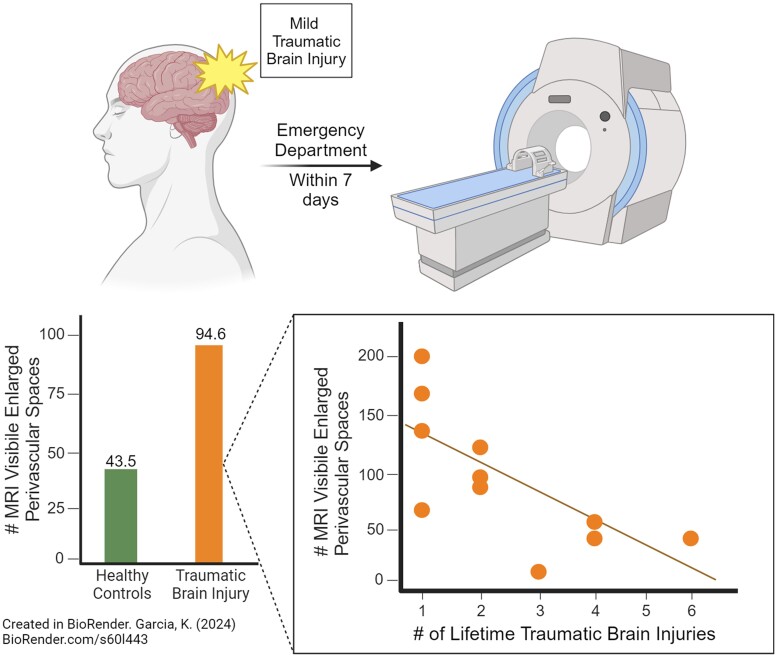
Traumatic brain injury impairs function of the glymphatic system, a perivascular network involved in waste clearance. Enlarged perivascular spaces visible on MRI are an emerging biomarker of glymphatic function. This study characterized enlarged perivascular spaces in acute head injury with 7 T MRI. Healthy controls (n = 8) and patients (n = 11) with mild traumatic brain injury underwent MRI within 7 days of injury and were evaluated for lifetime history of head injury, neurobehavioral symptoms and sleep disturbances. MRI-visible perivascular spaces were quantified and assessed according to published criteria. The number of enlarged perivascular spaces was significantly higher in traumatic brain injury patients than controls (P = 0.015). Among healthy controls, 6/8 scored 'none' or 'mild' on the perivascular space rating scale, while 10/11 patients scored 'moderate', 'frequent' or 'severe'. There was an inverse relationship between perivascular space number and number of lifetime head injuries. Patients with more prior head injuries exhibited fewer enlarged perivascular spaces (P = 0.014). These results indicate that mild head injury results in acute alterations in perivascular space number, and this effect is mediated by previous head injury history. Enlarged perivascular spaces may reflect a glymphatic response that is diminished after multiple head injuries, although this will require further study.





 京公网安备 11010802042870号
京ICP备2023020795号-1
京公网安备 11010802042870号
京ICP备2023020795号-1

 分享
分享

 求助内容:
求助内容: 应助结果提醒方式:
 扫码关注我们
