{"title":"Interference between multipolar two-photon transitions in quantum emitters near plasmonic nanostructures","authors":"S. Smeets, B. Maes, G. Rosolen","doi":"10.1186/s11671-024-04111-8","DOIUrl":null,"url":null,"abstract":"<div><p>In the vicinity of plasmonic nanostructures that support highly confined light fields, spontaneous emission processes, such as two-photon spontaneous emission (TPSE), exhibit higher-order multipolar emission pathways beyond the dipolar one. These multipolar emission channels occur simultaneously and can interfere with each other. We develop a novel framework that computes these interference effects for TPSE of a quantum emitter close to an arbitrary nanostructure. The model is based on the computation of Purcell factors that can be calculated with conventional electromagnetic simulations, which avoids complex analytic calculations for the environment. For a transition of a hydrogen-like emitter close to a graphene nanotriangle, we demonstrate a breakdown of the dipolar selection rule in the TPSE process. This breakdown is due to a huge enhancement of the two-electric dipole (2ED) and of the two-electric quadrupole (2EQ) transitions. We observe an important interference between these multipolar transitions, as it increases the total rate by <span>\\(67 \\, \\%\\)</span>. In the end, our framework is a complete tool to design emitters and nanostructures for TPSE, where the exploitation of previously ignored interference effects provides an additional degree of freedom, for example to boost desired transitions and to supress undesirable ones.</p></div>","PeriodicalId":51136,"journal":{"name":"Nanoscale Research Letters","volume":"19 1","pages":""},"PeriodicalIF":4.1000,"publicationDate":"2024-09-27","publicationTypes":"Journal Article","fieldsOfStudy":null,"isOpenAccess":false,"openAccessPdf":"https://www.ncbi.nlm.nih.gov/pmc/articles/PMC11436523/pdf/","citationCount":"0","resultStr":null,"platform":"Semanticscholar","paperid":null,"PeriodicalName":"Nanoscale Research Letters","FirstCategoryId":"88","ListUrlMain":"https://link.springer.com/article/10.1186/s11671-024-04111-8","RegionNum":3,"RegionCategory":"材料科学","ArticlePicture":[],"TitleCN":null,"AbstractTextCN":null,"PMCID":null,"EPubDate":"","PubModel":"","JCR":"Q2","JCRName":"MATERIALS SCIENCE, MULTIDISCIPLINARY","Score":null,"Total":0}
引用次数: 0
Abstract
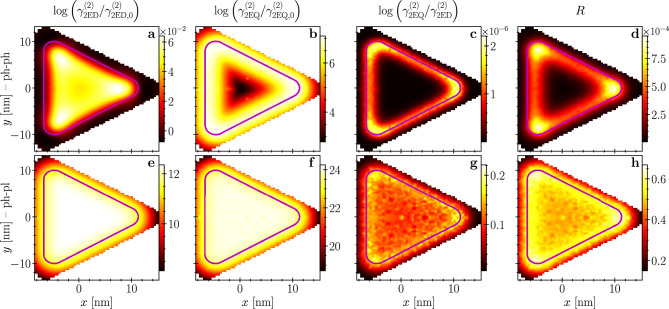
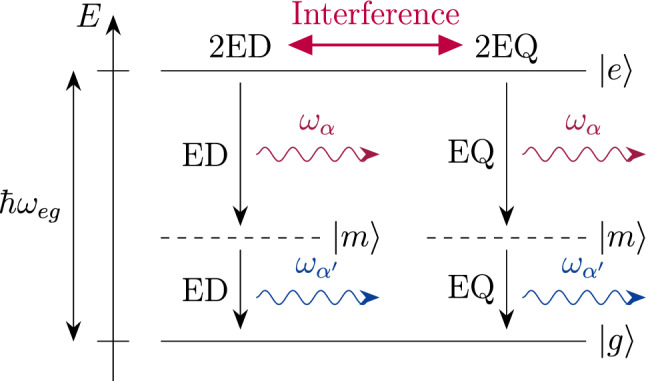
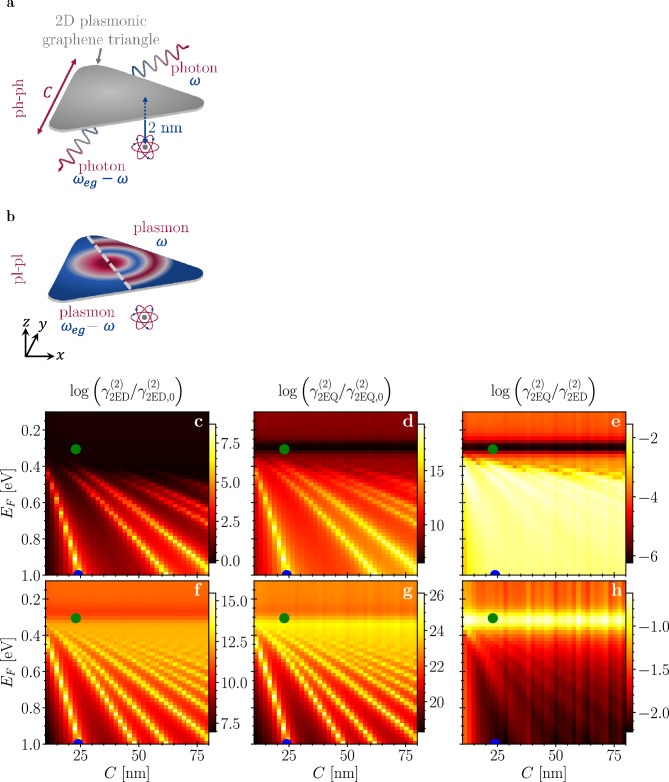
In the vicinity of plasmonic nanostructures that support highly confined light fields, spontaneous emission processes, such as two-photon spontaneous emission (TPSE), exhibit higher-order multipolar emission pathways beyond the dipolar one. These multipolar emission channels occur simultaneously and can interfere with each other. We develop a novel framework that computes these interference effects for TPSE of a quantum emitter close to an arbitrary nanostructure. The model is based on the computation of Purcell factors that can be calculated with conventional electromagnetic simulations, which avoids complex analytic calculations for the environment. For a transition of a hydrogen-like emitter close to a graphene nanotriangle, we demonstrate a breakdown of the dipolar selection rule in the TPSE process. This breakdown is due to a huge enhancement of the two-electric dipole (2ED) and of the two-electric quadrupole (2EQ) transitions. We observe an important interference between these multipolar transitions, as it increases the total rate by \(67 \, \%\). In the end, our framework is a complete tool to design emitters and nanostructures for TPSE, where the exploitation of previously ignored interference effects provides an additional degree of freedom, for example to boost desired transitions and to supress undesirable ones.
期刊介绍:
Nanoscale Research Letters (NRL) provides an interdisciplinary forum for communication of scientific and technological advances in the creation and use of objects at the nanometer scale. NRL is the first nanotechnology journal from a major publisher to be published with Open Access.



 京公网安备 11010802042870号
京ICP备2023020795号-1
京公网安备 11010802042870号
京ICP备2023020795号-1

 分享
分享
 求助内容:
求助内容: 应助结果提醒方式:
 扫码关注我们
