Yunna Zheng, Mingjiang Chen, Dunpin Xiong, Xiangbing Meng, Hong Yu, Hongwen Wang, Jiayang Li
{"title":"Generation of OsGRF4 and OsSNAC1 alleles for improving rice agronomic traits by CRISPR/Cas9-mediated manipulation of transposable elements","authors":"Yunna Zheng, Mingjiang Chen, Dunpin Xiong, Xiangbing Meng, Hong Yu, Hongwen Wang, Jiayang Li","doi":"10.1111/pbi.14465","DOIUrl":null,"url":null,"abstract":"<p>Transposable elements (TEs) contribute to gene regulation and phenotypic diversity in plants. Miniature inverted-repeat TEs (MITEs) are short, non-autonomous DNA transposons (100–800 bp) that are numerically the most abundant TEs in the rice genome, and tightly associated with at least 58% of rice genes (Lu <i>et al</i>., <span>2017</span>). MITEs have been shown to be a major driver of gene expression changes (Castanera <i>et al</i>., <span>2023</span>), and genome-wide association studies using MITE insertion polymorphisms may allow to dissect the underlying causal genes of agronomic traits (Castanera <i>et al</i>., <span>2021</span>).</p><p>As MITEs are an important source of genetic variation, we hypothesized that genome editing (GE) of MITEs might be an efficient approach to generate novel alleles with altered gene expression for tuning crop traits. Two agriculturally important rice genes, <i>growth-regulating factor 4</i> (<i>GRF4</i>) and <i>stress-responsive NAC1</i> (<i>SNAC1</i>), were selected for testing this hypothesis. <i>OsGRF4</i> could positively regulate yield-related traits (Wang <i>et al</i>., <span>2022</span>) and has a 294-bp <i>PIF/Harbinger</i> superfamily MITE inserted within 1200 bp 3′ to the stop codon (Figure S1). <i>OsSNAC1</i> can confer salt stress tolerance (Hu <i>et al</i>., <span>2006</span>), whereas no MITEs were detected in its upstream and downstream untranslated regions (UTRs) (Figure S2).</p><p>Since MITEs in the 3′ UTRs of certain rice genes have been revealed to mediate translational repression of target genes (Shen <i>et al</i>., <span>2017</span>), we proposed that the downstream MITE of <i>OsGRF4</i> could be excised by CRISPR/Cas9 to generate an overexpression allele, and designed a deletion vector transformed into rice calli. An average mutation frequency (35.4%) was achieved in the T<sub>0</sub> transgenic plants, carrying homozygous (10.4%) or heterozygous (16.7%) deletion mutations. Finally, we obtained two homozygous transgene-free T<sub>2</sub> <i>OsGRF4</i><sup><i>mite</i></sup> lines L1 and L2 (Figure 1a; Figure S3). <i>OsGRF4</i> mRNA levels in the <i>OsGRF4</i><sup><i>mite</i></sup> lines were comparable to those of wild type (WT) (Figure 1b). However, OsGRF4 protein levels of <i>OsGRF4</i><sup><i>mite</i></sup> lines were higher than that of WT (Figure 1c; Figure S4). We compared agronomical traits between <i>OsGRF4</i><sup><i>mite</i></sup> and WT plants grown under field conditions. Plant height of <i>OsGRF4</i><sup><i>mite</i></sup> lines decreased significantly compared to WT plants but the productive tiller number (PTN) per plant increased (Figure 1d–f). Thousand-grain weight (TGW) of the <i>OsGRF4</i><sup><i>mite</i></sup> lines increased 6.4% on average compared to WT. This increase is accompanied by a slight increase in grain length, but not in grain width (Figure 1g,h; Figure S5). A small decrease in seed setting rate (SSR) was observed in <i>OsGRF4</i><sup><i>mite</i></sup> L1 and L2 lines compared to WT, with an average decrease of 8.6% and 9.3%, respectively (Figure 1i). In general, <i>OsGRF4</i><sup><i>mite</i></sup> plants slightly increased grain yield per plant (Figure 1j), which was also observed in <i>OsGRF4</i>-overexpressing plants (Wang <i>et al</i>., <span>2022</span>). These results showed that the MITE deletion in <i>OsGRF4</i><sup><i>mite</i></sup> plants could increase OsGRF4 abundance to improve rice agronomic traits.</p><p>Some MITEs in the 5′ UTRs of rice genes have previously been reported to act as enhancers, such as the <i>miniature Ping</i> (<i>mPing</i>) TE, which could confer salt stress inducibility on nearby genes in rice (Naito <i>et al</i>., <span>2009</span>). Therefore, we attempted to insert the 430-bp <i>mPing</i> into salt-tolerance gene <i>OsSNAC1</i>. Recently, an efficient approach to inserting large DNA fragments was developed by combining CRISPR/Cas9 with phosphorothioate-modified 3′-overhang double-stranded oligodeoxynucleotides (dsODNs) (Han <i>et al</i>., <span>2023</span>). Using the above method to create the <i>OsSNAC1</i><sup><i>MITE</i></sup> allele, an sgRNA target site at 53-bp upstream of the <i>OsSNAC1</i> start codon was designed (sgRNA-1), and the corresponding CRISPR/Cas9 plasmid was constructed (Figure 1k). We synthesized dsODNs containing the <i>mPing</i> with five consecutive phosphorothioate modifications and 10-bp 3′-overhang complementary to the resected overhang induced by the Cas9. The <i>mPing</i> dsODNs were then delivered into rice calli together with the CRISPR/Cas9 vector by particle bombardment. A total of 81 independent T<sub>0</sub> transgenic plants were obtained. We found that five plants (6.2%) had targeted insertions in the intended orientation and two plants (2.5%) with the reverse orientation (Figure 1l). Two independent T<sub>2</sub> homozygous targeted lines, <i>OsSNAC1</i><sup><i>MITE</i></sup> L1 and L2, were obtained for further analysis (Figure 1m). Under control conditions, there were no obvious differences in <i>OsSNAC1</i> mRNA levels between <i>OsSNAC1</i><sup><i>MITE</i></sup> and WT plants. However, after 1 h of salt stress, the relative mRNA levels of <i>OsSNAC1</i> in <i>OsSNAC1</i><sup><i>MITE</i></sup> L1 and L2 were 1.9- and 2.3-fold that of WT, respectively (Figure 1n). Consistent with this, <i>OsSNAC1</i><sup><i>MITE</i></sup> lines showed higher survival rates than the WT plants under high-salinity conditions (Figure 1o,p). These results suggested that the <i>mPing</i> insertion in <i>OsSNAC1</i><sup><i>MITE</i></sup> plants confers enhanced salt-inducible gene expression, thereby increasing salt tolerance.</p><p>In summary, we have shown that genetic manipulation of MITEs in rice could create different beneficial alleles to regulate gene expression and improve crop traits. We have been able to engineer CRISPR/Cas9-targeted loci to achieve site-specific MITE deletion or insertion, thus enabling the regulation of target genes by exploiting the ability of MITEs to control gene expression. Given the widespread presence of MITEs in many plant genomes, it is conceivable that this strategy could be used more widely in the future to optimize plant development and improvement.</p><p>The authors have declared no conflict of interest.</p><p>H.W. and Y.Z. designed the experiments. Y.Z., M.C., X.M. and D.X. performed the experiments. Y.Z., M.C. and D.X. analysed the results. H.W. and J.L. supervised the project. H.W., H.Y. and J.L. wrote the paper. All authors approved the final manuscript.</p>","PeriodicalId":221,"journal":{"name":"Plant Biotechnology Journal","volume":"22 12","pages":"3453-3455"},"PeriodicalIF":10.5000,"publicationDate":"2024-10-01","publicationTypes":"Journal Article","fieldsOfStudy":null,"isOpenAccess":false,"openAccessPdf":"https://onlinelibrary.wiley.com/doi/epdf/10.1111/pbi.14465","citationCount":"0","resultStr":null,"platform":"Semanticscholar","paperid":null,"PeriodicalName":"Plant Biotechnology Journal","FirstCategoryId":"5","ListUrlMain":"https://onlinelibrary.wiley.com/doi/10.1111/pbi.14465","RegionNum":1,"RegionCategory":"生物学","ArticlePicture":[],"TitleCN":null,"AbstractTextCN":null,"PMCID":null,"EPubDate":"","PubModel":"","JCR":"Q1","JCRName":"BIOTECHNOLOGY & APPLIED MICROBIOLOGY","Score":null,"Total":0}
引用次数: 0
Abstract
Transposable elements (TEs) contribute to gene regulation and phenotypic diversity in plants. Miniature inverted-repeat TEs (MITEs) are short, non-autonomous DNA transposons (100–800 bp) that are numerically the most abundant TEs in the rice genome, and tightly associated with at least 58% of rice genes (Lu et al., 2017). MITEs have been shown to be a major driver of gene expression changes (Castanera et al., 2023), and genome-wide association studies using MITE insertion polymorphisms may allow to dissect the underlying causal genes of agronomic traits (Castanera et al., 2021).
As MITEs are an important source of genetic variation, we hypothesized that genome editing (GE) of MITEs might be an efficient approach to generate novel alleles with altered gene expression for tuning crop traits. Two agriculturally important rice genes, growth-regulating factor 4 (GRF4) and stress-responsive NAC1 (SNAC1), were selected for testing this hypothesis. OsGRF4 could positively regulate yield-related traits (Wang et al., 2022) and has a 294-bp PIF/Harbinger superfamily MITE inserted within 1200 bp 3′ to the stop codon (Figure S1). OsSNAC1 can confer salt stress tolerance (Hu et al., 2006), whereas no MITEs were detected in its upstream and downstream untranslated regions (UTRs) (Figure S2).
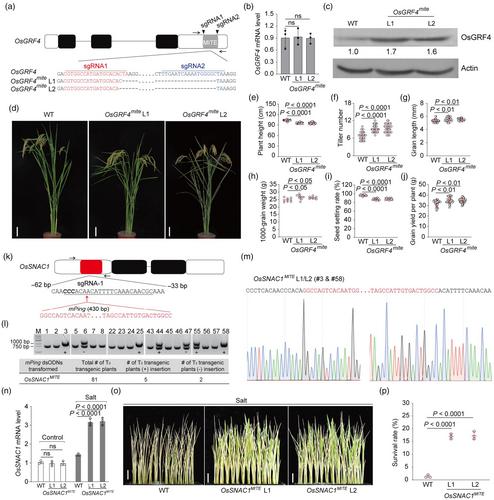
Since MITEs in the 3′ UTRs of certain rice genes have been revealed to mediate translational repression of target genes (Shen et al., 2017), we proposed that the downstream MITE of OsGRF4 could be excised by CRISPR/Cas9 to generate an overexpression allele, and designed a deletion vector transformed into rice calli. An average mutation frequency (35.4%) was achieved in the T0 transgenic plants, carrying homozygous (10.4%) or heterozygous (16.7%) deletion mutations. Finally, we obtained two homozygous transgene-free T2OsGRF4mite lines L1 and L2 (Figure 1a; Figure S3). OsGRF4 mRNA levels in the OsGRF4mite lines were comparable to those of wild type (WT) (Figure 1b). However, OsGRF4 protein levels of OsGRF4mite lines were higher than that of WT (Figure 1c; Figure S4). We compared agronomical traits between OsGRF4mite and WT plants grown under field conditions. Plant height of OsGRF4mite lines decreased significantly compared to WT plants but the productive tiller number (PTN) per plant increased (Figure 1d–f). Thousand-grain weight (TGW) of the OsGRF4mite lines increased 6.4% on average compared to WT. This increase is accompanied by a slight increase in grain length, but not in grain width (Figure 1g,h; Figure S5). A small decrease in seed setting rate (SSR) was observed in OsGRF4mite L1 and L2 lines compared to WT, with an average decrease of 8.6% and 9.3%, respectively (Figure 1i). In general, OsGRF4mite plants slightly increased grain yield per plant (Figure 1j), which was also observed in OsGRF4-overexpressing plants (Wang et al., 2022). These results showed that the MITE deletion in OsGRF4mite plants could increase OsGRF4 abundance to improve rice agronomic traits.
Some MITEs in the 5′ UTRs of rice genes have previously been reported to act as enhancers, such as the miniature Ping (mPing) TE, which could confer salt stress inducibility on nearby genes in rice (Naito et al., 2009). Therefore, we attempted to insert the 430-bp mPing into salt-tolerance gene OsSNAC1. Recently, an efficient approach to inserting large DNA fragments was developed by combining CRISPR/Cas9 with phosphorothioate-modified 3′-overhang double-stranded oligodeoxynucleotides (dsODNs) (Han et al., 2023). Using the above method to create the OsSNAC1MITE allele, an sgRNA target site at 53-bp upstream of the OsSNAC1 start codon was designed (sgRNA-1), and the corresponding CRISPR/Cas9 plasmid was constructed (Figure 1k). We synthesized dsODNs containing the mPing with five consecutive phosphorothioate modifications and 10-bp 3′-overhang complementary to the resected overhang induced by the Cas9. The mPing dsODNs were then delivered into rice calli together with the CRISPR/Cas9 vector by particle bombardment. A total of 81 independent T0 transgenic plants were obtained. We found that five plants (6.2%) had targeted insertions in the intended orientation and two plants (2.5%) with the reverse orientation (Figure 1l). Two independent T2 homozygous targeted lines, OsSNAC1MITE L1 and L2, were obtained for further analysis (Figure 1m). Under control conditions, there were no obvious differences in OsSNAC1 mRNA levels between OsSNAC1MITE and WT plants. However, after 1 h of salt stress, the relative mRNA levels of OsSNAC1 in OsSNAC1MITE L1 and L2 were 1.9- and 2.3-fold that of WT, respectively (Figure 1n). Consistent with this, OsSNAC1MITE lines showed higher survival rates than the WT plants under high-salinity conditions (Figure 1o,p). These results suggested that the mPing insertion in OsSNAC1MITE plants confers enhanced salt-inducible gene expression, thereby increasing salt tolerance.
In summary, we have shown that genetic manipulation of MITEs in rice could create different beneficial alleles to regulate gene expression and improve crop traits. We have been able to engineer CRISPR/Cas9-targeted loci to achieve site-specific MITE deletion or insertion, thus enabling the regulation of target genes by exploiting the ability of MITEs to control gene expression. Given the widespread presence of MITEs in many plant genomes, it is conceivable that this strategy could be used more widely in the future to optimize plant development and improvement.
The authors have declared no conflict of interest.
H.W. and Y.Z. designed the experiments. Y.Z., M.C., X.M. and D.X. performed the experiments. Y.Z., M.C. and D.X. analysed the results. H.W. and J.L. supervised the project. H.W., H.Y. and J.L. wrote the paper. All authors approved the final manuscript.
期刊介绍:
Plant Biotechnology Journal aspires to publish original research and insightful reviews of high impact, authored by prominent researchers in applied plant science. The journal places a special emphasis on molecular plant sciences and their practical applications through plant biotechnology. Our goal is to establish a platform for showcasing significant advances in the field, encompassing curiosity-driven studies with potential applications, strategic research in plant biotechnology, scientific analysis of crucial issues for the beneficial utilization of plant sciences, and assessments of the performance of plant biotechnology products in practical applications.



 京公网安备 11010802042870号
京ICP备2023020795号-1
京公网安备 11010802042870号
京ICP备2023020795号-1

 分享
分享
 求助内容:
求助内容: 应助结果提醒方式:
 扫码关注我们
