Lisha Zhang, Wei Gao, Li Su, Wenying He, Yize Wang, Minghui Hu, Zixi Liu, Yanling Liu, Huajie Feng
{"title":"Theoretical Study on Intramolecular Hydrogen Bonds of Flavonoid Cocrystals","authors":"Lisha Zhang, Wei Gao, Li Su, Wenying He, Yize Wang, Minghui Hu, Zixi Liu, Yanling Liu, Huajie Feng","doi":"10.1002/cphc.202400591","DOIUrl":null,"url":null,"abstract":"<p>This study investigates the role of intramolecular hydrogen bonds in the formation of cocrystals involving flavonoid molecules, focusing on three active pharmaceutical ingredients (APIs): chrysin (CHR), isoliquiritigenin (ISO), and kaempferol (KAE). These APIs form cocrystals with different cocrystal formers (CCFs) through intramolecular hydrogen bonding. We found that disruption of these intramolecular hydrogen bonds leads to decreased stability compared to molecules with intact bonds. The extrema of molecular electrostatic potential surfaces (MEPS) show that flavonoid molecules with disrupted intramolecular hydrogen bonds have stronger hydrogen bond donors and acceptors than those with intact bonds. Using the artificial bee colony algorithm, dimeric structures of these flavonoid molecules were explored, representing early-stage structures in cocrystal formation, including API-API, API-CCF, and CCF-CCF dimers. It was observed that the number and strength of dimeric interactions significantly increased, and the types of interactions changed when intramolecular hydrogen bonds were disrupted. These findings suggest that disrupting intramolecular hydrogen bonds generally hinders the formation of cocrystals. This theoretical study provides deeper insight into the role of intramolecular hydrogen bonds in the cocrystal formation of flavonoids.</p>","PeriodicalId":9819,"journal":{"name":"Chemphyschem","volume":"26 1","pages":""},"PeriodicalIF":2.4000,"publicationDate":"2024-10-01","publicationTypes":"Journal Article","fieldsOfStudy":null,"isOpenAccess":false,"openAccessPdf":"","citationCount":"0","resultStr":null,"platform":"Semanticscholar","paperid":null,"PeriodicalName":"Chemphyschem","FirstCategoryId":"92","ListUrlMain":"https://chemistry-europe.onlinelibrary.wiley.com/doi/10.1002/cphc.202400591","RegionNum":3,"RegionCategory":"化学","ArticlePicture":[],"TitleCN":null,"AbstractTextCN":null,"PMCID":null,"EPubDate":"","PubModel":"","JCR":"Q3","JCRName":"CHEMISTRY, PHYSICAL","Score":null,"Total":0}
引用次数: 0
Abstract
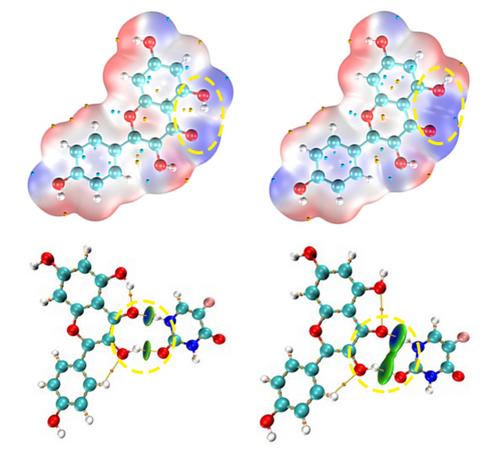
This study investigates the role of intramolecular hydrogen bonds in the formation of cocrystals involving flavonoid molecules, focusing on three active pharmaceutical ingredients (APIs): chrysin (CHR), isoliquiritigenin (ISO), and kaempferol (KAE). These APIs form cocrystals with different cocrystal formers (CCFs) through intramolecular hydrogen bonding. We found that disruption of these intramolecular hydrogen bonds leads to decreased stability compared to molecules with intact bonds. The extrema of molecular electrostatic potential surfaces (MEPS) show that flavonoid molecules with disrupted intramolecular hydrogen bonds have stronger hydrogen bond donors and acceptors than those with intact bonds. Using the artificial bee colony algorithm, dimeric structures of these flavonoid molecules were explored, representing early-stage structures in cocrystal formation, including API-API, API-CCF, and CCF-CCF dimers. It was observed that the number and strength of dimeric interactions significantly increased, and the types of interactions changed when intramolecular hydrogen bonds were disrupted. These findings suggest that disrupting intramolecular hydrogen bonds generally hinders the formation of cocrystals. This theoretical study provides deeper insight into the role of intramolecular hydrogen bonds in the cocrystal formation of flavonoids.
期刊介绍:
ChemPhysChem is one of the leading chemistry/physics interdisciplinary journals (ISI Impact Factor 2018: 3.077) for physical chemistry and chemical physics. It is published on behalf of Chemistry Europe, an association of 16 European chemical societies.
ChemPhysChem is an international source for important primary and critical secondary information across the whole field of physical chemistry and chemical physics. It integrates this wide and flourishing field ranging from Solid State and Soft-Matter Research, Electro- and Photochemistry, Femtochemistry and Nanotechnology, Complex Systems, Single-Molecule Research, Clusters and Colloids, Catalysis and Surface Science, Biophysics and Physical Biochemistry, Atmospheric and Environmental Chemistry, and many more topics. ChemPhysChem is peer-reviewed.






 京公网安备 11010802042870号
京ICP备2023020795号-1
京公网安备 11010802042870号
京ICP备2023020795号-1

 分享
分享
 求助内容:
求助内容: 应助结果提醒方式:
 扫码关注我们
