Hyaluronic Acid and Calcium Hydroxyapatite in the Context of Hypertrophic Photoaging. Evaluation by 2D, 3D Photographs and Reflectance Confocal Microscopy (RCM)
{"title":"Hyaluronic Acid and Calcium Hydroxyapatite in the Context of Hypertrophic Photoaging. Evaluation by 2D, 3D Photographs and Reflectance Confocal Microscopy (RCM)","authors":"Ilaria Proietti, Federica Trovato, Francesca Paola Sasso, Emanuele Amore, Concetta Potenza, Stefania Guida, Giovanni Pellacani","doi":"10.1111/jocd.16605","DOIUrl":null,"url":null,"abstract":"<p>Our understanding of injectables has changed a lot from the 1990s to today. In the past we were looking for the near-ideal filler and discovering the advantages of temporary fillers. Nowadays we are looking for injectables that emulate the physiology of regeneration and we are discovering the effects of injectables on skin regeneration [<span>1</span>]. Biomaterial-based injectables for anti-aging and rejuvenation purposes have long been used in regenerative and aesthetic medicine. The injection induces a phlogistic response that causes a series of processes, ranging from tissue regeneration to fibrosis [<span>2, 3</span>]. These are aesthetic regenerative scaffolds: injected biomaterials that can predetermine the inflammatory response, inhibiting chronic inflammatory response, reverting fibrosis, and enhancing physiological tissue regeneration. They include calcium hydroxyapatite (CaHA), hyaluronic acid (HA), and poly-L-lactic acid (PLLA) dermal fillers [<span>4</span>].</p><p>We present the case of a 56-year-old woman with Fitzpatrick skin phototype III, who complained of prominent wrinkles, dull facial appearance, and uneven skin texture. She denied smoking habit, reported spending a lot of time outdoors for work purposes and never applying sunscreen. On clinical observation, the patient displayed all the features of hypertrophic photo-aging (HP) (Figure 1A). HP is characterized by deep wrinkles and a leathery appearance of the skin, primarily affecting skin phototypes III–IV. HP presents clinically with responses such as permanent tan, deep wrinkles, coarseness, leathery skin, that correspond to histological feature as reduced epidermal thickness, reduced CD44 expression, elastosis, reduced amount of elastic fibers, loss of fibrillin-rich microfibrils (FRMs) at the dermo-epidermal junction (DEJ), aberrant arrangement of collagen in dermis, reduced intensity of collagen VII [<span>5, 6</span>].</p><p>We decided to use a hybrid injectable, combining HA and CaHA, in a 1.25 mL prefilled syringe with hydrochloride lidocaine (3 mg/mL). The patient was injected with cannula 22G 70 mm, 1 syringe per each side, at T0, and a follow-up visit was scheduled after 4 weeks (T4w). At T0 and T4w we obtained two-dimensional (2D) and three-dimensional (3D) photos, and reflectance confocal microscopy (RCM) Figures 1 and 2.</p><p>The comparison of 2D and 3D pictures at T0 and T4w highlighted a bright appearance of the skin, reduced wrinkles depth, improved texture, and increased tissue support after treatment Figures 1 and 2. Specifically, 3D assessment provided an even better evaluation of the restored facial structure with improved skin firmness and elasticity, as confirmed by finger and pinch tests (Figure 1C–E).</p><p>Additionally, RCM at the level of DEJ/superficial dermis revealed a hyporefractive and fragmented coarse network of collagen (Figure 2A) at T0 while hyperrefractive collagen fibers organized in linear network were observed at T4w (Figure 2B). The optical coherence tomography (OCT) analysis conducted on the left and tight cheeks at T0 and T1 revealed an improvement in collagen disposition. Collagen density increased after 4 weeks (Table 1; Figure 2C–F). This experience aims to share our decision-making paths in the field of injectables. The choice of injectables in the field of facial rejuvenation has to be based on the needs of the patient's skin. In this case, our patient needed the rearrangement of fibrillar collagen fibers of papillary dermis in linear and ordered pattern, the reconstitution of the structure of the skin, and the regeneration of the DEJ. We chose a HA + CaHA-based injectable to induce fibroblast differentiation, stimulate neocollagenogenesis, and restore plumpness, as supported by clinical results and non-invasive skin imaging. We firmly believe that within the plethora of fillers available, choosing the right product for the right patient is critically important for a successful treatment.</p><p>The study was conducted in accordance with the Declaration of Helsinki.</p><p>Informed consent was obtained from subjects involved in the study.</p><p>The authors declare no conflicts of interest.</p>","PeriodicalId":15546,"journal":{"name":"Journal of Cosmetic Dermatology","volume":"24 1","pages":""},"PeriodicalIF":2.5000,"publicationDate":"2024-09-27","publicationTypes":"Journal Article","fieldsOfStudy":null,"isOpenAccess":false,"openAccessPdf":"https://www.ncbi.nlm.nih.gov/pmc/articles/PMC11743252/pdf/","citationCount":"0","resultStr":null,"platform":"Semanticscholar","paperid":null,"PeriodicalName":"Journal of Cosmetic Dermatology","FirstCategoryId":"3","ListUrlMain":"https://onlinelibrary.wiley.com/doi/10.1111/jocd.16605","RegionNum":4,"RegionCategory":"医学","ArticlePicture":[],"TitleCN":null,"AbstractTextCN":null,"PMCID":null,"EPubDate":"","PubModel":"","JCR":"Q2","JCRName":"DERMATOLOGY","Score":null,"Total":0}
引用次数: 0
Abstract
Our understanding of injectables has changed a lot from the 1990s to today. In the past we were looking for the near-ideal filler and discovering the advantages of temporary fillers. Nowadays we are looking for injectables that emulate the physiology of regeneration and we are discovering the effects of injectables on skin regeneration [1]. Biomaterial-based injectables for anti-aging and rejuvenation purposes have long been used in regenerative and aesthetic medicine. The injection induces a phlogistic response that causes a series of processes, ranging from tissue regeneration to fibrosis [2, 3]. These are aesthetic regenerative scaffolds: injected biomaterials that can predetermine the inflammatory response, inhibiting chronic inflammatory response, reverting fibrosis, and enhancing physiological tissue regeneration. They include calcium hydroxyapatite (CaHA), hyaluronic acid (HA), and poly-L-lactic acid (PLLA) dermal fillers [4].
We present the case of a 56-year-old woman with Fitzpatrick skin phototype III, who complained of prominent wrinkles, dull facial appearance, and uneven skin texture. She denied smoking habit, reported spending a lot of time outdoors for work purposes and never applying sunscreen. On clinical observation, the patient displayed all the features of hypertrophic photo-aging (HP) (Figure 1A). HP is characterized by deep wrinkles and a leathery appearance of the skin, primarily affecting skin phototypes III–IV. HP presents clinically with responses such as permanent tan, deep wrinkles, coarseness, leathery skin, that correspond to histological feature as reduced epidermal thickness, reduced CD44 expression, elastosis, reduced amount of elastic fibers, loss of fibrillin-rich microfibrils (FRMs) at the dermo-epidermal junction (DEJ), aberrant arrangement of collagen in dermis, reduced intensity of collagen VII [5, 6].
We decided to use a hybrid injectable, combining HA and CaHA, in a 1.25 mL prefilled syringe with hydrochloride lidocaine (3 mg/mL). The patient was injected with cannula 22G 70 mm, 1 syringe per each side, at T0, and a follow-up visit was scheduled after 4 weeks (T4w). At T0 and T4w we obtained two-dimensional (2D) and three-dimensional (3D) photos, and reflectance confocal microscopy (RCM) Figures 1 and 2.
The comparison of 2D and 3D pictures at T0 and T4w highlighted a bright appearance of the skin, reduced wrinkles depth, improved texture, and increased tissue support after treatment Figures 1 and 2. Specifically, 3D assessment provided an even better evaluation of the restored facial structure with improved skin firmness and elasticity, as confirmed by finger and pinch tests (Figure 1C–E).
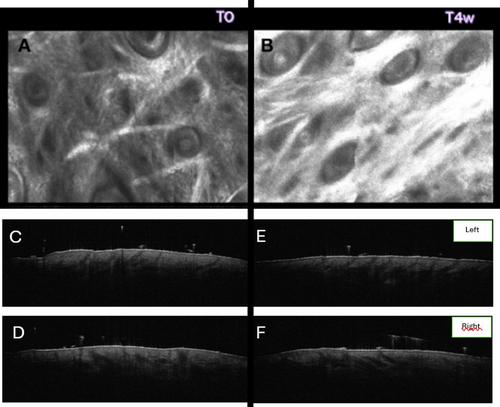
Additionally, RCM at the level of DEJ/superficial dermis revealed a hyporefractive and fragmented coarse network of collagen (Figure 2A) at T0 while hyperrefractive collagen fibers organized in linear network were observed at T4w (Figure 2B). The optical coherence tomography (OCT) analysis conducted on the left and tight cheeks at T0 and T1 revealed an improvement in collagen disposition. Collagen density increased after 4 weeks (Table 1; Figure 2C–F). This experience aims to share our decision-making paths in the field of injectables. The choice of injectables in the field of facial rejuvenation has to be based on the needs of the patient's skin. In this case, our patient needed the rearrangement of fibrillar collagen fibers of papillary dermis in linear and ordered pattern, the reconstitution of the structure of the skin, and the regeneration of the DEJ. We chose a HA + CaHA-based injectable to induce fibroblast differentiation, stimulate neocollagenogenesis, and restore plumpness, as supported by clinical results and non-invasive skin imaging. We firmly believe that within the plethora of fillers available, choosing the right product for the right patient is critically important for a successful treatment.
The study was conducted in accordance with the Declaration of Helsinki.
Informed consent was obtained from subjects involved in the study.
期刊介绍:
The Journal of Cosmetic Dermatology publishes high quality, peer-reviewed articles on all aspects of cosmetic dermatology with the aim to foster the highest standards of patient care in cosmetic dermatology. Published quarterly, the Journal of Cosmetic Dermatology facilitates continuing professional development and provides a forum for the exchange of scientific research and innovative techniques.
The scope of coverage includes, but will not be limited to: healthy skin; skin maintenance; ageing skin; photodamage and photoprotection; rejuvenation; biochemistry, endocrinology and neuroimmunology of healthy skin; imaging; skin measurement; quality of life; skin types; sensitive skin; rosacea and acne; sebum; sweat; fat; phlebology; hair conservation, restoration and removal; nails and nail surgery; pigment; psychological and medicolegal issues; retinoids; cosmetic chemistry; dermopharmacy; cosmeceuticals; toiletries; striae; cellulite; cosmetic dermatological surgery; blepharoplasty; liposuction; surgical complications; botulinum; fillers, peels and dermabrasion; local and tumescent anaesthesia; electrosurgery; lasers, including laser physics, laser research and safety, vascular lasers, pigment lasers, hair removal lasers, tattoo removal lasers, resurfacing lasers, dermal remodelling lasers and laser complications.



 京公网安备 11010802042870号
京ICP备2023020795号-1
京公网安备 11010802042870号
京ICP备2023020795号-1

 分享
分享
 求助内容:
求助内容: 应助结果提醒方式:
 扫码关注我们
