{"title":"Transcriptome and Metabolomic Analyses Reveal Tissue-Specific Glycosylation of Phenylpropanoids and Flavonoids in Toxicodendron vernicifluum.","authors":"Aiguo Zhao, Yuxi He, Ruixiang Sun, DongDong Xie, Hangyu Bai, Feng Han, Xiaohua Huang, Haitang Wu, Chaobin Liu","doi":"10.1111/ppl.14545","DOIUrl":null,"url":null,"abstract":"<p><p>Toxicodendron vernicifluum (Stokes) F. A. Barkley is a tree species used primarily for lacquer production. Our study utilized transcriptome and metabolomic analysis to investigate the biosynthesis of phenylpropanoids and flavonoids, specifically the glycosylated forms, in T. vernicifluum roots, stems, and leaves. HPLC-QTOF-MS/MS identified 186 compounds, with tissue-specific distributions revealed by PCA. Flavonoids and phenylpropanoids glycosides were significantly more abundant in leaves compared with roots and stems. Full-length sequencing uncovered 17,266 transcripts in T. vernicifluum. Gene expression analysis showed higher activity of phenylpropanoid and flavonoid biosynthesis pathways in leaves. Certain genes, such as CYP73A, 4CL, CRR, CYP84A/F5H, and CYP93C, displayed associations with compound content distributions. Root tissue exhibited a higher concentration of isoflavones. Notably, glycosyltransferase expression demonstrated significant correlations with glycosylated compounds' content. Biochemical validation confirmed the involvement of TvPB_c0_g2904, encoding a UDP-glucosyltransferase, in genistin biosynthesis in T. vernicifluum.</p>","PeriodicalId":20164,"journal":{"name":"Physiologia plantarum","volume":"176 5","pages":"e14545"},"PeriodicalIF":3.6000,"publicationDate":"2024-09-01","publicationTypes":"Journal Article","fieldsOfStudy":null,"isOpenAccess":false,"openAccessPdf":"","citationCount":"0","resultStr":null,"platform":"Semanticscholar","paperid":null,"PeriodicalName":"Physiologia plantarum","FirstCategoryId":"99","ListUrlMain":"https://doi.org/10.1111/ppl.14545","RegionNum":2,"RegionCategory":"生物学","ArticlePicture":[],"TitleCN":null,"AbstractTextCN":null,"PMCID":null,"EPubDate":"","PubModel":"","JCR":"Q1","JCRName":"PLANT SCIENCES","Score":null,"Total":0}
引用次数: 0
Abstract
Toxicodendron vernicifluum (Stokes) F. A. Barkley is a tree species used primarily for lacquer production. Our study utilized transcriptome and metabolomic analysis to investigate the biosynthesis of phenylpropanoids and flavonoids, specifically the glycosylated forms, in T. vernicifluum roots, stems, and leaves. HPLC-QTOF-MS/MS identified 186 compounds, with tissue-specific distributions revealed by PCA. Flavonoids and phenylpropanoids glycosides were significantly more abundant in leaves compared with roots and stems. Full-length sequencing uncovered 17,266 transcripts in T. vernicifluum. Gene expression analysis showed higher activity of phenylpropanoid and flavonoid biosynthesis pathways in leaves. Certain genes, such as CYP73A, 4CL, CRR, CYP84A/F5H, and CYP93C, displayed associations with compound content distributions. Root tissue exhibited a higher concentration of isoflavones. Notably, glycosyltransferase expression demonstrated significant correlations with glycosylated compounds' content. Biochemical validation confirmed the involvement of TvPB_c0_g2904, encoding a UDP-glucosyltransferase, in genistin biosynthesis in T. vernicifluum.
期刊介绍:
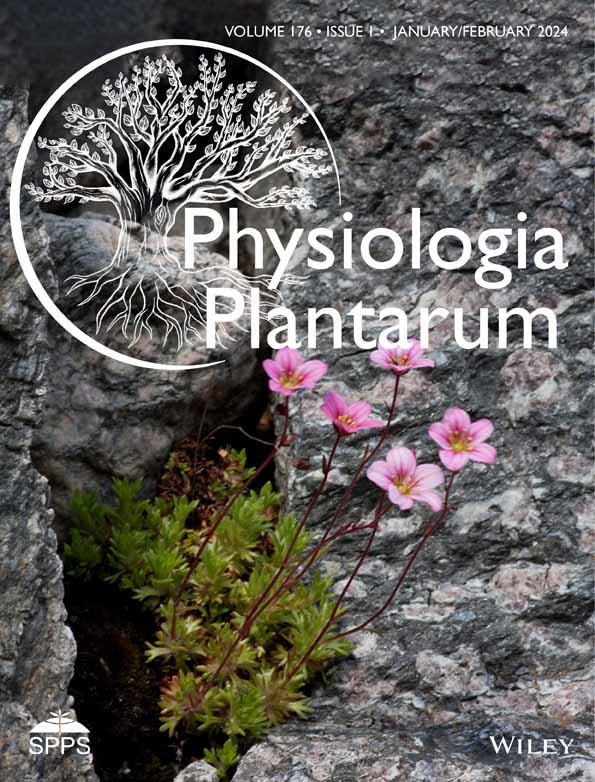
Physiologia Plantarum is an international journal committed to publishing the best full-length original research papers that advance our understanding of primary mechanisms of plant development, growth and productivity as well as plant interactions with the biotic and abiotic environment. All organisational levels of experimental plant biology – from molecular and cell biology, biochemistry and biophysics to ecophysiology and global change biology – fall within the scope of the journal. The content is distributed between 5 main subject areas supervised by Subject Editors specialised in the respective domain: (1) biochemistry and metabolism, (2) ecophysiology, stress and adaptation, (3) uptake, transport and assimilation, (4) development, growth and differentiation, (5) photobiology and photosynthesis.




 京公网安备 11010802042870号
京ICP备2023020795号-1
京公网安备 11010802042870号
京ICP备2023020795号-1

 分享
分享
 求助内容:
求助内容: 应助结果提醒方式:
 扫码关注我们
