David M Crizer, Julie R Rice, Marci G Smeltz, Katelyn S Lavrich, Krishna Ravindra, John F Wambaugh, Michael DeVito, Barbara A Wetmore
{"title":"In Vitro Hepatic Clearance Evaluations of Per- and Polyfluoroalkyl Substances (PFAS) across Multiple Structural Categories.","authors":"David M Crizer, Julie R Rice, Marci G Smeltz, Katelyn S Lavrich, Krishna Ravindra, John F Wambaugh, Michael DeVito, Barbara A Wetmore","doi":"10.3390/toxics12090672","DOIUrl":null,"url":null,"abstract":"<p><p>Toxicokinetic (TK) assays and in vitro-in vivo extrapolation (IVIVE) models are New Approach Methods (NAMs) used to translate in vitro points of departure to exposure estimates required to reach equivalent blood concentrations. Per- and polyfluoroalkyl substances (PFAS) are a large chemical class with wide-ranging industrial applications for which only limited toxicity data are available for human health evaluation. To address the lack of TK data, a pooled primary human hepatocyte suspension model was used with targeted liquid chromatography-mass spectrometry to investigate substrate depletion for 54 PFAS. A median value of 4.52 μL/(min x million cells) was observed across those that showed significant clearance, with 35 displaying no substrate depletion. Bayesian modeling propagated uncertainty around clearance values for use in IVIVE models. Structural evaluations showed the fluorotelomer carboxylic acids were the only PFAS carboxylates showing appreciable clearance, and per- and polyfluorosulfonamides were more readily metabolized than other PFAS sulfonates. Biotransformation product prediction, using the chemical transformation simulator, suggested hydrolysis of PFAS sulfonamides to more stable sulfonic acids, which is an important consideration for exposure modeling. This effort greatly expands the PFAS in vitro toxicokinetic dataset, enabling refined TK modeling, in silico tool development, and NAM-based human health evaluations across this important set of emerging contaminants.</p>","PeriodicalId":23195,"journal":{"name":"Toxics","volume":"12 9","pages":""},"PeriodicalIF":4.1000,"publicationDate":"2024-09-14","publicationTypes":"Journal Article","fieldsOfStudy":null,"isOpenAccess":false,"openAccessPdf":"https://www.ncbi.nlm.nih.gov/pmc/articles/PMC11435625/pdf/","citationCount":"0","resultStr":null,"platform":"Semanticscholar","paperid":null,"PeriodicalName":"Toxics","FirstCategoryId":"93","ListUrlMain":"https://doi.org/10.3390/toxics12090672","RegionNum":3,"RegionCategory":"环境科学与生态学","ArticlePicture":[],"TitleCN":null,"AbstractTextCN":null,"PMCID":null,"EPubDate":"","PubModel":"","JCR":"Q2","JCRName":"ENVIRONMENTAL SCIENCES","Score":null,"Total":0}
引用次数: 0
Abstract
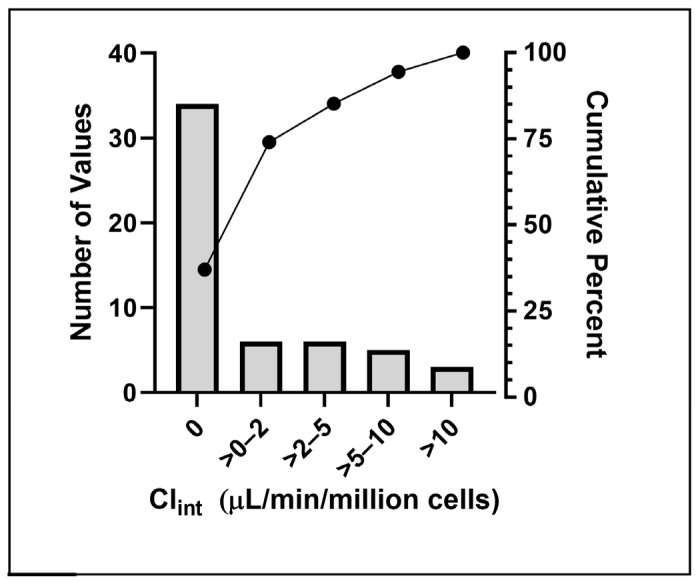
Toxicokinetic (TK) assays and in vitro-in vivo extrapolation (IVIVE) models are New Approach Methods (NAMs) used to translate in vitro points of departure to exposure estimates required to reach equivalent blood concentrations. Per- and polyfluoroalkyl substances (PFAS) are a large chemical class with wide-ranging industrial applications for which only limited toxicity data are available for human health evaluation. To address the lack of TK data, a pooled primary human hepatocyte suspension model was used with targeted liquid chromatography-mass spectrometry to investigate substrate depletion for 54 PFAS. A median value of 4.52 μL/(min x million cells) was observed across those that showed significant clearance, with 35 displaying no substrate depletion. Bayesian modeling propagated uncertainty around clearance values for use in IVIVE models. Structural evaluations showed the fluorotelomer carboxylic acids were the only PFAS carboxylates showing appreciable clearance, and per- and polyfluorosulfonamides were more readily metabolized than other PFAS sulfonates. Biotransformation product prediction, using the chemical transformation simulator, suggested hydrolysis of PFAS sulfonamides to more stable sulfonic acids, which is an important consideration for exposure modeling. This effort greatly expands the PFAS in vitro toxicokinetic dataset, enabling refined TK modeling, in silico tool development, and NAM-based human health evaluations across this important set of emerging contaminants.
ToxicsChemical Engineering-Chemical Health and Safety
CiteScore
4.50
自引率
10.90%
发文量
681
审稿时长
6 weeks
期刊介绍:
Toxics (ISSN 2305-6304) is an international, peer-reviewed, open access journal which provides an advanced forum for studies related to all aspects of toxic chemicals and materials. It publishes reviews, regular research papers, and short communications. Our aim is to encourage scientists to publish their experimental and theoretical results in detail. There is, therefore, no restriction on the maximum length of the papers, although authors should write their papers in a clear and concise way. The full experimental details must be provided so that the results can be reproduced. Electronic files or software regarding the full details of calculations and experimental procedure can be deposited as supplementary material, if it is not possible to publish them along with the text.





 京公网安备 11010802042870号
京ICP备2023020795号-1
京公网安备 11010802042870号
京ICP备2023020795号-1

 分享
分享
 求助内容:
求助内容: 应助结果提醒方式:
 扫码关注我们
