Karlo Jakac , Luka Lanča , Ante Sikirica , Stefan Ivić
{"title":"Approximation of sea surface velocity field by fitting surrogate two-dimensional flow to scattered measurements","authors":"Karlo Jakac , Luka Lanča , Ante Sikirica , Stefan Ivić","doi":"10.1016/j.apor.2024.104246","DOIUrl":null,"url":null,"abstract":"<div><div>In this paper, a rapid approximation method is introduced to estimate the sea surface velocity field based on scattered measurements. The method uses a simplified two-dimensional flow model as a surrogate model, which mimics the real submesoscale flow. The proposed approach treats the interpolation of the flow velocities as an optimization problem, aiming to fit the flow model to the scattered measurements. To ensure consistency between the simulated velocity field and the measured values, the boundary conditions in the numerical simulations are adjusted during the optimization process. Additionally, the relevance of quantity and quality of the scattered measurements is assessed, emphasizing the importance of the measurement locations within the domain as well as explaining how these measurements contribute to the accuracy and reliability of the sea surface velocity field approximation. The proposed methodology has been successfully tested in both synthetic and real-world scenarios, leveraging measurements obtained from Global Positioning System (GPS) drifters and high-frequency (HF) radar systems. The adaptability of this approach for different domains, measurement types and conditions implies that it is suitable for real-world submesoscale scenarios where only an approximation of the sea surface velocity field is sufficient.</div></div>","PeriodicalId":8261,"journal":{"name":"Applied Ocean Research","volume":"153 ","pages":"Article 104246"},"PeriodicalIF":4.4000,"publicationDate":"2024-12-01","publicationTypes":"Journal Article","fieldsOfStudy":null,"isOpenAccess":false,"openAccessPdf":"","citationCount":"0","resultStr":null,"platform":"Semanticscholar","paperid":null,"PeriodicalName":"Applied Ocean Research","FirstCategoryId":"5","ListUrlMain":"https://www.sciencedirect.com/science/article/pii/S0141118724003675","RegionNum":2,"RegionCategory":"工程技术","ArticlePicture":[],"TitleCN":null,"AbstractTextCN":null,"PMCID":null,"EPubDate":"2024/9/28 0:00:00","PubModel":"Epub","JCR":"Q1","JCRName":"ENGINEERING, OCEAN","Score":null,"Total":0}
引用次数: 0
Abstract
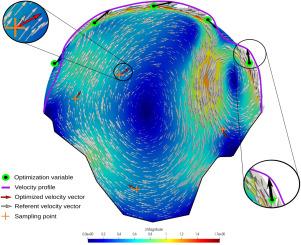
In this paper, a rapid approximation method is introduced to estimate the sea surface velocity field based on scattered measurements. The method uses a simplified two-dimensional flow model as a surrogate model, which mimics the real submesoscale flow. The proposed approach treats the interpolation of the flow velocities as an optimization problem, aiming to fit the flow model to the scattered measurements. To ensure consistency between the simulated velocity field and the measured values, the boundary conditions in the numerical simulations are adjusted during the optimization process. Additionally, the relevance of quantity and quality of the scattered measurements is assessed, emphasizing the importance of the measurement locations within the domain as well as explaining how these measurements contribute to the accuracy and reliability of the sea surface velocity field approximation. The proposed methodology has been successfully tested in both synthetic and real-world scenarios, leveraging measurements obtained from Global Positioning System (GPS) drifters and high-frequency (HF) radar systems. The adaptability of this approach for different domains, measurement types and conditions implies that it is suitable for real-world submesoscale scenarios where only an approximation of the sea surface velocity field is sufficient.
期刊介绍:
The aim of Applied Ocean Research is to encourage the submission of papers that advance the state of knowledge in a range of topics relevant to ocean engineering.




 京公网安备 11010802042870号
京ICP备2023020795号-1
京公网安备 11010802042870号
京ICP备2023020795号-1

 分享
分享
 求助内容:
求助内容: 应助结果提醒方式:
 扫码关注我们
