Zongbin Liu, Xiaojiao Yu, Kai Wang, Jian Zhang, Jinfen Niu
{"title":"Introducing oxygen cacancies to tune Cu2O by Sn ion-doped for high-effective photocatalytic degradation of norfloxacin in wastewater","authors":"Zongbin Liu, Xiaojiao Yu, Kai Wang, Jian Zhang, Jinfen Niu","doi":"10.1016/j.seppur.2024.129810","DOIUrl":null,"url":null,"abstract":"<div><div>Photocatalytic materials have attracted considerable attention owing to its positive environmental impact and efficiency in wastewater treatment. Herein, tin (Sn)-doped copper oxide (Cu<sub>2</sub>O) photocatalysts were successfully synthesized via a facile hydrothermal approach. The doping of Sn ions into the Cu<sub>2</sub>O lattice promoted the formation of more oxygen vacancies, which increased the separation efficiency of photogenerated carriers and enhanced photocatalytic activity. Moreover, the presence of Sn ions enhanced light absorption and the specific surface area of Cu<sub>2</sub>O, and reduced photogenerated carriers recombination. The synergistic effect of the abovementioned advantages, induced excellent photocatalytic activity to the as-prepared catalysts. Tin chloride (30 mg)-doped Cu<sub>2</sub>O showed optimal photocatalytic properties with the highest norfloxacin degradation rate of 83.9 % in 140 min under visible light irradiation. Hydroxy radicals played a major role during degradation as demonstrated by the capturing of active species experiment and EPR testing. Photocatalytic mechanisms and possible degradation pathways were proposed based on Perdew-Burke-Ernzerhof and high-performance liquid chromatography-mass spectrometry techniques. The toxicity analyses of the intermediates proved their low toxicity. Repeated cycling experiments confirmed the excellent stability of the catalysts. This work provides a feasible strategy for fabricating high-performance Cu<sub>2</sub>O-based photocatalysts.</div></div>","PeriodicalId":427,"journal":{"name":"Separation and Purification Technology","volume":"356 ","pages":"Article 129810"},"PeriodicalIF":9.0000,"publicationDate":"2024-09-21","publicationTypes":"Journal Article","fieldsOfStudy":null,"isOpenAccess":false,"openAccessPdf":"","citationCount":"0","resultStr":null,"platform":"Semanticscholar","paperid":null,"PeriodicalName":"Separation and Purification Technology","FirstCategoryId":"5","ListUrlMain":"https://www.sciencedirect.com/science/article/pii/S1383586624035494","RegionNum":1,"RegionCategory":"工程技术","ArticlePicture":[],"TitleCN":null,"AbstractTextCN":null,"PMCID":null,"EPubDate":"","PubModel":"","JCR":"Q1","JCRName":"ENGINEERING, CHEMICAL","Score":null,"Total":0}
引用次数: 0
Abstract
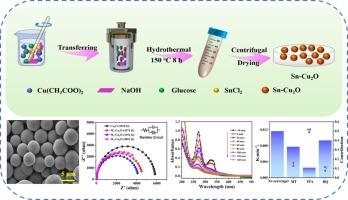
Photocatalytic materials have attracted considerable attention owing to its positive environmental impact and efficiency in wastewater treatment. Herein, tin (Sn)-doped copper oxide (Cu2O) photocatalysts were successfully synthesized via a facile hydrothermal approach. The doping of Sn ions into the Cu2O lattice promoted the formation of more oxygen vacancies, which increased the separation efficiency of photogenerated carriers and enhanced photocatalytic activity. Moreover, the presence of Sn ions enhanced light absorption and the specific surface area of Cu2O, and reduced photogenerated carriers recombination. The synergistic effect of the abovementioned advantages, induced excellent photocatalytic activity to the as-prepared catalysts. Tin chloride (30 mg)-doped Cu2O showed optimal photocatalytic properties with the highest norfloxacin degradation rate of 83.9 % in 140 min under visible light irradiation. Hydroxy radicals played a major role during degradation as demonstrated by the capturing of active species experiment and EPR testing. Photocatalytic mechanisms and possible degradation pathways were proposed based on Perdew-Burke-Ernzerhof and high-performance liquid chromatography-mass spectrometry techniques. The toxicity analyses of the intermediates proved their low toxicity. Repeated cycling experiments confirmed the excellent stability of the catalysts. This work provides a feasible strategy for fabricating high-performance Cu2O-based photocatalysts.
期刊介绍:
Separation and Purification Technology is a premier journal committed to sharing innovative methods for separation and purification in chemical and environmental engineering, encompassing both homogeneous solutions and heterogeneous mixtures. Our scope includes the separation and/or purification of liquids, vapors, and gases, as well as carbon capture and separation techniques. However, it's important to note that methods solely intended for analytical purposes are not within the scope of the journal. Additionally, disciplines such as soil science, polymer science, and metallurgy fall outside the purview of Separation and Purification Technology. Join us in advancing the field of separation and purification methods for sustainable solutions in chemical and environmental engineering.



 京公网安备 11010802042870号
京ICP备2023020795号-1
京公网安备 11010802042870号
京ICP备2023020795号-1

 分享
分享
 求助内容:
求助内容: 应助结果提醒方式:
 扫码关注我们
