{"title":"Investigation of in vitro susceptibility and resistance mechanisms to amikacin among diverse carbapenemase-producing Enterobacteriaceae.","authors":"Xiaoyan Wu, Xiaosi Li, Junjie Yu, Chenliang Fan, Mengli Shen, Xiangchen Li","doi":"10.1186/s12920-024-02016-0","DOIUrl":null,"url":null,"abstract":"<p><strong>Objective: </strong>This study aims to assess the in vitro drug susceptibility of various Carbapenemase-Producing Enterobacteriaceae (CPE) genotypes and elucidate the underlying mechanisms of amikacin resistance.</p><p><strong>Methods: </strong>A total of 72 unique CPE strains were collected from the Second Hospital of Jiaxing between 2019 and 2022, including 51 strains of Klebsiella pneumoniae, 11 strains of Escherichia coli, 6 strains of Enterobacter cloacae, 2 strains of Klebsiella aerogenes, 1 strain of Citrobacter freundii, and 1strain of Citrobacter werkmanii. Among these strains, 24 carried bla<sub>KPC</sub> gene, 20 carried bla<sub>NDM</sub> gene, 23 carried bla<sub>OXA-48-like</sub> gene, and 5 carried both bla<sub>KPC</sub> and bla<sub>NDM</sub>. We measured the in vitro activity of amikacin and other common antibiotics. Strains carrying bla<sub>OXA-48</sub>-like gene were selected for whole genome sequencing (WGS) via next-generation sequencing to identify genes related to antimicrobial resistance (AMR) and virulence factor (VF).</p><p><strong>Results: </strong>Out of the 72 CPE strains tested, 41.7% exhibited resistance to amikacin. The drug resistance rates for K. pneumoniae, E. coli, and Enterobacter spp. were 51.0%, 27.3%, and 10.0%, respectively. The majority of the CPE strains (> 90%) displayed resistance to cephalosporins and carbapenems, while most of them were sensitive to polymyxin B and tigecycline (97.2% and 94.4%). The amikacin resistance rate was 100% for strains carrying bla<sub>OXA-48</sub>, 20.8% for those with bla<sub>KPC</sub>, 5.0% for those with bla<sub>NDM</sub>, and 20.0% for those with both bla<sub>KPC</sub> and bla<sub>NDM</sub>. These differences were statistically significant (P < 0.05). Through sequencing, we detected aminoglycoside resistance genes rmtF and aac(6')-Ib, VF genes iucABCD and rmpA2 in OXA-48-producing multidrug resistance and highly virulent strains. These genes were located on a IncFIB- and IncHI1B-type plasmid, respectively. Both plasmids were highly homologous to the plasmid from OXA-232 strains in Zhejiang province and Shanghai province. Integration of these resistance genes into the IncFIB plasmid, facilitated by the IS6 and/or Tn3 transposons, resulted in OXA232-producing K. pneumoniae with amikacin resistance.</p><p><strong>Conclusion: </strong>This study identified significant amikacin resistance in CPE strains, particularly in those carrying the bla<sub>OXA-48</sub> gene. Resistance genes rmtF and aac(6')-Ib were identified on plasmids. These results highlight the need for careful monitoring of amikacin resistance.</p>","PeriodicalId":8915,"journal":{"name":"BMC Medical Genomics","volume":"17 1","pages":"240"},"PeriodicalIF":2.0000,"publicationDate":"2024-10-01","publicationTypes":"Journal Article","fieldsOfStudy":null,"isOpenAccess":false,"openAccessPdf":"https://www.ncbi.nlm.nih.gov/pmc/articles/PMC11446084/pdf/","citationCount":"0","resultStr":null,"platform":"Semanticscholar","paperid":null,"PeriodicalName":"BMC Medical Genomics","FirstCategoryId":"3","ListUrlMain":"https://doi.org/10.1186/s12920-024-02016-0","RegionNum":4,"RegionCategory":"医学","ArticlePicture":[],"TitleCN":null,"AbstractTextCN":null,"PMCID":null,"EPubDate":"","PubModel":"","JCR":"Q3","JCRName":"GENETICS & HEREDITY","Score":null,"Total":0}
引用次数: 0
Abstract
Objective: This study aims to assess the in vitro drug susceptibility of various Carbapenemase-Producing Enterobacteriaceae (CPE) genotypes and elucidate the underlying mechanisms of amikacin resistance.
Methods: A total of 72 unique CPE strains were collected from the Second Hospital of Jiaxing between 2019 and 2022, including 51 strains of Klebsiella pneumoniae, 11 strains of Escherichia coli, 6 strains of Enterobacter cloacae, 2 strains of Klebsiella aerogenes, 1 strain of Citrobacter freundii, and 1strain of Citrobacter werkmanii. Among these strains, 24 carried blaKPC gene, 20 carried blaNDM gene, 23 carried blaOXA-48-like gene, and 5 carried both blaKPC and blaNDM. We measured the in vitro activity of amikacin and other common antibiotics. Strains carrying blaOXA-48-like gene were selected for whole genome sequencing (WGS) via next-generation sequencing to identify genes related to antimicrobial resistance (AMR) and virulence factor (VF).
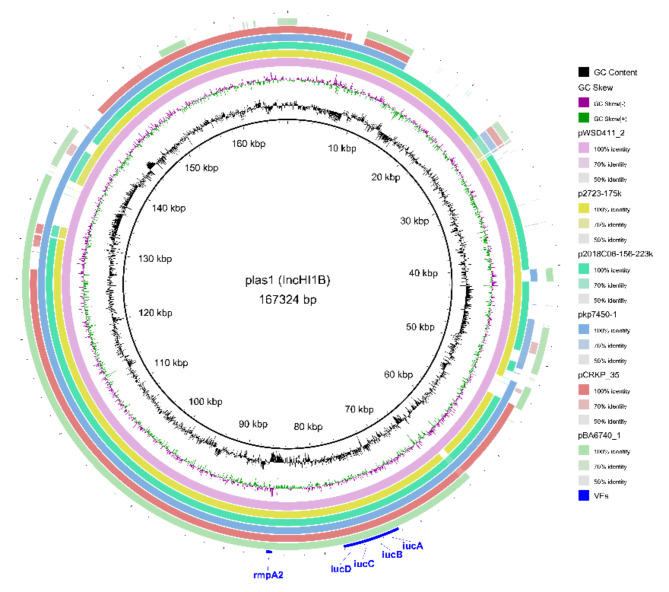
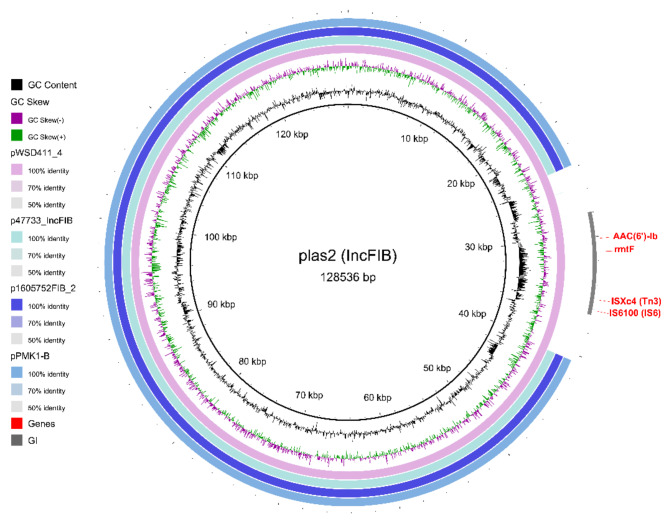
Results: Out of the 72 CPE strains tested, 41.7% exhibited resistance to amikacin. The drug resistance rates for K. pneumoniae, E. coli, and Enterobacter spp. were 51.0%, 27.3%, and 10.0%, respectively. The majority of the CPE strains (> 90%) displayed resistance to cephalosporins and carbapenems, while most of them were sensitive to polymyxin B and tigecycline (97.2% and 94.4%). The amikacin resistance rate was 100% for strains carrying blaOXA-48, 20.8% for those with blaKPC, 5.0% for those with blaNDM, and 20.0% for those with both blaKPC and blaNDM. These differences were statistically significant (P < 0.05). Through sequencing, we detected aminoglycoside resistance genes rmtF and aac(6')-Ib, VF genes iucABCD and rmpA2 in OXA-48-producing multidrug resistance and highly virulent strains. These genes were located on a IncFIB- and IncHI1B-type plasmid, respectively. Both plasmids were highly homologous to the plasmid from OXA-232 strains in Zhejiang province and Shanghai province. Integration of these resistance genes into the IncFIB plasmid, facilitated by the IS6 and/or Tn3 transposons, resulted in OXA232-producing K. pneumoniae with amikacin resistance.
Conclusion: This study identified significant amikacin resistance in CPE strains, particularly in those carrying the blaOXA-48 gene. Resistance genes rmtF and aac(6')-Ib were identified on plasmids. These results highlight the need for careful monitoring of amikacin resistance.
期刊介绍:
BMC Medical Genomics is an open access journal publishing original peer-reviewed research articles in all aspects of functional genomics, genome structure, genome-scale population genetics, epigenomics, proteomics, systems analysis, and pharmacogenomics in relation to human health and disease.



 京公网安备 11010802042870号
京ICP备2023020795号-1
京公网安备 11010802042870号
京ICP备2023020795号-1

 分享
分享
 求助内容:
求助内容: 应助结果提醒方式:
 扫码关注我们
