Feng-Li Chen, Xin-Li Liu, Yue Zhao, Gang Li, Bo-Hong Gao and Xin-Yi Wang
{"title":"Spin crossover FeIII complexes with a substituted Hqnal ligand: effects of anions and solvents†","authors":"Feng-Li Chen, Xin-Li Liu, Yue Zhao, Gang Li, Bo-Hong Gao and Xin-Yi Wang","doi":"10.1039/D4DT01954G","DOIUrl":null,"url":null,"abstract":"<p >A new substituted Hqnal ligand, Hqnal-5-Br<small><sub>q</sub></small>, and four resulting Fe<small><sup>III</sup></small> complexes [Fe(qnal-5-Br<small><sub>q</sub></small>)<small><sub>2</sub></small>]A·sol (A = NO<small><sub>3</sub></small><small><sup>−</sup></small>, sol = CH<small><sub>3</sub></small>OH <strong>1</strong>; A = ClO<small><sub>4</sub></small><small><sup>−</sup></small>, sol = CH<small><sub>3</sub></small>OH <strong>2</strong>; A = OTf<small><sup>−</sup></small>, sol = 2CH<small><sub>3</sub></small>OH·H<small><sub>2</sub></small>O <strong>3</strong>; and A = NTf<small><sub>2</sub></small><small><sup>−</sup></small>, sol = CH<small><sub>2</sub></small>Cl<small><sub>2</sub></small><strong>4</strong>; Hqnal-5-Br<small><sub>q</sub></small> = <em>N</em>-(5-bromo-8-quinolinyl)-2-hydroxynaphthaldimine), have been synthesized and characterized. All four complexes, despite having different anions, adopt similar 1D [Fe(qnal-5-Br<small><sub>q</sub></small>)<small><sub>2</sub></small>]<small><sup>+</sup></small> cation chains linked by orthogonal π⋯π interactions. These chains are further connected to form 2D and 3D structures by other supramolecular interactions. Complexes <strong>1–3</strong> all exhibit abrupt spin crossover behaviors, with the transition temperatures being 230, 189, and 185 K, respectively, while complex <strong>4</strong> is in a high-spin state. The influence of solvents on spin crossover properties was assessed <em>via</em> magnetic measurements on the desolvated samples. Following desolvation, while complexes <strong>1</strong> and <strong>2</strong> show slight variations in their transition temperatures, complexes <strong>3</strong> and <strong>4</strong> undergo significant changes in their magnetic profiles. Desolvation in complex <strong>3</strong> leads to either a HS state or a very incomplete hysteretic transition with a low transition temperature for different sample batches. In contrast, the gradual desolvation in complex <strong>4</strong> leads to diminished solvent residues and progressive transition from a stable HS state to an SCO-active state.</p>","PeriodicalId":71,"journal":{"name":"Dalton Transactions","volume":" 42","pages":" 17233-17243"},"PeriodicalIF":3.3000,"publicationDate":"2024-10-02","publicationTypes":"Journal Article","fieldsOfStudy":null,"isOpenAccess":false,"openAccessPdf":"","citationCount":"0","resultStr":null,"platform":"Semanticscholar","paperid":null,"PeriodicalName":"Dalton Transactions","FirstCategoryId":"92","ListUrlMain":"https://pubs.rsc.org/en/content/articlelanding/2024/dt/d4dt01954g","RegionNum":3,"RegionCategory":"化学","ArticlePicture":[],"TitleCN":null,"AbstractTextCN":null,"PMCID":null,"EPubDate":"","PubModel":"","JCR":"Q2","JCRName":"CHEMISTRY, INORGANIC & NUCLEAR","Score":null,"Total":0}
引用次数: 0
Abstract
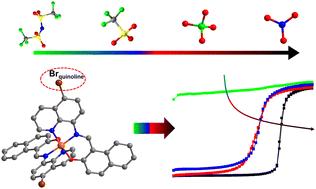
A new substituted Hqnal ligand, Hqnal-5-Brq, and four resulting FeIII complexes [Fe(qnal-5-Brq)2]A·sol (A = NO3−, sol = CH3OH 1; A = ClO4−, sol = CH3OH 2; A = OTf−, sol = 2CH3OH·H2O 3; and A = NTf2−, sol = CH2Cl24; Hqnal-5-Brq = N-(5-bromo-8-quinolinyl)-2-hydroxynaphthaldimine), have been synthesized and characterized. All four complexes, despite having different anions, adopt similar 1D [Fe(qnal-5-Brq)2]+ cation chains linked by orthogonal π⋯π interactions. These chains are further connected to form 2D and 3D structures by other supramolecular interactions. Complexes 1–3 all exhibit abrupt spin crossover behaviors, with the transition temperatures being 230, 189, and 185 K, respectively, while complex 4 is in a high-spin state. The influence of solvents on spin crossover properties was assessed via magnetic measurements on the desolvated samples. Following desolvation, while complexes 1 and 2 show slight variations in their transition temperatures, complexes 3 and 4 undergo significant changes in their magnetic profiles. Desolvation in complex 3 leads to either a HS state or a very incomplete hysteretic transition with a low transition temperature for different sample batches. In contrast, the gradual desolvation in complex 4 leads to diminished solvent residues and progressive transition from a stable HS state to an SCO-active state.
期刊介绍:
Dalton Transactions is a journal for all areas of inorganic chemistry, which encompasses the organometallic, bioinorganic and materials chemistry of the elements, with applications including synthesis, catalysis, energy conversion/storage, electrical devices and medicine. Dalton Transactions welcomes high-quality, original submissions in all of these areas and more, where the advancement of knowledge in inorganic chemistry is significant.



 京公网安备 11010802042870号
京ICP备2023020795号-1
京公网安备 11010802042870号
京ICP备2023020795号-1

 分享
分享
 求助内容:
求助内容: 应助结果提醒方式:
 扫码关注我们
