Guiqin Huang , Yawen Cai , Menghui Ren , Xiaoyu Zhang , Yu Fu , Run Cheng , Yingdi Wang , Mingxing Miao , Lingpeng Zhu , Tianhua Yan
{"title":"Salidroside sensitizes Triple-negative breast cancer to ferroptosis by SCD1-mediated lipogenesis and NCOA4-mediated ferritinophagy","authors":"Guiqin Huang , Yawen Cai , Menghui Ren , Xiaoyu Zhang , Yu Fu , Run Cheng , Yingdi Wang , Mingxing Miao , Lingpeng Zhu , Tianhua Yan","doi":"10.1016/j.jare.2024.09.027","DOIUrl":null,"url":null,"abstract":"<div><h3>Introduction</h3><div>Triple-negative breast cancer (TNBC) is the primary cause of breast cancer-induced death in women. Literature has confirmed the benefits of Salidroside (Sal) in treating TNBC. However, the study about potential therapeutic targets and mechanisms of Sal-anchored TNBC remains limited.</div></div><div><h3>Objective</h3><div>This study was designed to explore the main targets and potential mechanisms of Sal against TNBC.</div></div><div><h3>Methods</h3><div>Network pharmacology, bioinformatics, and machine learning algorithm strategies were integrated to examine the role, potential targets, and mechanisms of the Sal act in TNBC. MDA-MB-231 cells and tumor-bearing nude mice were chosen for <em>in vitro</em> and <em>in vivo</em> experimentation. Cell viability and cytotoxicity were determined using CCK-8, LDH test, and Calcein-AM/PI staining. Antioxidant defense, lipid peroxidation, and iron metabolism were explored using glutathione, glutathione peroxidase, malondialdehyde (MDA), C11-BODIPY 581/591 probe, and FerroOrange dye. Glutathione peroxidase 4 (GPX4) or stearoyl-CoA desaturase 1 (SCD1) overexpression or nuclear receptor co-activator 4 (NCOA4) deficiency was performed to demonstrate the mechanism of Sal on TNBC.</div></div><div><h3>Results</h3><div>The prediction results confirmed that 22 ferroptosis-related genes were identified in Sal and TNBC, revealing that the potential mechanism of the Sal act on TNBC was linked with ferroptosis. Besides, these genes were mainly involved in the mTOR, PI3K/AKT, and autophagy signaling pathway by functional enrichment analysis. The <em>in vitro</em> validation results confirmed that Sal inhibited TNBC cell proliferation by modulating ferroptosis via elevation of intracellular Fe<sup>2+</sup> and lipid peroxidation. Mechanistically, Sal sensitized TNBC cells to ferroptosis by inhibiting the PI3K/AKT/mTOR axis, thereby suppressing SCD1-mediated lipogenesis of monounsaturated fatty acids to induce lipid peroxidation, additionally facilitating NCOA4-mediated ferritinophagy to increase intracellular Fe<sup>2+</sup> content. The GPX4 or SCD1 overexpression or NCOA4 deficiency results further supported our mechanistic studies. <em>In vivo</em> experimentation confirmed that Sal is vital for slowing down tumor growth by inducing ferroptosis.</div></div><div><h3>Conclusions</h3><div>Overall, this study elucidates TNBC pathogenesis closely linked to ferroptosis and identifies potential biomarkers in TNBC. Meanwhile, the study elucidates that Sal sensitizes TNBC to ferroptosis by SCD1-mediated lipogenesis and NCOA4-mediated ferritinophagy, regulated by PI3K/AKT/mTOR signaling pathways. Our findings provide a theoretical basis for applying Sal to treat TNBC.</div></div>","PeriodicalId":14952,"journal":{"name":"Journal of Advanced Research","volume":"74 ","pages":"Pages 589-607"},"PeriodicalIF":13.0000,"publicationDate":"2025-08-01","publicationTypes":"Journal Article","fieldsOfStudy":null,"isOpenAccess":false,"openAccessPdf":"","citationCount":"0","resultStr":null,"platform":"Semanticscholar","paperid":null,"PeriodicalName":"Journal of Advanced Research","FirstCategoryId":"103","ListUrlMain":"https://www.sciencedirect.com/science/article/pii/S2090123224004296","RegionNum":1,"RegionCategory":"综合性期刊","ArticlePicture":[],"TitleCN":null,"AbstractTextCN":null,"PMCID":null,"EPubDate":"2024/9/29 0:00:00","PubModel":"Epub","JCR":"Q1","JCRName":"MULTIDISCIPLINARY SCIENCES","Score":null,"Total":0}
引用次数: 0
Abstract
Introduction
Triple-negative breast cancer (TNBC) is the primary cause of breast cancer-induced death in women. Literature has confirmed the benefits of Salidroside (Sal) in treating TNBC. However, the study about potential therapeutic targets and mechanisms of Sal-anchored TNBC remains limited.
Objective
This study was designed to explore the main targets and potential mechanisms of Sal against TNBC.
Methods
Network pharmacology, bioinformatics, and machine learning algorithm strategies were integrated to examine the role, potential targets, and mechanisms of the Sal act in TNBC. MDA-MB-231 cells and tumor-bearing nude mice were chosen for in vitro and in vivo experimentation. Cell viability and cytotoxicity were determined using CCK-8, LDH test, and Calcein-AM/PI staining. Antioxidant defense, lipid peroxidation, and iron metabolism were explored using glutathione, glutathione peroxidase, malondialdehyde (MDA), C11-BODIPY 581/591 probe, and FerroOrange dye. Glutathione peroxidase 4 (GPX4) or stearoyl-CoA desaturase 1 (SCD1) overexpression or nuclear receptor co-activator 4 (NCOA4) deficiency was performed to demonstrate the mechanism of Sal on TNBC.
Results
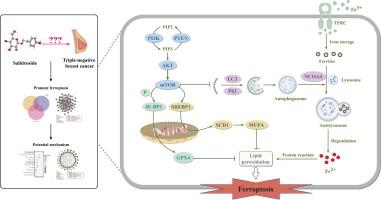
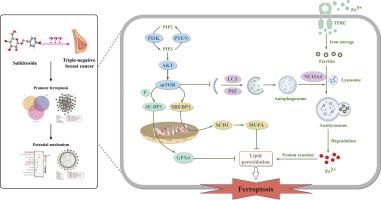
The prediction results confirmed that 22 ferroptosis-related genes were identified in Sal and TNBC, revealing that the potential mechanism of the Sal act on TNBC was linked with ferroptosis. Besides, these genes were mainly involved in the mTOR, PI3K/AKT, and autophagy signaling pathway by functional enrichment analysis. The in vitro validation results confirmed that Sal inhibited TNBC cell proliferation by modulating ferroptosis via elevation of intracellular Fe2+ and lipid peroxidation. Mechanistically, Sal sensitized TNBC cells to ferroptosis by inhibiting the PI3K/AKT/mTOR axis, thereby suppressing SCD1-mediated lipogenesis of monounsaturated fatty acids to induce lipid peroxidation, additionally facilitating NCOA4-mediated ferritinophagy to increase intracellular Fe2+ content. The GPX4 or SCD1 overexpression or NCOA4 deficiency results further supported our mechanistic studies. In vivo experimentation confirmed that Sal is vital for slowing down tumor growth by inducing ferroptosis.
Conclusions
Overall, this study elucidates TNBC pathogenesis closely linked to ferroptosis and identifies potential biomarkers in TNBC. Meanwhile, the study elucidates that Sal sensitizes TNBC to ferroptosis by SCD1-mediated lipogenesis and NCOA4-mediated ferritinophagy, regulated by PI3K/AKT/mTOR signaling pathways. Our findings provide a theoretical basis for applying Sal to treat TNBC.
期刊介绍:
Journal of Advanced Research (J. Adv. Res.) is an applied/natural sciences, peer-reviewed journal that focuses on interdisciplinary research. The journal aims to contribute to applied research and knowledge worldwide through the publication of original and high-quality research articles in the fields of Medicine, Pharmaceutical Sciences, Dentistry, Physical Therapy, Veterinary Medicine, and Basic and Biological Sciences.
The following abstracting and indexing services cover the Journal of Advanced Research: PubMed/Medline, Essential Science Indicators, Web of Science, Scopus, PubMed Central, PubMed, Science Citation Index Expanded, Directory of Open Access Journals (DOAJ), and INSPEC.



 京公网安备 11010802042870号
京ICP备2023020795号-1
京公网安备 11010802042870号
京ICP备2023020795号-1

 分享
分享
 求助内容:
求助内容: 应助结果提醒方式:
 扫码关注我们
