Gong Feng , Ferenc E. Mózes , Dong Ji , Sombat Treeprasertsuk , Takeshi Okanoue , Toshihide Shima , Huiqing Liang , Emmanuel Tsochatzis , Jinjun Chen , Jörn M. Schattenberg , Christian Labenz , Sanjiv Mahadeva , Wah Kheong Chan , Xiaoling Chi , Adèle Delamarre , Victor de Lédinghen , Salvatore Petta , Elisabetta Bugianesi , Hannes Hagström , Jérôme Boursier , Ming-Hua Zheng
{"title":"acFibroMASH Index for the Diagnosis of Fibrotic MASH and Prediction of Liver-related Events: An International Multicenter Study","authors":"Gong Feng , Ferenc E. Mózes , Dong Ji , Sombat Treeprasertsuk , Takeshi Okanoue , Toshihide Shima , Huiqing Liang , Emmanuel Tsochatzis , Jinjun Chen , Jörn M. Schattenberg , Christian Labenz , Sanjiv Mahadeva , Wah Kheong Chan , Xiaoling Chi , Adèle Delamarre , Victor de Lédinghen , Salvatore Petta , Elisabetta Bugianesi , Hannes Hagström , Jérôme Boursier , Ming-Hua Zheng","doi":"10.1016/j.cgh.2024.07.045","DOIUrl":null,"url":null,"abstract":"<div><h3>Background & Aims</h3><div>Metabolic dysfunction-associated steatohepatitis (MASH) and fibrotic MASH are significant health challenges. This multi-national study aimed to validate the acMASH index (including serum creatinine and aspartate aminotransferase concentrations) for MASH diagnosis and develop a new index (acFibroMASH) for non-invasively identifying fibrotic MASH and exploring its predictive value for liver-related events (LREs).</div></div><div><h3>Methods</h3><div>We analyzed data from 3004 individuals with biopsy-proven metabolic dysfunction-associated steatotic liver disease (MASLD) across 29 Chinese and 9 international cohorts to validate the acMASH index and develop the acFibroMASH index. Additionally, we utilized the independent external data from a multi-national cohort of 9034 patients with MASLD to examine associations between the acFibroMASH index and the risk of LREs.</div></div><div><h3>Results</h3><div>In the pooled global cohort, the acMASH index identified MASH with an area under the receiver operating characteristic curve (AUROC) of 0.802 (95% confidence interval [CI], 0.786-0.818). The acFibroMASH index (including the acMASH index plus liver stiffness measurement) accurately identified fibrotic MASH with an AUROC of 0.808 in the derivation cohort and 0.800 in the validation cohort. Notably, the AUROC for the acFibroMASH index was 0.835 (95% CI, 0.786-0.882), superior to that of the FAST score at 0.750 (95% CI, 0.693-0.800; <em>P</em> < .01) in predicting the 5-year risk of LREs. Patients with acFibroMASH >0.39 had a higher risk of LREs than those with acFibroMASH <0.15 (adjusted hazard ratio, 11.23; 95% CI, 3.98-31.66).</div></div><div><h3>Conclusions</h3><div>This multi-ethnic study validates the acMASH index as a reliable, noninvasive test for identifying MASH. The newly proposed acFibroMASH index is a reliable test for identifying fibrotic MASH and predicting the risk of LREs.</div></div>","PeriodicalId":10347,"journal":{"name":"Clinical Gastroenterology and Hepatology","volume":"23 5","pages":"Pages 785-796"},"PeriodicalIF":12.0000,"publicationDate":"2025-04-01","publicationTypes":"Journal Article","fieldsOfStudy":null,"isOpenAccess":false,"openAccessPdf":"","citationCount":"0","resultStr":null,"platform":"Semanticscholar","paperid":null,"PeriodicalName":"Clinical Gastroenterology and Hepatology","FirstCategoryId":"3","ListUrlMain":"https://www.sciencedirect.com/science/article/pii/S1542356524008632","RegionNum":1,"RegionCategory":"医学","ArticlePicture":[],"TitleCN":null,"AbstractTextCN":null,"PMCID":null,"EPubDate":"2024/10/2 0:00:00","PubModel":"Epub","JCR":"Q1","JCRName":"GASTROENTEROLOGY & HEPATOLOGY","Score":null,"Total":0}
引用次数: 0
Abstract
Background & Aims
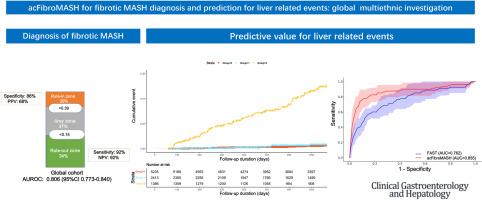
Metabolic dysfunction-associated steatohepatitis (MASH) and fibrotic MASH are significant health challenges. This multi-national study aimed to validate the acMASH index (including serum creatinine and aspartate aminotransferase concentrations) for MASH diagnosis and develop a new index (acFibroMASH) for non-invasively identifying fibrotic MASH and exploring its predictive value for liver-related events (LREs).
Methods
We analyzed data from 3004 individuals with biopsy-proven metabolic dysfunction-associated steatotic liver disease (MASLD) across 29 Chinese and 9 international cohorts to validate the acMASH index and develop the acFibroMASH index. Additionally, we utilized the independent external data from a multi-national cohort of 9034 patients with MASLD to examine associations between the acFibroMASH index and the risk of LREs.
Results
In the pooled global cohort, the acMASH index identified MASH with an area under the receiver operating characteristic curve (AUROC) of 0.802 (95% confidence interval [CI], 0.786-0.818). The acFibroMASH index (including the acMASH index plus liver stiffness measurement) accurately identified fibrotic MASH with an AUROC of 0.808 in the derivation cohort and 0.800 in the validation cohort. Notably, the AUROC for the acFibroMASH index was 0.835 (95% CI, 0.786-0.882), superior to that of the FAST score at 0.750 (95% CI, 0.693-0.800; P < .01) in predicting the 5-year risk of LREs. Patients with acFibroMASH >0.39 had a higher risk of LREs than those with acFibroMASH <0.15 (adjusted hazard ratio, 11.23; 95% CI, 3.98-31.66).
Conclusions
This multi-ethnic study validates the acMASH index as a reliable, noninvasive test for identifying MASH. The newly proposed acFibroMASH index is a reliable test for identifying fibrotic MASH and predicting the risk of LREs.
期刊介绍:
Clinical Gastroenterology and Hepatology (CGH) is dedicated to offering readers a comprehensive exploration of themes in clinical gastroenterology and hepatology. Encompassing diagnostic, endoscopic, interventional, and therapeutic advances, the journal covers areas such as cancer, inflammatory diseases, functional gastrointestinal disorders, nutrition, absorption, and secretion.
As a peer-reviewed publication, CGH features original articles and scholarly reviews, ensuring immediate relevance to the practice of gastroenterology and hepatology. Beyond peer-reviewed content, the journal includes invited key reviews and articles on endoscopy/practice-based technology, health-care policy, and practice management. Multimedia elements, including images, video abstracts, and podcasts, enhance the reader's experience. CGH remains actively engaged with its audience through updates and commentary shared via platforms such as Facebook and Twitter.



 京公网安备 11010802042870号
京ICP备2023020795号-1
京公网安备 11010802042870号
京ICP备2023020795号-1

 分享
分享
 求助内容:
求助内容: 应助结果提醒方式:
 扫码关注我们
