A Dermocosmetic Balm Containing Vitamin B5, Madecassoside, and a Prebiotic Complex Significantly Improves Post Fractionated CO2 Laser Downtime Versus a Repairing Skin Care: Results of a Randomized Double Blind Intra-Individual Exploratory Study
{"title":"A Dermocosmetic Balm Containing Vitamin B5, Madecassoside, and a Prebiotic Complex Significantly Improves Post Fractionated CO2 Laser Downtime Versus a Repairing Skin Care: Results of a Randomized Double Blind Intra-Individual Exploratory Study","authors":"Jean-Michel Amici, Guénaelle Le Dantec, Ann' Laure Demessant, Catherine Queille-Roussel, Magali Procacci Babled, Anne Claire Cathelineau, Alix Danoy, Solene Trevisan, Merete Haedersdal","doi":"10.1111/jocd.16610","DOIUrl":null,"url":null,"abstract":"<p>Ablative fractional (Fx) CO<sub>2</sub> skin resurfacing laser can reduce scars and alleviate aging signs by removing the superficial epidermal layers [<span>1, 2</span>]. However, temporary but bothersome side effects such as erythema, desquamation, and crusts may occur with a frequency and severity depending on laser settings which may impact the patient's quality of life (QoL) [<span>2</span>]. Therefore, experts recommend appropriate post CO<sub>2</sub> laser skin care using dermocosmetics (DC) to restore the skin barrier integrity and to improve physical cutaneous signs [<span>3, 4</span>].</p><p>With this double-blind, randomized intra-individual study, we evaluated the skin re-epithelization kinetics and barrier-associated clinical signs and symptoms management with DC balm (Cicaplast® Baume B5+, La Roche-Posay Laboratoire Dermatologique, France) containing vitamin B5, madecassoside, and a prebiotic complex including inactivated <i>Lactobacillus</i> spp. ferments, oligosaccharides, mannose, and <i>Aqua posae filiformis</i> <i>versus</i> a repairing DC (RDC) cream featuring thermal spring water, <i>Aquaphilus dolomiae</i> ferment filtrate, and purifying actives following Fx CO<sub>2</sub> laser (LaserPulse®, Luminenis Ltd., France).</p><p>We included 25 adults, 15 women and 10 men, with a mean age of 37.7 ± 7.3 years and a Phototype II (3;12%) or III (22;88%). Clinical assessments comprised the assessment of the wound healing kinetic overtime based on re-epithelization of the lesional area, the wound healing score (0 = none to 5 = complete healing), individual scores of erythema, desquamation and crusts (from 0 = none to 3 = severe) as well as their composite score (0–9). Moreover, the investigator assessed the skin color (ITA, individual typology angle) using a colorimeter (CL400 (E®), Courage & Khazaka, Germany) and took photos using SkinTone technologies (Newtone Technologies, France). The area under the curve (AUC) was calculated for the wound healing score and ITA values.</p><p>The mean complete healing kinetic was achieved significantly (<i>p</i> = 0.003) faster with DC balm (13.5 ± 3.1 days) than with RDC (15.8 ± 2.3 days); the mean LS difference was 2.771 days (CI 95%: 0.741; 4.801). The mean wound healing score (Figure 1) was significantly (<i>p</i> < 0.05) higher with DC balm compared to RDC between Day 6 and 10 and at Days 13 and 14 confirming a faster lesion healing with DC balm. At Day 17, 14 areas treated with DC balm compared to 10 treated with RDC were completely healed.</p><p>Furthermore, both the composite and crust scores had significantly (<i>p</i> < 0.05) faster and better improved compared to the RDC-treated area between Day 6 and 10 as well as on Day 14. Nevertheless, we did not observe any significant differences between both products for the improvement of erythema and desquamation.</p><p>Finally, the AUC of the wound healing score was 44.9 ± 10.05 n/N (10.1%) for DC balm and 36.18 n/N (10.7%) for RDC. The difference was significantly (<i>p</i> < 0.01) in favor of DC balm (LS means: −8.72, CI 95%: −13.67; −3.74). The AUC for ITA was also significantly (<i>p</i> < 0.001; LS means: −136.79, CI 95%: −215.02; −58.56) in favor of DC balm 541.7 n/N (175.0%) over RDC 404.9 n/N (254.6%).</p><p>Figure 2 provides an example comparing the re-epithelization of two zones treated with either DC balm or RDC.</p><p>In conclusion, this study demonstrated that a daily use of DC balm post-Fx CO<sub>2</sub> laser resulted in a significantly faster and better skin repair, especially during the first 14 days of application potentially improving the patients' QoL during this critical period. Moreover it significantly reduced crust formation and limited skin discoloration compared to RDC. The herewith presented exploratory results require confirmation through a large randomized study assessing not only the clinical benefits of the tested products but also the patients' quality of life status post-laser.</p><p>C.Q.R. performed the study, G.L.D. and A.L.D. supervised the study, all authors analyzed the data. G.L.D. and A.L.D. wrote, and all authors read and approved the manuscript.</p><p>This single center, intra-individual, randomized study adhered to the principles of Good Clinical Practices and the declaration of Helsinki. According to French regulatory guidelines, this type of trial received ethics committee approval (Comité Ethique Nord-Ouest I on September 8, 2022, approval number 2022-A01037-36). All subjects provided written informed consent prior to their participation.</p><p>Guénaelle Le Dantec and Ann'Laure Demessant are employees of La Roche-Posay Laboratoire Dermatologique.</p>","PeriodicalId":15546,"journal":{"name":"Journal of Cosmetic Dermatology","volume":"24 1","pages":""},"PeriodicalIF":2.5000,"publicationDate":"2024-10-03","publicationTypes":"Journal Article","fieldsOfStudy":null,"isOpenAccess":false,"openAccessPdf":"https://www.ncbi.nlm.nih.gov/pmc/articles/PMC11743220/pdf/","citationCount":"0","resultStr":null,"platform":"Semanticscholar","paperid":null,"PeriodicalName":"Journal of Cosmetic Dermatology","FirstCategoryId":"3","ListUrlMain":"https://onlinelibrary.wiley.com/doi/10.1111/jocd.16610","RegionNum":4,"RegionCategory":"医学","ArticlePicture":[],"TitleCN":null,"AbstractTextCN":null,"PMCID":null,"EPubDate":"","PubModel":"","JCR":"Q2","JCRName":"DERMATOLOGY","Score":null,"Total":0}
引用次数: 0
Abstract
Ablative fractional (Fx) CO2 skin resurfacing laser can reduce scars and alleviate aging signs by removing the superficial epidermal layers [1, 2]. However, temporary but bothersome side effects such as erythema, desquamation, and crusts may occur with a frequency and severity depending on laser settings which may impact the patient's quality of life (QoL) [2]. Therefore, experts recommend appropriate post CO2 laser skin care using dermocosmetics (DC) to restore the skin barrier integrity and to improve physical cutaneous signs [3, 4].
With this double-blind, randomized intra-individual study, we evaluated the skin re-epithelization kinetics and barrier-associated clinical signs and symptoms management with DC balm (Cicaplast® Baume B5+, La Roche-Posay Laboratoire Dermatologique, France) containing vitamin B5, madecassoside, and a prebiotic complex including inactivated Lactobacillus spp. ferments, oligosaccharides, mannose, and Aqua posae filiformisversus a repairing DC (RDC) cream featuring thermal spring water, Aquaphilus dolomiae ferment filtrate, and purifying actives following Fx CO2 laser (LaserPulse®, Luminenis Ltd., France).
We included 25 adults, 15 women and 10 men, with a mean age of 37.7 ± 7.3 years and a Phototype II (3;12%) or III (22;88%). Clinical assessments comprised the assessment of the wound healing kinetic overtime based on re-epithelization of the lesional area, the wound healing score (0 = none to 5 = complete healing), individual scores of erythema, desquamation and crusts (from 0 = none to 3 = severe) as well as their composite score (0–9). Moreover, the investigator assessed the skin color (ITA, individual typology angle) using a colorimeter (CL400 (E®), Courage & Khazaka, Germany) and took photos using SkinTone technologies (Newtone Technologies, France). The area under the curve (AUC) was calculated for the wound healing score and ITA values.
The mean complete healing kinetic was achieved significantly (p = 0.003) faster with DC balm (13.5 ± 3.1 days) than with RDC (15.8 ± 2.3 days); the mean LS difference was 2.771 days (CI 95%: 0.741; 4.801). The mean wound healing score (Figure 1) was significantly (p < 0.05) higher with DC balm compared to RDC between Day 6 and 10 and at Days 13 and 14 confirming a faster lesion healing with DC balm. At Day 17, 14 areas treated with DC balm compared to 10 treated with RDC were completely healed.
Furthermore, both the composite and crust scores had significantly (p < 0.05) faster and better improved compared to the RDC-treated area between Day 6 and 10 as well as on Day 14. Nevertheless, we did not observe any significant differences between both products for the improvement of erythema and desquamation.
Finally, the AUC of the wound healing score was 44.9 ± 10.05 n/N (10.1%) for DC balm and 36.18 n/N (10.7%) for RDC. The difference was significantly (p < 0.01) in favor of DC balm (LS means: −8.72, CI 95%: −13.67; −3.74). The AUC for ITA was also significantly (p < 0.001; LS means: −136.79, CI 95%: −215.02; −58.56) in favor of DC balm 541.7 n/N (175.0%) over RDC 404.9 n/N (254.6%).
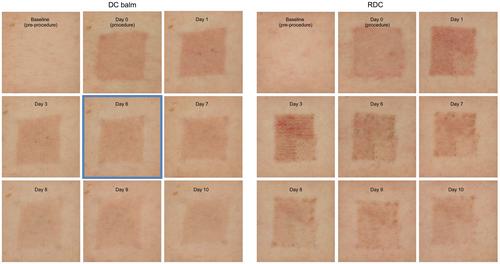
Figure 2 provides an example comparing the re-epithelization of two zones treated with either DC balm or RDC.
In conclusion, this study demonstrated that a daily use of DC balm post-Fx CO2 laser resulted in a significantly faster and better skin repair, especially during the first 14 days of application potentially improving the patients' QoL during this critical period. Moreover it significantly reduced crust formation and limited skin discoloration compared to RDC. The herewith presented exploratory results require confirmation through a large randomized study assessing not only the clinical benefits of the tested products but also the patients' quality of life status post-laser.
C.Q.R. performed the study, G.L.D. and A.L.D. supervised the study, all authors analyzed the data. G.L.D. and A.L.D. wrote, and all authors read and approved the manuscript.
This single center, intra-individual, randomized study adhered to the principles of Good Clinical Practices and the declaration of Helsinki. According to French regulatory guidelines, this type of trial received ethics committee approval (Comité Ethique Nord-Ouest I on September 8, 2022, approval number 2022-A01037-36). All subjects provided written informed consent prior to their participation.
Guénaelle Le Dantec and Ann'Laure Demessant are employees of La Roche-Posay Laboratoire Dermatologique.
期刊介绍:
The Journal of Cosmetic Dermatology publishes high quality, peer-reviewed articles on all aspects of cosmetic dermatology with the aim to foster the highest standards of patient care in cosmetic dermatology. Published quarterly, the Journal of Cosmetic Dermatology facilitates continuing professional development and provides a forum for the exchange of scientific research and innovative techniques.
The scope of coverage includes, but will not be limited to: healthy skin; skin maintenance; ageing skin; photodamage and photoprotection; rejuvenation; biochemistry, endocrinology and neuroimmunology of healthy skin; imaging; skin measurement; quality of life; skin types; sensitive skin; rosacea and acne; sebum; sweat; fat; phlebology; hair conservation, restoration and removal; nails and nail surgery; pigment; psychological and medicolegal issues; retinoids; cosmetic chemistry; dermopharmacy; cosmeceuticals; toiletries; striae; cellulite; cosmetic dermatological surgery; blepharoplasty; liposuction; surgical complications; botulinum; fillers, peels and dermabrasion; local and tumescent anaesthesia; electrosurgery; lasers, including laser physics, laser research and safety, vascular lasers, pigment lasers, hair removal lasers, tattoo removal lasers, resurfacing lasers, dermal remodelling lasers and laser complications.



 京公网安备 11010802042870号
京ICP备2023020795号-1
京公网安备 11010802042870号
京ICP备2023020795号-1

 分享
分享
 求助内容:
求助内容: 应助结果提醒方式:
 扫码关注我们
