Inmaculada Doña, María Salas, Esther Moreno, Marta Ferrer, Cristobalina Mayorga, María José Torres
{"title":"An algorithm for the diagnosis of beta-lactam allergy, 2024 update","authors":"Inmaculada Doña, María Salas, Esther Moreno, Marta Ferrer, Cristobalina Mayorga, María José Torres","doi":"10.1111/all.16348","DOIUrl":null,"url":null,"abstract":"<p>The diagnostic work-up for diagnosing betalactam (BL) allergy includes clinical history, skin test (ST), in vitro tests (specific immunoglobulin E (sIgE) and basophil activation test (BAT) for immediate reactions (IRs), and lymphocyte transformation test (LTT) for non-immediate reactions (NIRs)), and drug provocation test (DPT)<span><sup>1, 2</sup></span> (Figure 1).</p><p>Regarding ST and in vitro tests, a recent metanalysis including studies conducted in patients reporting a penicillin allergy show a ST sensitivity of 31% and specificity of 97%, and sIgE sensitivity of 19% and specificity of 97%. This data mainly reflect the low frequency of true BL allergy.<span><sup>3</sup></span> In fact, in studies including truly allergic patients, STs showed a higher sensitivity, reaching up to 60–70% in IRs and 20% in NIRs.<span><sup>1</sup></span> sIgE in patients experiencing IRs confirmed by positive STs showed sensitivity values of 39%–52%, with false-positive results to penicillin G in up to 16% of cases.<span><sup>4</sup></span> A recent metanalysis gave a BAT sensitivity of 51% and specificity of 89%.<span><sup>5</sup></span> Recently, it has been demonstrated that CD203c as activation marker in BAT showed a good confirmatory power, especially for amoxicillin allergy.<span><sup>6, 7</sup></span> The diagnostic value of LTT for NIRs has been evaluated only in few papers, displaying a sensitivity of 53–65% and specificity of 94–96%.<span><sup>1</sup></span> Both BAT and LTT cannot be considered as a routine element of clinical practice due to the complex procedures and the lack of standardization, however they may be useful as a complemmentary diagnostic tool.<span><sup>1, 6</sup></span> In fact, in vitro tests are recommended to be performed before in vivo tests when evaluating patients with severe reactions.<span><sup>1, 6</sup></span></p><p>Considering that in vitro and skin testing lack 100% negative predictive value, DPT is the gold standard for diagnosis.<span><sup>1, 2</sup></span> DPT protocols are far from being standardized and vary among studies in terms of dose steps, time intervals between incremental doses, and days of dosing. The whole allergological work-up, in general, takes several days.<span><sup>8</sup></span> However, taking into account the low proportion of patients who are truly allergic, faster pathways has been proposed such as direct DPT without previous STs. This procedure has shown to be safe on multiple large studies performed in children,<span><sup>9, 10</sup></span> and more recently, in adults,<span><sup>11, 12</sup></span> giving a prevalence of reactions lower than 7%, being less than 0.1% severe. In fact, direct penicillin DPT has been recently advocated by UK and Asia guidelines.<span><sup>13, 14</sup></span> It is important to highlight that in all the subjects included in those studies performing a direct DPT, the risk of being true allergic was low. In consequence, risk stratification has emerged as an important tool for adapting the diagnostic strategy to the perceived probability of being truly allergic, whilst still maintaining the safety for the patient, with the aim of optimizing investigations in terms of efficiency and resources. However, nowadays there is still no broad consensus on the risk stratification of subjects labelled as BL allergic.<span><sup>1, 8, 14, 15</sup></span> Therefore, over recent years, interest has grown in the development of validated point-of-care assessment tools that, based on the information obtained from clinical history, generate a quantitative scoring scale for stratifying patients into risk categories, with ‘low-risk’ patients able to proceed straight to direct DPT. In that sense, a clinical decision rule called PEN-FAST has shown a high negative predictive value of 96% in delabeling patients in USA and Australia,<span><sup>16</sup></span> and a direct oral DPT with penicillin showed to be safe (only 0.5% reacted in DPT experiencing mild cutaneous symptoms) and effective in those estratified as low-risk (PEN-FAST score less than 3).<span><sup>17</sup></span> Current efforts are focused in the validation and optimization of these tools in ethnically diverse populations,<span><sup>18, 19</sup></span> as well as for providing not only allergist-designed guidance but also for non-allergists.</p><p>Another matter of debate has been the length of DPT needed for an accurate diagnosis. Nowadays, there is no evidence that support the use of extended-day DPT over single-day DPT. It has been proposed prolonged DPT only for NIRs reaching at least the maximum single therapeutic/unit dose and with a minimum 48 h washout period between doses. Additionally, the duration of a full treatment (7–10 days) is not recommended.<span><sup>8</sup></span></p><p>In patients with strong suspicion of immediate allergic reactions to penicillins who display negative results on the allergological work-up, a risk of resensitisation should be considered before considering the patient as non-allergic. Retest should be considered to be performed 4–6 weeks later, specially for severe IRs.<span><sup>20</sup></span></p><p>In those patients confirmed as allergic, for selecting alternative BLs it is important to take into account the role of side chain<span><sup>1, 2</sup></span> (Table 1).</p><p>The authors declare no conflicts of interest.</p>","PeriodicalId":122,"journal":{"name":"Allergy","volume":"80 2","pages":"633-637"},"PeriodicalIF":12.0000,"publicationDate":"2024-10-04","publicationTypes":"Journal Article","fieldsOfStudy":null,"isOpenAccess":false,"openAccessPdf":"https://onlinelibrary.wiley.com/doi/epdf/10.1111/all.16348","citationCount":"0","resultStr":null,"platform":"Semanticscholar","paperid":null,"PeriodicalName":"Allergy","FirstCategoryId":"3","ListUrlMain":"https://onlinelibrary.wiley.com/doi/10.1111/all.16348","RegionNum":1,"RegionCategory":"医学","ArticlePicture":[],"TitleCN":null,"AbstractTextCN":null,"PMCID":null,"EPubDate":"","PubModel":"","JCR":"Q1","JCRName":"ALLERGY","Score":null,"Total":0}
引用次数: 0
Abstract
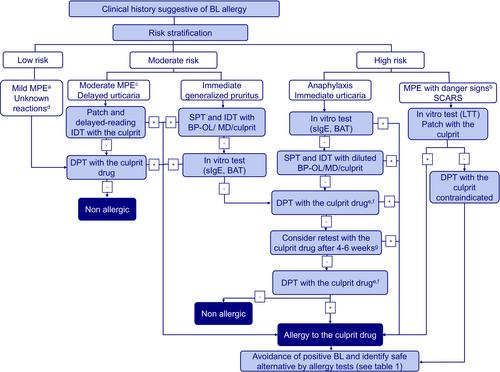
The diagnostic work-up for diagnosing betalactam (BL) allergy includes clinical history, skin test (ST), in vitro tests (specific immunoglobulin E (sIgE) and basophil activation test (BAT) for immediate reactions (IRs), and lymphocyte transformation test (LTT) for non-immediate reactions (NIRs)), and drug provocation test (DPT)1, 2 (Figure 1).
Regarding ST and in vitro tests, a recent metanalysis including studies conducted in patients reporting a penicillin allergy show a ST sensitivity of 31% and specificity of 97%, and sIgE sensitivity of 19% and specificity of 97%. This data mainly reflect the low frequency of true BL allergy.3 In fact, in studies including truly allergic patients, STs showed a higher sensitivity, reaching up to 60–70% in IRs and 20% in NIRs.1 sIgE in patients experiencing IRs confirmed by positive STs showed sensitivity values of 39%–52%, with false-positive results to penicillin G in up to 16% of cases.4 A recent metanalysis gave a BAT sensitivity of 51% and specificity of 89%.5 Recently, it has been demonstrated that CD203c as activation marker in BAT showed a good confirmatory power, especially for amoxicillin allergy.6, 7 The diagnostic value of LTT for NIRs has been evaluated only in few papers, displaying a sensitivity of 53–65% and specificity of 94–96%.1 Both BAT and LTT cannot be considered as a routine element of clinical practice due to the complex procedures and the lack of standardization, however they may be useful as a complemmentary diagnostic tool.1, 6 In fact, in vitro tests are recommended to be performed before in vivo tests when evaluating patients with severe reactions.1, 6
Considering that in vitro and skin testing lack 100% negative predictive value, DPT is the gold standard for diagnosis.1, 2 DPT protocols are far from being standardized and vary among studies in terms of dose steps, time intervals between incremental doses, and days of dosing. The whole allergological work-up, in general, takes several days.8 However, taking into account the low proportion of patients who are truly allergic, faster pathways has been proposed such as direct DPT without previous STs. This procedure has shown to be safe on multiple large studies performed in children,9, 10 and more recently, in adults,11, 12 giving a prevalence of reactions lower than 7%, being less than 0.1% severe. In fact, direct penicillin DPT has been recently advocated by UK and Asia guidelines.13, 14 It is important to highlight that in all the subjects included in those studies performing a direct DPT, the risk of being true allergic was low. In consequence, risk stratification has emerged as an important tool for adapting the diagnostic strategy to the perceived probability of being truly allergic, whilst still maintaining the safety for the patient, with the aim of optimizing investigations in terms of efficiency and resources. However, nowadays there is still no broad consensus on the risk stratification of subjects labelled as BL allergic.1, 8, 14, 15 Therefore, over recent years, interest has grown in the development of validated point-of-care assessment tools that, based on the information obtained from clinical history, generate a quantitative scoring scale for stratifying patients into risk categories, with ‘low-risk’ patients able to proceed straight to direct DPT. In that sense, a clinical decision rule called PEN-FAST has shown a high negative predictive value of 96% in delabeling patients in USA and Australia,16 and a direct oral DPT with penicillin showed to be safe (only 0.5% reacted in DPT experiencing mild cutaneous symptoms) and effective in those estratified as low-risk (PEN-FAST score less than 3).17 Current efforts are focused in the validation and optimization of these tools in ethnically diverse populations,18, 19 as well as for providing not only allergist-designed guidance but also for non-allergists.
Another matter of debate has been the length of DPT needed for an accurate diagnosis. Nowadays, there is no evidence that support the use of extended-day DPT over single-day DPT. It has been proposed prolonged DPT only for NIRs reaching at least the maximum single therapeutic/unit dose and with a minimum 48 h washout period between doses. Additionally, the duration of a full treatment (7–10 days) is not recommended.8
In patients with strong suspicion of immediate allergic reactions to penicillins who display negative results on the allergological work-up, a risk of resensitisation should be considered before considering the patient as non-allergic. Retest should be considered to be performed 4–6 weeks later, specially for severe IRs.20
In those patients confirmed as allergic, for selecting alternative BLs it is important to take into account the role of side chain1, 2 (Table 1).
期刊介绍:
Allergy is an international and multidisciplinary journal that aims to advance, impact, and communicate all aspects of the discipline of Allergy/Immunology. It publishes original articles, reviews, position papers, guidelines, editorials, news and commentaries, letters to the editors, and correspondences. The journal accepts articles based on their scientific merit and quality.
Allergy seeks to maintain contact between basic and clinical Allergy/Immunology and encourages contributions from contributors and readers from all countries. In addition to its publication, Allergy also provides abstracting and indexing information. Some of the databases that include Allergy abstracts are Abstracts on Hygiene & Communicable Disease, Academic Search Alumni Edition, AgBiotech News & Information, AGRICOLA Database, Biological Abstracts, PubMed Dietary Supplement Subset, and Global Health, among others.



 京公网安备 11010802042870号
京ICP备2023020795号-1
京公网安备 11010802042870号
京ICP备2023020795号-1

 分享
分享
 求助内容:
求助内容: 应助结果提醒方式:
 扫码关注我们
