{"title":"BL-918 alleviates oxidative stress in rats after subarachnoid hemorrhage by promoting mitophagy through the ULK1/PINK1/Parkin pathway","authors":"Jinshuo Yang, Qiaowei Wu, Yuchen Li, Yongzhi Zhang, Shuai Lan, Kaikun Yuan, Jiaxing Dai, Bowen Sun, Yuxiao Meng, Shancai Xu, Huaizhang Shi","doi":"10.1016/j.freeradbiomed.2024.10.261","DOIUrl":null,"url":null,"abstract":"<div><h3>Background and purpose</h3><div>Oxidative stress plays a critical role in early brain injury (EBI) following subarachnoid hemorrhage (SAH). The small molecule ULK1 agonist, BL-918, demonstrated neuroprotective effects in other central nervous system diseases; however, its role in SAH has not yet been explored. This study aimed to evaluate whether BL-918 could provide neuroprotective effects in rats following SAH.</div></div><div><h3>Methods</h3><div>An SAH model was established in Sprague-Dawley rats using endovascular perforation. BL-918 was administered intraperitoneally after SAH, while the ULK1 inhibitor SBI was given intraperitoneally prior to SAH modeling. PINK1 siRNA was administered into the lateral ventricle before SAH induction. The neuroprotective effects and mechanisms of BL-918 were assessed through SAH grading, brain water content measurement, blood-brain barrier permeability, neurobehavioral tests, Western blot, immunofluorescence, TUNEL staining, DHE staining, and transmission electron microscopy (TEM).</div></div><div><h3>Results</h3><div>After SAH, the expression levels of p-ULK1, PINK1, Parkin, and LC3Ⅱ increased, peaking at 24 h post-SAH. BL-918 treatment improved neurological function in rats, reduced brain water content and blood-brain barrier permeability, and exhibited anti-oxidative stress and anti-apoptotic effects. Western blot analysis revealed that BL-918 increased the expression of p-ULK1, PINK1, Parkin, LC3Ⅱ, Bcl-xl, and Bcl-2 while inhibiting the expression of Bax and Cleaved Caspase-3. Oxidative stress-related indicators showed that BL-918 alleviated oxidative stress. Immunofluorescence and TEM results demonstrated that BL-918 promoted mitophagy and preserved mitochondrial morphology. Furthermore, the positive effects of BL-918 were reversed by SBI and PINK1 siRNA, respectively.</div></div><div><h3>Conclusion</h3><div>BL-918 improved both short-term and long-term neurological impairments in rats after SAH and reduced oxidative stress by promoting mitophagy, at least partially through the ULK1/PINK1/Parkin signaling pathway.</div></div>","PeriodicalId":12407,"journal":{"name":"Free Radical Biology and Medicine","volume":"224 ","pages":"Pages 846-861"},"PeriodicalIF":8.2000,"publicationDate":"2024-11-01","publicationTypes":"Journal Article","fieldsOfStudy":null,"isOpenAccess":false,"openAccessPdf":"","citationCount":"0","resultStr":null,"platform":"Semanticscholar","paperid":null,"PeriodicalName":"Free Radical Biology and Medicine","FirstCategoryId":"3","ListUrlMain":"https://www.sciencedirect.com/science/article/pii/S0891584924009626","RegionNum":2,"RegionCategory":"生物学","ArticlePicture":[],"TitleCN":null,"AbstractTextCN":null,"PMCID":null,"EPubDate":"2024/10/4 0:00:00","PubModel":"Epub","JCR":"Q1","JCRName":"BIOCHEMISTRY & MOLECULAR BIOLOGY","Score":null,"Total":0}
引用次数: 0
Abstract
Background and purpose
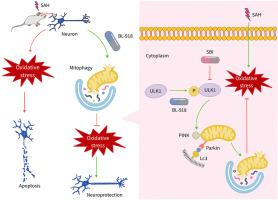
Oxidative stress plays a critical role in early brain injury (EBI) following subarachnoid hemorrhage (SAH). The small molecule ULK1 agonist, BL-918, demonstrated neuroprotective effects in other central nervous system diseases; however, its role in SAH has not yet been explored. This study aimed to evaluate whether BL-918 could provide neuroprotective effects in rats following SAH.
Methods
An SAH model was established in Sprague-Dawley rats using endovascular perforation. BL-918 was administered intraperitoneally after SAH, while the ULK1 inhibitor SBI was given intraperitoneally prior to SAH modeling. PINK1 siRNA was administered into the lateral ventricle before SAH induction. The neuroprotective effects and mechanisms of BL-918 were assessed through SAH grading, brain water content measurement, blood-brain barrier permeability, neurobehavioral tests, Western blot, immunofluorescence, TUNEL staining, DHE staining, and transmission electron microscopy (TEM).
Results
After SAH, the expression levels of p-ULK1, PINK1, Parkin, and LC3Ⅱ increased, peaking at 24 h post-SAH. BL-918 treatment improved neurological function in rats, reduced brain water content and blood-brain barrier permeability, and exhibited anti-oxidative stress and anti-apoptotic effects. Western blot analysis revealed that BL-918 increased the expression of p-ULK1, PINK1, Parkin, LC3Ⅱ, Bcl-xl, and Bcl-2 while inhibiting the expression of Bax and Cleaved Caspase-3. Oxidative stress-related indicators showed that BL-918 alleviated oxidative stress. Immunofluorescence and TEM results demonstrated that BL-918 promoted mitophagy and preserved mitochondrial morphology. Furthermore, the positive effects of BL-918 were reversed by SBI and PINK1 siRNA, respectively.
Conclusion
BL-918 improved both short-term and long-term neurological impairments in rats after SAH and reduced oxidative stress by promoting mitophagy, at least partially through the ULK1/PINK1/Parkin signaling pathway.
期刊介绍:
Free Radical Biology and Medicine is a leading journal in the field of redox biology, which is the study of the role of reactive oxygen species (ROS) and other oxidizing agents in biological systems. The journal serves as a premier forum for publishing innovative and groundbreaking research that explores the redox biology of health and disease, covering a wide range of topics and disciplines. Free Radical Biology and Medicine also commissions Special Issues that highlight recent advances in both basic and clinical research, with a particular emphasis on the mechanisms underlying altered metabolism and redox signaling. These Special Issues aim to provide a focused platform for the latest research in the field, fostering collaboration and knowledge exchange among researchers and clinicians.



 京公网安备 11010802042870号
京ICP备2023020795号-1
京公网安备 11010802042870号
京ICP备2023020795号-1

 分享
分享
 求助内容:
求助内容: 应助结果提醒方式:
 扫码关注我们
