Santiago Diaz-Arauzo, Julia R. Downing, Daphne Tsai, Jenna Trost, Janan Hui, Kevin Donahue, Nick Antonopoulos, Lindsay E. Chaney, Jennifer B. Dunn and Mark C. Hersam
{"title":"Ultrahigh-throughput cross-flow filtration of solution-processed 2D materials enabled by porous ceramic membranes†","authors":"Santiago Diaz-Arauzo, Julia R. Downing, Daphne Tsai, Jenna Trost, Janan Hui, Kevin Donahue, Nick Antonopoulos, Lindsay E. Chaney, Jennifer B. Dunn and Mark C. Hersam","doi":"10.1039/D4MH01205D","DOIUrl":null,"url":null,"abstract":"<p >Printed electronics is a disruptive technology in multiple applications including environmental and biological sensors, flexible displays, and wearable diagnostic devices. With superlative electronic, optical, mechanical, and chemical properties, two-dimensional (2D) materials are promising candidates for printable electronic inks. While liquid-phase exfoliation (LPE) methods can produce electronic-grade 2D materials, conventional batch separation processes typically rely on centrifugation, which requires significant time and effort to remove incompletely exfoliated bulk powders, hindering the scale-up of 2D ink manufacturing. While cross-flow filtration (CFF) has emerged as a promising continuous flow separation method for solution-processed 2D nanosheets, previously demonstrated polymer CFF membranes necessitate low 2D nanosheet concentrations to avoid fouling, which ultimately limits mass throughput. Here, we demonstrate a fully flow-based, exfoliation-to-ink system for electronic-grade 2D materials using an integrated cross-flow separation and concentration system. To overcome the relatively low-throughput processing concentrations of incumbent polymer CFF membranes, we employ porous ceramic CFF membranes that are tolerant to 10-fold higher nanosheet concentrations and flow rates without compromising separation efficiency. Furthermore, we demonstrate a concentration method <em>via</em> cross-flow ultrafiltration, where the retentate can be directly formulated into printable inks with electronic-grade performance that meets or exceeds centrifugally produced inks. Life cycle assessment and technoeconomic analysis quantitatively confirm the advantages of ceramic <em>versus</em> polymer CFF membranes including reductions of 97%, 96%, 94%, and 93% for greenhouse gas emissions, water consumption, fossil fuel consumption, and specific production costs, respectively. Overall, this work presents an environmentally sustainable and cost-effective solution for the fabrication, separation, and printing of electronic-grade 2D materials.</p>","PeriodicalId":87,"journal":{"name":"Materials Horizons","volume":" 23","pages":" 5960-5971"},"PeriodicalIF":10.7000,"publicationDate":"2024-10-03","publicationTypes":"Journal Article","fieldsOfStudy":null,"isOpenAccess":false,"openAccessPdf":"https://pubs.rsc.org/en/content/articlepdf/2024/mh/d4mh01205d?page=search","citationCount":"0","resultStr":null,"platform":"Semanticscholar","paperid":null,"PeriodicalName":"Materials Horizons","FirstCategoryId":"88","ListUrlMain":"https://pubs.rsc.org/en/content/articlelanding/2024/mh/d4mh01205d","RegionNum":2,"RegionCategory":"材料科学","ArticlePicture":[],"TitleCN":null,"AbstractTextCN":null,"PMCID":null,"EPubDate":"","PubModel":"","JCR":"Q1","JCRName":"CHEMISTRY, MULTIDISCIPLINARY","Score":null,"Total":0}
引用次数: 0
Abstract
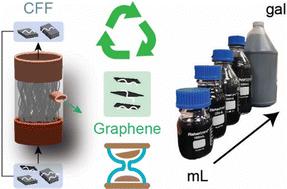
Printed electronics is a disruptive technology in multiple applications including environmental and biological sensors, flexible displays, and wearable diagnostic devices. With superlative electronic, optical, mechanical, and chemical properties, two-dimensional (2D) materials are promising candidates for printable electronic inks. While liquid-phase exfoliation (LPE) methods can produce electronic-grade 2D materials, conventional batch separation processes typically rely on centrifugation, which requires significant time and effort to remove incompletely exfoliated bulk powders, hindering the scale-up of 2D ink manufacturing. While cross-flow filtration (CFF) has emerged as a promising continuous flow separation method for solution-processed 2D nanosheets, previously demonstrated polymer CFF membranes necessitate low 2D nanosheet concentrations to avoid fouling, which ultimately limits mass throughput. Here, we demonstrate a fully flow-based, exfoliation-to-ink system for electronic-grade 2D materials using an integrated cross-flow separation and concentration system. To overcome the relatively low-throughput processing concentrations of incumbent polymer CFF membranes, we employ porous ceramic CFF membranes that are tolerant to 10-fold higher nanosheet concentrations and flow rates without compromising separation efficiency. Furthermore, we demonstrate a concentration method via cross-flow ultrafiltration, where the retentate can be directly formulated into printable inks with electronic-grade performance that meets or exceeds centrifugally produced inks. Life cycle assessment and technoeconomic analysis quantitatively confirm the advantages of ceramic versus polymer CFF membranes including reductions of 97%, 96%, 94%, and 93% for greenhouse gas emissions, water consumption, fossil fuel consumption, and specific production costs, respectively. Overall, this work presents an environmentally sustainable and cost-effective solution for the fabrication, separation, and printing of electronic-grade 2D materials.



 京公网安备 11010802042870号
京ICP备2023020795号-1
京公网安备 11010802042870号
京ICP备2023020795号-1

 分享
分享
 求助内容:
求助内容: 应助结果提醒方式:
 扫码关注我们
