Yubin He, Chunyang Wang, Ruoqian Lin, Enyuan Hu, Stephen E. Trask, Ju Li, Huolin L. Xin
{"title":"A Self-Healing, Flowable, Yet Solid Electrolyte Suppresses Li-Metal Morphological Instabilities","authors":"Yubin He, Chunyang Wang, Ruoqian Lin, Enyuan Hu, Stephen E. Trask, Ju Li, Huolin L. Xin","doi":"10.1002/adma.202406315","DOIUrl":null,"url":null,"abstract":"<p>Lithium metal (Li<sup>0</sup>) solid-state batteries encounter implementation challenges due to dendrite formation, side reactions, and movement of the electrode–electrolyte interface in cycling. Notably, voids and cracks formed during battery fabrication/operation are hot spots for failure. Here, a self-healing, flowable yet solid electrolyte composed of mobile ceramic crystals embedded in a reconfigurable polymer network is reported. This electrolyte can auto-repair voids and cracks through a two-step self-healing process that occurs at a fast rate of 5.6 µm h<sup>−1</sup>. A dynamical phase diagram is generated, showing the material can switch between liquid and solid forms in response to external strain rates. The flowability of the electrolyte allows it to accommodate the electrode volume change during Li<sup>0</sup> stripping. Simultaneously, the electrolyte maintains a solid form with high tensile strength (0.28 MPa), facilitating the regulation of mossy Li<sup>0</sup> deposition. The chemistries and kinetics are studied by operando synchrotron X-ray and in situ transmission electron microscopy (TEM). Solid-state NMR reveals a dual-phase ion conduction pathway and rapid Li<sup>+</sup> diffusion through the stable polymer-ceramic interphase. This designed electrolyte exhibits extended cycling life in Li<sup>0</sup>–Li<sup>0</sup> cells, reaching 12 000 h at 0.2 mA cm<sup>−2</sup> and 5000 h at 0.5 mA cm<sup>−2</sup>. Furthermore, owing to its high critical current density of 9 mA cm<sup>−2</sup>, the Li<sup>0</sup>–LiNi<sub>0.8</sub>Mn<sub>0.1</sub>Co<sub>0.1</sub>O<sub>2</sub> (NMC811) full cell demonstrates stable cycling at 5 mA cm<sup>−2</sup> for 1100 cycles, retaining 88% of its capacity, even under near-zero stack pressure conditions.</p>","PeriodicalId":114,"journal":{"name":"Advanced Materials","volume":"36 49","pages":""},"PeriodicalIF":26.8000,"publicationDate":"2024-10-10","publicationTypes":"Journal Article","fieldsOfStudy":null,"isOpenAccess":false,"openAccessPdf":"","citationCount":"0","resultStr":null,"platform":"Semanticscholar","paperid":null,"PeriodicalName":"Advanced Materials","FirstCategoryId":"88","ListUrlMain":"https://advanced.onlinelibrary.wiley.com/doi/10.1002/adma.202406315","RegionNum":1,"RegionCategory":"材料科学","ArticlePicture":[],"TitleCN":null,"AbstractTextCN":null,"PMCID":null,"EPubDate":"","PubModel":"","JCR":"Q1","JCRName":"CHEMISTRY, MULTIDISCIPLINARY","Score":null,"Total":0}
引用次数: 0
Abstract
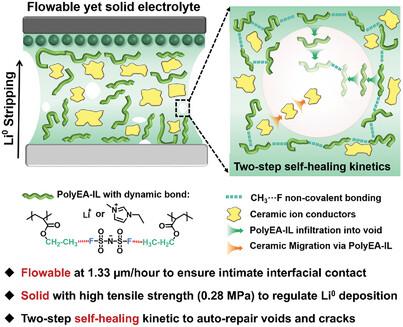
Lithium metal (Li0) solid-state batteries encounter implementation challenges due to dendrite formation, side reactions, and movement of the electrode–electrolyte interface in cycling. Notably, voids and cracks formed during battery fabrication/operation are hot spots for failure. Here, a self-healing, flowable yet solid electrolyte composed of mobile ceramic crystals embedded in a reconfigurable polymer network is reported. This electrolyte can auto-repair voids and cracks through a two-step self-healing process that occurs at a fast rate of 5.6 µm h−1. A dynamical phase diagram is generated, showing the material can switch between liquid and solid forms in response to external strain rates. The flowability of the electrolyte allows it to accommodate the electrode volume change during Li0 stripping. Simultaneously, the electrolyte maintains a solid form with high tensile strength (0.28 MPa), facilitating the regulation of mossy Li0 deposition. The chemistries and kinetics are studied by operando synchrotron X-ray and in situ transmission electron microscopy (TEM). Solid-state NMR reveals a dual-phase ion conduction pathway and rapid Li+ diffusion through the stable polymer-ceramic interphase. This designed electrolyte exhibits extended cycling life in Li0–Li0 cells, reaching 12 000 h at 0.2 mA cm−2 and 5000 h at 0.5 mA cm−2. Furthermore, owing to its high critical current density of 9 mA cm−2, the Li0–LiNi0.8Mn0.1Co0.1O2 (NMC811) full cell demonstrates stable cycling at 5 mA cm−2 for 1100 cycles, retaining 88% of its capacity, even under near-zero stack pressure conditions.
由于枝晶的形成、副反应以及循环过程中电极-电解质界面的移动,锂金属(Li0)固态电池在实施过程中遇到了挑战。值得注意的是,电池制造/运行过程中形成的空隙和裂缝是失效的热点。本文报告了一种自修复、可流动的固体电解质,由嵌入可重构聚合物网络的可移动陶瓷晶体组成。这种电解质可通过两步自修复过程自动修复空隙和裂缝,修复速度高达 5.6 µm h-1。所生成的动态相图显示,这种材料可根据外部应变率在液态和固态之间切换。电解质的流动性使其能够适应锂离子剥离过程中电极体积的变化。同时,电解质还能保持固态,具有很高的拉伸强度(0.28 兆帕),有利于调节苔藓状锂离子沉积。通过操作同步辐射 X 射线和原位透射电子显微镜(TEM)对化学和动力学进行了研究。固态核磁共振显示了双相离子传导途径,以及 Li+ 在稳定的聚合物-陶瓷间相中的快速扩散。这种设计的电解质延长了锂0-锂0电池的循环寿命,在0.2 mA cm-2条件下达到12000小时,在0.5 mA cm-2条件下达到5000小时。此外,由于临界电流密度高达 9 mA cm-2,Li0-LiNi0.8Mn0.1Co0.1O2(NMC811)全电池在 5 mA cm-2 下可稳定循环 1100 次,即使在接近零堆压条件下也能保持 88% 的容量。
期刊介绍:
Advanced Materials, one of the world's most prestigious journals and the foundation of the Advanced portfolio, is the home of choice for best-in-class materials science for more than 30 years. Following this fast-growing and interdisciplinary field, we are considering and publishing the most important discoveries on any and all materials from materials scientists, chemists, physicists, engineers as well as health and life scientists and bringing you the latest results and trends in modern materials-related research every week.





 京公网安备 11010802042870号
京ICP备2023020795号-1
京公网安备 11010802042870号
京ICP备2023020795号-1

 分享
分享
 求助内容:
求助内容: 应助结果提醒方式:
 扫码关注我们
